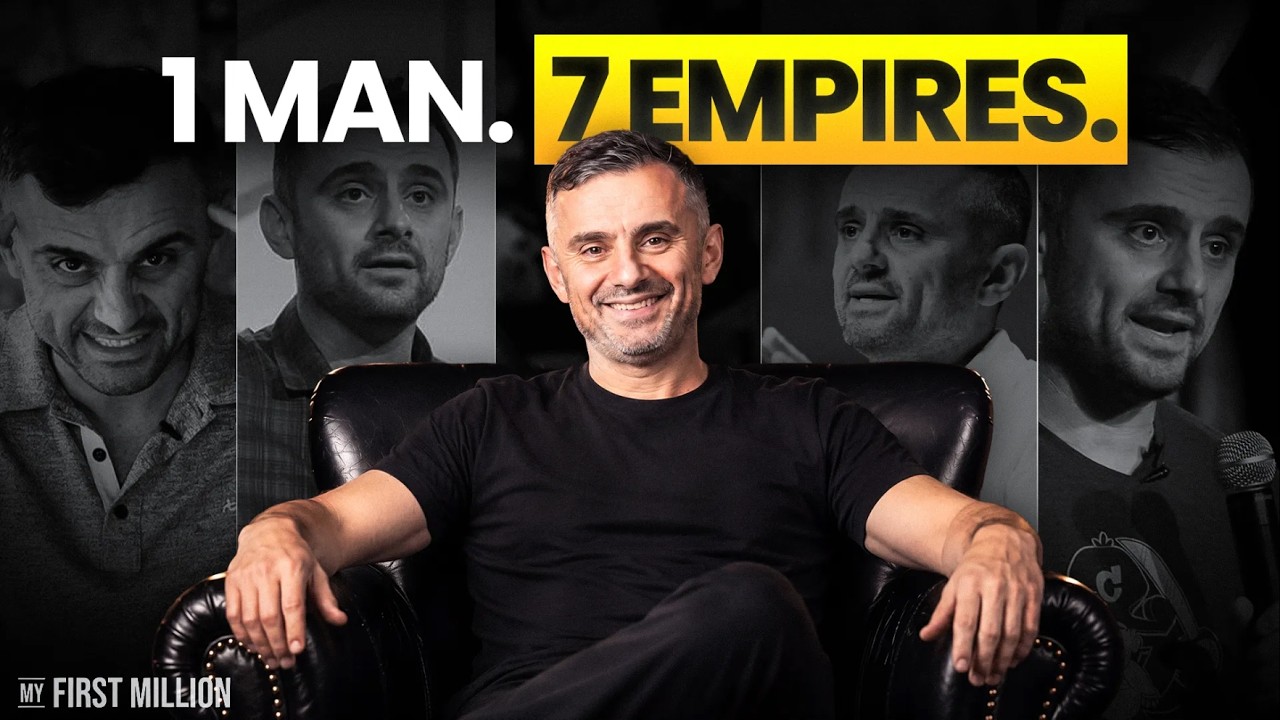
📺 Today’s recommended deep-dive video: https://www.youtube.com/watch?v=byAExsTL4g0
The Invisible Empire: Gary V’s Blueprint for Scaling Karma and IP
Most people recognize Gary Vaynerchuk as a high-energy social media personality, yet few see the ruthless operational machinery driving his multi-hundred-million-dollar portfolio. By shifting focus from short-term transactions to long-term “human equity,” Gary has built a system where relationship building is a scalable corporate function rather than a personal hobby. This discussion reveals how he manages seven eight-figure businesses through 15-minute meetings and a management philosophy rooted in “Kind Candor.”
Core Question: How can an entrepreneur scale their personal influence and diverse business interests without losing the human touch that created their success?
Highlights
- The “VP of Relationships” model for scaling personal karma through proxy dinners and introductions.
- Why Gary spent four years without a laptop and how he now uses AI agents to manage his “relationship graph.”
- The transition from being an “atrocious” manager who avoided conflict to a CEO leading with Kind Candor.
- A breakdown of the Vayner portfolio, from the $400M VaynerX agency to the IP play of VeeFriends.
⏱️ Reading time: approx. 8 minutes · Saves you about 40 minutes vs. watching.
Want to take notes while watching? Click the image below and let AI Notebook capture the key points for you 👇

Scaling the Unscalable: Human Relationships
The VP of Karma
Gary Vaynerchuk operates on a philosophy he calls “long-term greedy,” where the highest ROI comes from doing things that don’t make financial sense on paper.
To execute this at scale, he employs a VP of Relationships, Nick Dio, whose entire mandate is to travel the world, host dinners, and listen for opportunities to help people without any immediate KPI or expected return. By utilizing a trusted proxy who has been with the company for twelve years, Gary can effectively “be in the room” across the globe, facilitating connections between D2C founders and marketing talent or athletes and executives, building a massive reservoir of social capital that pays off years later.
This investment in human connection is the professional equivalent of LeBron James spending a million dollars a year on his physical body; it is the maintenance of his most valuable asset.
While most CEOs focus on quarterly earnings, Gary is focused on the “rainy day human stuff”—the hope that by helping a stranger’s nephew today, he ensures his own family has a supportive network two decades from now.

💡 Digging Deeper
Q: Why would a business fund dinners for people they aren’t even working with?
A: It is a low-risk, high-reward play where the “cost” is a dinner, but the “reward” is a reputation for being the wind in people’s sails, which eventually leads to high-value deal flow.
Q: How does Gary manage the information from all these interactions?
A: He uses what he refers to as “Open Law” or custom AI agents to capture relationship data and context, allowing him to send automated yet personalized congratulatory notes when a contact reaches a major milestone.
Q: Is this model applicable to smaller businesses?
A: Yes, the principle of “connecting two people who can help each other” costs zero dollars and establishes you as a central node in your industry’s network.
The 15-Minute CEO: Operating at Scale
Maximum Efficiency Through Context Switching
Gary’s day is a masterclass in “uncomfortable efficiency,” typically running from 8:00 AM to late evening without breaks for lunch or rest.
The secret weapon of his schedule is the 15-minute meeting, a format he adopted after realizing that most hour-long sessions are filled with unnecessary fluff that dilutes productivity. By compressing his schedule, he claims to get three days of work done in one, relying heavily on a core group of “1A and 1B” partners who have been with him for over a decade. These partners act as the operational brains of his various entities—VaynerMedia, VeeFriends, and VCR Group—allowing Gary to step in only where his specific intuition or “tummy tickles” are needed to solve a problem.
He doesn’t view himself as a motivational speaker, but as a “weirdly good operator” who manages seven distinct businesses by moving his finger to whichever hole in the boat is currently leaking.
This ability to context-switch between a restaurant group, a sports agency, and a TV production company requires a unique emotional framework that can absorb bad news in one minute and project high energy in the next.

The Evolution of Management: From Conflict Avoidance to Kind Candor
Solving the “Superhuman” Firing Problem
For the first 30 years of his career, Gary admits he was an “all-time atrocious” manager when it came to firing and hard conversations.
His “superhero syndrome” led him to believe he could fix anyone through love and elimination of fear, but this actually created a culture of uncertainty where employees didn’t know where they stood until the day they were let go. This lack of candor resulted in “sloppy exits” and resentment from former staff who felt blindsided by his sudden decisions to move on after months of internal dissatisfaction.
It wasn’t until his early 40s that he realized his greatest strength—his kindness—was becoming a liability because it wasn’t paired with honesty.
He eventually rebranded his management style as “Kind Candor,” ensuring that feedback is delivered frequently and gently, rather than being suppressed until it explodes into a termination. By putting the word “Kind” in front of “Candor,” he prevents the feedback from being used as a tool for suppression or being “a dick face,” creating a healthier, more transparent environment.
💡 Digging Deeper
Q: How does Gary handle the urge to “fix” underperforming employees now?
A: He recognizes his “non-profit therapy DNA” but forces himself to use Kind Candor so the employee has the information they need to fix themselves or find a better fit.
Q: What was the “watershed moment” for this change?
A: Seeing a Facebook group of former employees speaking poorly of him made him realize that his lack of candor was the common denominator in their negative experiences.
Q: How does he view the “hire slow, fire fast” mantra?
A: He leans toward it now but balances it with the belief that greatness can be squeezed out of people if they are led with the right mix of pressure and support.
Key Takeaways
Gary Vaynerchuk’s success is built on the paradoxical combination of hyper-efficient time management and incredibly slow, “long-term greedy” relationship building. While his schedule is sliced into 15-minute increments, his vision for businesses like VeeFriends spans decades, aiming to transform a collection of NFT characters into a legacy IP empire on par with Disney or Pokémon.
The shift from being an emotional “fixer” to a practitioner of Kind Candor highlights a crucial lesson for all leaders: kindness without honesty is eventually perceived as manipulation or weakness. By scaling his personality through trusted long-term partners and using “karma agents” to maintain his network, Gary has created a model where the individual entrepreneur can indeed become a Fortune 500 equivalent.
Ultimately, the goal isn’t just to maximize dollars, but to maximize the “process” that feels good to the operator. Whether it’s opening a steakhouse in New Jersey or licensing comic books, Gary’s portfolio reflects a man who chooses his battles based on gut instinct and the joy of the build rather than just the spreadsheet’s bottom line.
Q&A
Q1: How did Gary transition back to using a laptop after years of only using a phone?
A1: He went back to the laptop around 2019 because he started building custom logic and AI agents to manage his “relationship graph,” which required more robust input methods than a mobile device.
Q2: What is VaynerWatt?
A2: It is Gary’s TV production company that has quietly sold shows to major platforms like Hulu, ABC, and Netflix, moving his content strategy into long-form traditional media.
Q3: What is the “mimetic rival” concept mentioned in the talk?
A3: It is the idea that we often want things simply because others want them, leading to intense envy and rivalry between successful people (like Bezos and Musk) who should otherwise feel secure.
Q4: Why does Gary prefer high-net-worth suburban neighborhoods for his restaurant group?
A4: He believes these areas are underserved by high-quality steakhouses with “New York City vibes,” and his model focuses 20% more on food quality than the typical “nightlife” restaurant.
Q5: What does Gary think will happen to “live shopping” in the next decade?
A5: He predicts live shopping will account for 10-15% of all commerce within 6 to 10 years, mirroring the way e-commerce disrupted traditional retail.
Q6: How does Gary avoid being scammed in the content/business world?
A6: He is extremely selective about his associations, avoiding “tier 19” criminals who try to use selfies as endorsements for masterminds, and relies on his reputation as a “nice person” to keep his interactions honorable.
Q7: What is Gary’s view on bankruptcy and payroll?
A7: He was trained by his Soviet immigrant father to never use debt or credit lines; consequently, he has always maintained a “money in the bank” mentality to ensure he never misses payroll.