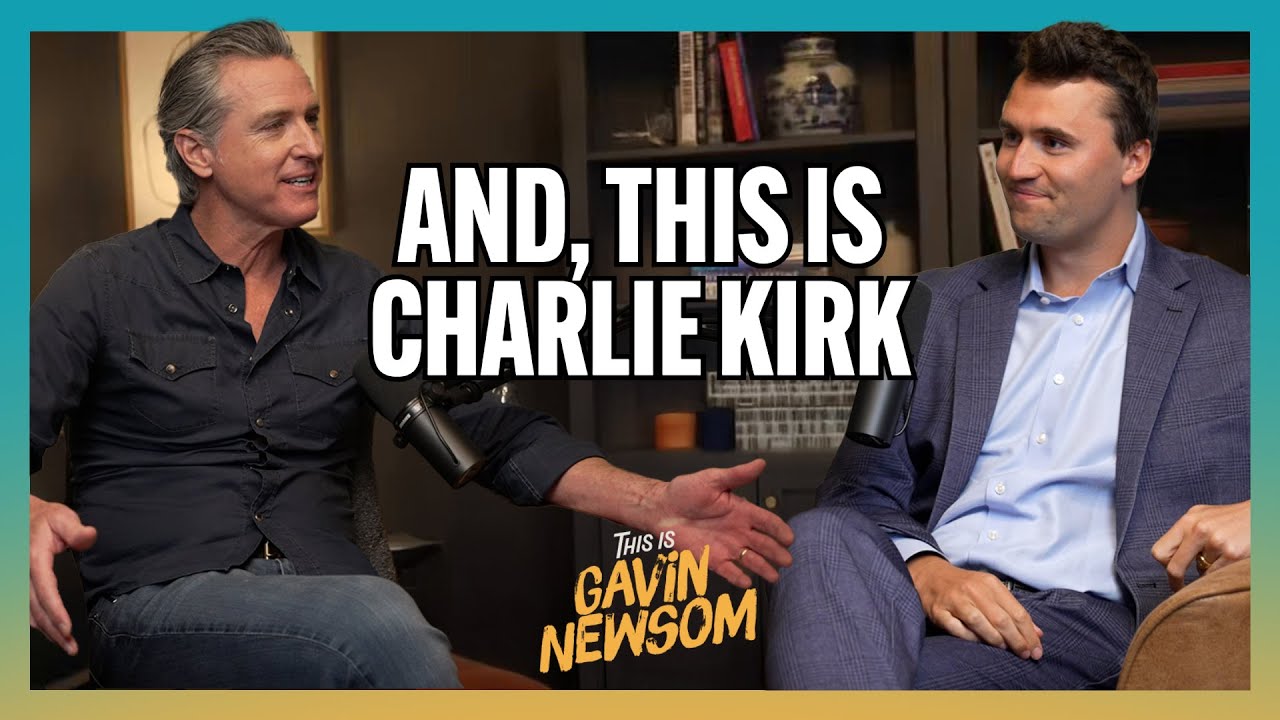
📺 Today’s recommended deep-dive video: https://www.youtube.com/watch?v=9XJ6rQDRKGA
The Red Pill on Campus: Charlie Kirk and Gavin Newsom Clash on the Future of the American Youth
In an unexpected meeting of ideological worlds, California Governor Gavin Newsom sits down with Turning Point USA’s Charlie Kirk to dissect the seismic shift in youth politics. From the “manosphere” to the collapse of institutional trust, they explore why the Democratic brand is struggling to keep pace with a new generation of rebels.
Core Question: Can the Democratic Party survive the rising tide of conservative populism among young voters, or is their “credentialed elite” brand permanently broken?
Highlights
- The 13-point shift in the youth vote toward Republicans achieved in just four years.
- The impact of long-form podcasting versus traditional “sanitized” media hits.
- Kirk’s critique of “Oppressor vs. Oppressed” frameworks in modern policy and education.
- Newsom’s defense of California’s housing reforms and its role as an economic engine.
⏱️ Reading time: approx. 8 minutes · Saves you about 63 minutes vs. watching.
Want to take notes while watching? Click the image below and let AI Notebook capture the key points for you 👇

The New Political Battleground: College Campuses
Capturing the Disenchanted Youth
For decades, American universities were seen as impenetrable fortresses of progressive thought, but Charlie Kirk claims that the ideological monopoly is finally starting to crumble under its own weight.
Kirk attributes this shift to a deliberate strategy by Turning Point USA to engage young voters where they live—on social media and through raw, unscripted campus debates. By moving the youth vote significantly toward Donald Trump, they have challenged the long-held assumption that Democrats own the next generation by default.
The data suggests a deepening crisis among young Americans who feel abandoned by traditional institutions. They are the first generation predicted to be worse off than their parents, struggling with mental health, inflation, and a breakdown of the social compact. Kirk argues that while the Democratic Party offers a “lower your expectations” message, the conservative movement has tapped into a “rebel attitude” that resonates with young men who feel increasingly marginalized by modern cultural norms.

💡 Digging Deeper
Q: Why did Turning Point target campuses?
A: They saw a 20-million-strong population being ideologically monopolized and ignored by the right, creating a vacuum for a counter-perspective.
Q: What was the specific numerical goal?
A: To move the youth vote by 10 points over 10 years; Kirk claims they achieved a 13-point shift in just one election cycle.
Q: How does institutional trust factor in?
A: Kirk argues that Republicans are now the “low trust” party, appealing to those who feel lied to by experts, while Democrats have become the “gatekeepers” of the establishment.
The “Woke” Brand Crisis
Why Democrats are Losing the Narrative
The conversation turned sharply toward the perceived cultural excesses of the Democratic Party, which Kirk describes as an “oppressor-oppressed” lens that has alienated the “muscular class” of American workers. He points to specific policies, like transgender participation in female sports, as “80/20” issues that Democrats are currently on the wrong side of.
Newsom conceded that the issue of fairness in sports is a legitimate concern that Democrats must acknowledge to avoid being labeled as out of touch.
Kirk contends that the “purification process” within the Democratic Party has pushed out heterodox thinkers like Tulsi Gabbard and RFK Jr., leaving behind a sanitized brand that struggles to survive in the “wilderness” of long-form media. He argues that by focusing on DEI and “privilege walks,” schools are failing to prepare students for an AI-driven future, instead fostering a culture of victimhood that lacks the resilience needed for a difficult and unpredictable world.
💡 Digging Deeper
Q: What was the most effective ad of 2024 according to Kirk?
A: The “Trump is for you, she’s for they/them” ad regarding taxpayer-funded gender reassignment surgeries for illegal immigrants and inmates.
Q: How does Newsom view the “woke” critique?
A: He admits the brand has been “crushed” but argues that policy is often more nuanced than the “weaponized” narratives suggest.
Q: What is the “Oppressor-Oppressed” framework?
A: A worldview Kirk claims Democrats use that eventually runs out of real oppressors and starts inventing them among ordinary citizens to justify policy.
Economics, Housing, and the American Dream
The Original Sin of California Affordability
While cultural issues dominate the headlines, the underlying driver of political discontent remains the skyrocketing cost of living, particularly the “original sin” of housing affordability in the state of California.
Newsom defended his record, citing interest rates and local “NIMBYism” as the primary obstacles to progress. He argued that California remains the world’s fifth-largest economy and a hub for AI innovation, suggesting that current struggles are part of a broader national trend in housing supply shortages that his administration is aggressively reforming.
Kirk countered that the Democratic supermajority in California has failed to deliver on promises of massive housing production despite having total control. He emphasized that the average home price of $850,000 creates a generation of “Russian serfs” who can never hope to own property. Both men agreed, however, that the role of private equity and mass asset managers in the housing market is a significant problem that requires urgent legislative attention to allow families to compete.

💡 Digging Deeper
Q: What is “generational theft”?
A: The idea that current economic policies favor older, wealthier homeowners at the expense of young people’s ability to build wealth through property.
Q: Why does Newsom blame “NIMBYs”?
A: Because local planning and zoning boards often block the state-mandated housing developments he is trying to push through via 42 different reform bills.
Q: Does Kirk support the ban on TikTok?
A: He changed his mind after the platform demonstrated a commitment to free speech for conservative creators, allowing him to reach billions of viewers.
Key Takeaways
The Democratic Party faces a critical crossroads: it must decide whether to continue prioritizing the “credentialed elite” or return to a message that resonates with the working class. Charlie Kirk argues that the shift in youth voting patterns is not a fluke but a fundamental realignment against institutional control.
Success in the new media landscape requires a willingness to engage in unscripted, long-form debate—an arena where Democrats have historically struggled to compete effectively. While Newsom is attempting to bridge this gap, Kirk remains convinced that without major policy shifts on immigration and culture, the “ascendant worldview” belongs to the right.
Q&A
Q1: What started Turning Point USA?
A: It began 13 years ago as a “scrappy startup” with card tables on campuses to challenge the liberal ideological monopoly that Kirk saw as harmful to students.
Q2: Why is Trump so popular with young men?
A: He personifies a “rebel attitude” against institutions that many young men feel have failed them personally, economically, and culturally.
Q3: Does Newsom believe Biden was in mental decline?
A: He maintains Biden was sharp in the Oval Office but admits he saw a “different person” during a fundraiser just before the debate.
Q4: What is “ballot chasing”?
A: A strategy of tracking low-propensity voters and ensuring their ballots are cast, which Kirk says Turning Point mastered in swing states like Arizona.
Q5: What is the core disagreement on education?
A: Kirk believes college degrees are becoming obsolete and ideologically toxic; Newsom argues they remain a pathway to higher lifetime earnings despite systemic flaws.
Q6: How often does Kirk talk to Trump?
A: Once or twice a week, discussing everything from campaign strategy to observations on the youth movement’s growth.
Q7: What is Newsom’s “B-level” advice for Democrats?
A: Kirk suggests they must stop the “illegal immigration thing,” address the trans issue in sports, and focus on visible quality-of-life improvements in cities.