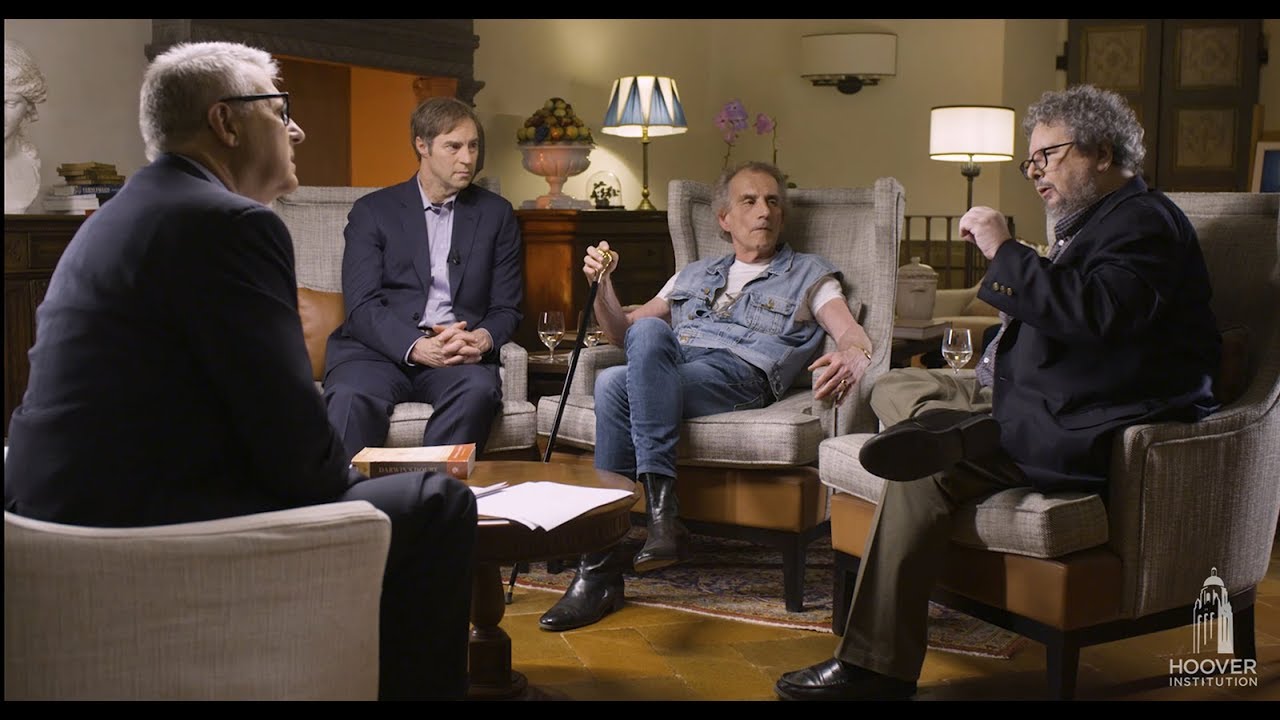
📺 Today’s recommended deep-dive video: https://www.youtube.com/watch?v=noj4phMT9OE
The Darwinian Deficit: Why Leading Minds are Abandoning Neo-Darwinism
The long-standing consensus on evolutionary biology is facing a mathematical and molecular reckoning. Distinguished scholars David Berlinski, David Gelernter, and Stephen Meyer discuss why the “beautiful” theory of Darwin fails to account for the sudden appearance of species and the digital complexity of the cell.
Core Question: Is neo-Darwinian evolution a scientifically sufficient explanation for the origin of biological information, or has it become a protected secular religion?
Highlights
- The Cambrian Explosion presents a “fossil gap” that Darwinian gradualism cannot bridge within the known timeframe of Earth’s history.
- Mathematical analysis of protein folding reveals that functional sequences are so rare that random mutation is statistically incapable of finding them.
- Developmental biology shows that mutations affecting early “body plan” development are almost universally fatal, preventing the emergence of new forms.
- Intelligent Design is presented not as a theological deduction, but as a scientific inference from the discovery of digital code within DNA.
⏱️ Reading time: approx. 8 minutes · Saves you about 49 minutes vs. watching.
Want to take notes while watching? Click the image below and let AI Notebook capture the key points for you 👇

The Fossil Gap and the Cambrian Wall
The Problem of Sudden Appearance
David Gelernter notes that while Darwin successfully explained small adjustments—like the density of a sheep’s fur or the shape of a bird’s beak—the theory founders when trying to explain the “big picture” of how entirely new species emerge from the void of pre-history.
The Cambrian Explosion represents a biological event where a striking variety of new organisms, featuring unique body plans, appeared suddenly in the fossil record without discernible ancestors.
Stephen Meyer points out that the time window for this explosion has narrowed from 70 million years to potentially as little as 10 million years, which is a geological blink of an eye. When we apply population genetics to this timeframe, the math simply does not work; the expected waiting times for these massive biological changes to occur via random mutation far exceed the age of the Earth itself.

💡 Digging Deeper
Q: Is the definition of “species” just being used to rig the argument against Darwin?
A: No. Berlinski argues that even a child can distinguish between major groups like cats, cows, and sheep; these represent distinct biological realities, not just semantic categories.
Q: Why did Gelernter call Darwin’s theory “beautiful”?
A: Its aesthetic appeal lies in its simplicity—the idea that the same mechanism explaining tiny variations in a beak could explain the entire history of life on Earth.
Q: What is a “body plan”?
A: It is a unique configuration of body parts and tissues; the Cambrian era saw these plans arrive abruptly without intermediate forms in the layers below.
The Code Problem: Mathematics vs. Mutation
Combinatorial Inflation in the Cell
Modern biology has moved beyond viewing the cell as a simple “brick of jello,” revealing instead an unfathomably complex factory driven by digital information stored in DNA. Stephen Meyer argues that building a new form of life requires new code, just as a computer requires new software to perform a new function. This realization shifts the debate from physical traits to the origin of the information necessary to construct functional protein molecules.
David Berlinski describes this as a problem of “combinatorial inflation,” where the number of ways to arrange amino acids in a protein necklace grows exponentially with length. The odds of a random search hitting a functional sequence are roughly one in ten to the 77th power.
Even if every organism that ever lived on Earth participated in this search, they would only cover a microscopic fraction of the possibilities, making a successful random mutation statistically impossible.

💡 Digging Deeper
Q: Can’t time solve the problem of low probability?
A: Not in this case. The number of trials allowed by the history of life is “puny” compared to the vastness of the search space for functional proteins.
Q: What happens if a mutation occurs early in an embryo’s development?
A: It is almost always fatal. To change a body plan, you must change the early stages of development, but those stages are the most sensitive to disruption.
Q: Is DNA actually digital code?
A: Yes. Since 1957, biologists have recognized that nucleotide bases function like alphabetic characters or binary code, where meaning is derived from specific arrangement rather than chemical properties.
The Intellectual Stranglehold of Neo-Darwinism
Science as Secular Religion
Intelligent Design is often dismissed as a religious “put-up job,” yet Gelernter and Meyer insist it is a valid scientific inference based on our experience with information systems.
Meyer argues that whenever we find information—whether in a radio signal, a computer program, or a hieroglyphic inscription—and trace it back to its source, we always find a mind at work. By recognizing DNA as a high-tech information storage system, the inference to an intelligent designer becomes a matter of logic rather than theology, even if the “messy” state of the world suggests a subsequent process of decay or entropy.
The academic resistance to these ideas is fierce, with Gelernter describing a culture of “anti-religious bigotry” where challenging Darwin is seen as heresy. This suggests that for many, Darwinism has transitioned from a scientific theory into a secular religion that provides a materialistic account of origins, purpose, and morality.

💡 Digging Deeper
Q: Why does Gelernter reject Intelligent Design even though he rejects Darwin?
A: He struggles with the “strategy” of a designer who allows for so much decay, heartbreak, and biological waste, viewing the world as a “mess” rather than a perfect creation.
Q: How does Meyer answer the problem of “bad design” like viruses?
A: He suggests that virulent bacteria often result from a loss of information or decay (entropy) of an originally functional system, which aligns with the concept of design followed by degradation.
Q: Is the shift away from Darwin generational?
A: Gelernter is skeptical, noting that universities often treat Darwinism as an indoctrination process rather than an open intellectual inquiry.
Key Takeaways
The debate over Darwinism is no longer just about fossils; it is a battle over the nature of information. As we discover that life is built upon a foundation of digital code, the 19th-century reliance on “bottom-up” material processes looks increasingly inadequate. The mathematical rarity of functional proteins and the fatal nature of developmental mutations create a “double bind” that neo-Darwinian theory cannot easily escape.
Furthermore, the conversation highlights a growing rift in academia. While the scientific evidence against gradualism mounts, the institutional commitment to Darwinism remains rigid. This suggests that the theory functions as a necessary pillar for a broader materialistic worldview—one that, alongside Marx and Freud, sought to explain the human condition without recourse to the transcendent.
Ultimately, the contributors suggest that biology is entering a “new day.” By moving away from undirected processes and toward an information-based model of life, science may yield fresh insights into the functional regions of the genome and the complex machinery of the cell. Whether the field will be allowed to move on from Darwinian orthodoxy remains the defining question for 21st-century science.
Q&A
Q1: Why is the Cambrian Explosion so significant to this debate?
A1: It shows that major animal groups appeared suddenly in the fossil record without the long, gradual chains of ancestors that Darwin’s theory requires.
Q2: What is “combinatorial inflation”?
A2: It is the mathematical reality that as a sequence (like a protein or code) gets longer, the number of possible arrangements grows so large that finding a functional one by chance becomes impossible.
Q3: Is Intelligent Design just “stealth theology”?
A3: Stephen Meyer argues it is a scientific inference based on the fact that complex, functional information always originates from an intelligent mind in our experience.
Q4: Why are early-stage mutations a problem for evolution?
A4: To change a species’ body plan, you must mutate the embryo early, but these mutations are universally fatal because they disrupt the entire developmental sequence.
Q5: Does the existence of “junk DNA” support Darwinism?
A5: No; recent findings show that much of the so-called “junk” is actually functional, a discovery that was predicted by proponents of Intelligent Design rather than neo-Darwinists.
Q6: How did David Gelernter’s colleagues react to his skepticism?
A6: While personally courteous, he notes they exhibit “intellectual bigotry,” effectively forbidding students from questioning Darwinian orthodoxy in a serious way.
Q7: Will Darwin’s name eventually disappear from science?
A7: David Berlinski believes that while the specific theory will fail, the name “Darwinian” will likely persist as a commemorative label for any future theories of biological change.