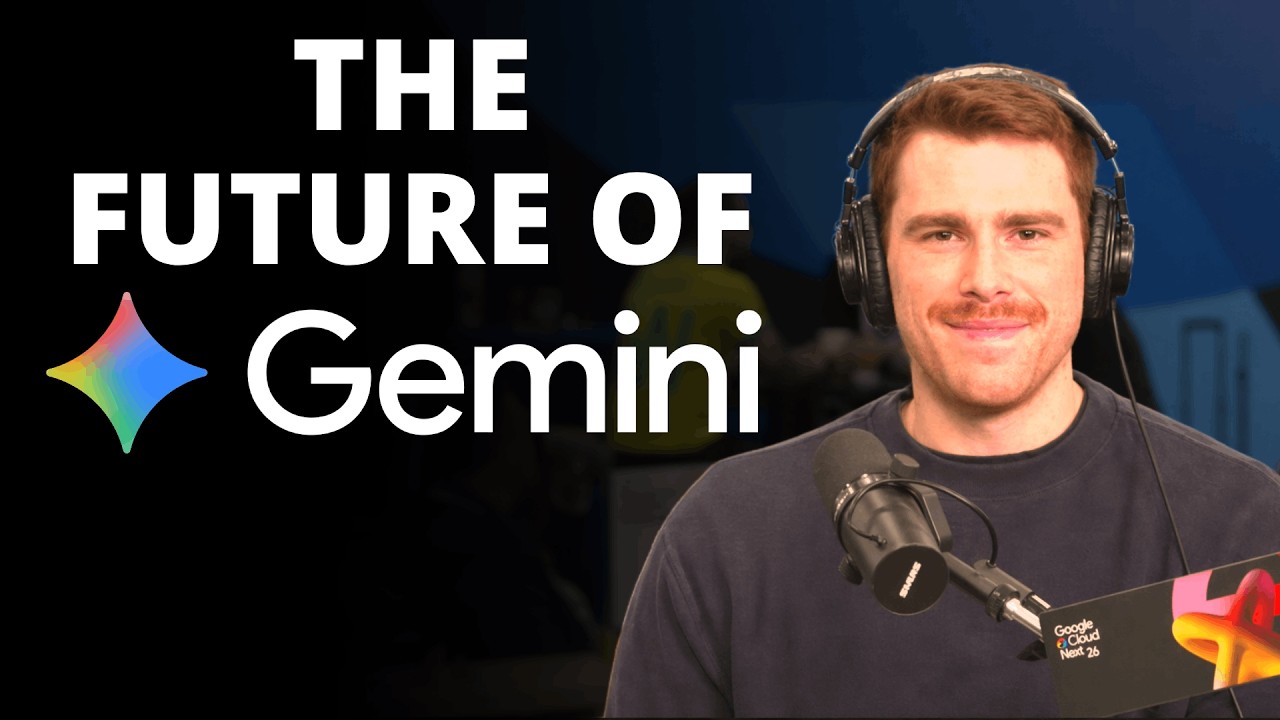
📺 Today’s recommended deep-dive video: https://www.youtube.com/watch?v=voWCwpibLZM
From Vibe Coding to Production: The New Era of Agentic Engineering
Artificial intelligence is rapidly shifting from simple chat interfaces to sophisticated agents capable of building entire applications from a single voice command. At Google Cloud Next, Logan Kilpatrick reveals how Google AI Studio is turning “vibe coding” into a serious production-grade discipline, bridging the gap between a vague idea and a deployed product.
Core Question: How is Google democratizing software creation through multimodal agents and high-ambition development tools that empower both non-coders and professional engineers?
Highlights
- The transition from “prompt-to-prototype” to “prompt-to-production” using the AI Studio Build tab.
- Why “Agentic Engineering” is replacing traditional coding for high-ambition side projects.
- The rise of long-running agents that can operate independently for days rather than hours.
- How new TPU architectures are struggling to keep up with the “death by success” demand for tokens.
⏱️ Reading time: approx. 6 minutes · Saves you about 38 minutes vs. watching.
Want to take notes while watching? Click the image below and let AI Notebook capture the key points for you 👇

The Evolution of Google AI Studio
From API Keys to Full-Stack Deployment
Google AI Studio has undergone a fundamental transformation, moving away from being a mere playground for testing prompts to becoming a robust development environment. The introduction of the “Build” tab allows users to go from a text prompt to a working application, complete with a database and authentication, in a matter of minutes. By integrating directly with Cloud Run and Firebase, the platform removes the traditional friction of infrastructure setup.
This shift enables a “vibe coding” experience where the barrier to entry is effectively zero for the next generation of builders.
The platform now features tools like “Tap-Tap-Tab” and “Yap to App,” which leverage Gemini Flash to predict user intent and fill in technical gaps that non-coders might overlook. These features don’t just generate text; they formulate coherent architectural ideas and suggest design iterations in real-time. It is an opinionated take on low-code development that prioritizes getting a functional product into the hands of users over manual configuration.

💡 Digging Deeper
Q: What is “Yap to App” exactly?
A: It is a feature where users provide a “garble of words” via voice, and Gemini interprets the mess into a coherent app structure, filling in missing technical requirements automatically.
Q: Is this only for web dev?
A: Currently focused on web stacks like Next.js, but Google is pushing hard to bring AI Studio to mobile platforms and enable on-device model execution via Gemma.
Agentic Engineering and the Ambition Gap
Professional Stewardship in the AI Era
As “vibe coding” matures into what Kilpatrick calls “Agentic Engineering,” the relationship between AI and human developers is changing. Within Google, the team uses a partnership model where agents generate the initial codebases, but senior engineers act as stewards, ensuring the output meets high bars for reliability and scalability. This hybrid approach allows for faster contribution cycles without sacrificing the quality expected of a platform used by millions.
The real bottleneck in software today is no longer technical syntax, but the level of ambition a builder brings to the table.
Kilpatrick notes that because modern models are so capable, the “weight of responsibility” has shifted to the human to dream bigger. Previously, developers would abandon ideas because they feared hitting a technical wall; now, the assumption is that the model can handle the complexity. This change means side projects that once took months can now be attempted in a weekend, provided the builder has the vision to guide the agent.

💡 Digging Deeper
Q: Does this replace professional developers?
A: No; it increases the total addressable market for software. As more non-coders build, the demand for “traditional” developers to solve deep architectural problems and partner on complex projects actually grows.
Q: How does Google maintain code quality?
A: They use a “Technical Staff” model where humans monitor agentic changes, ensuring CI/CD tests pass before code hits production, treating the AI as a high-velocity contributor.
Multimodality and Long-Running Agents
The Future of “Omnipresent” Assistants
The next phase of Gemini involves moving beyond static text to “live” multimodal interactions where the model can see and hear in real-time. This enables use cases like screen-sharing with an agent that acts as a tutor, navigating complex e-commerce UIs or debugging local code environments by “looking” over the user’s shoulder. This isn’t just a chatbot; it’s a digital pair-programmer with vision.
We are transitioning from agents that run for a few hours to autonomous systems that can operate for days or weeks.
The release of “Deep Research” agents signifies a shift toward high-autonomy tasks that require rigorous, multi-step reasoning. By treating agents as first-class citizens in the Gemini API—side-by-side with raw models—Google is creating a seamless transition for developers. This evolution suggests a future where every consumer product, from Gmail to Search, becomes natively agentic, moving from a tool you use to a partner you delegate to.

Key Takeaways
The democratisation of software is no longer a futuristic concept but a present reality. By providing “opinionated” tools in AI Studio, Google is allowing people who have never written a line of code to become creators in the software economy. This “phase change” is similar to the impact YouTube had on video content, where the means of production are finally distributed as widely as human intelligence itself.
However, this success brings its own set of challenges, specifically regarding compute supply. The “death by success” story means that even with massive investments in TPU infrastructure, the demand for tokens remains insatiable. Developers must move from “throwing AI at everything” to being more intentional, focusing on high-value use cases where agentic engineering provides the most leverage.
Finally, the field of robotics is poised for a breakthrough similar to what we saw in LLMs eighteen months ago. As multimodal understanding improves, the ability to pack intelligence into physical systems will solve the “edge case” problems that have historically plagued automation. Whether in the digital or physical realm, the next year will be defined by agents that can work longer and more independently than ever before.
Q&A
Q1: What is the biggest hurdle for new developers using AI Studio?
A: It is often an “inspiration problem.” Many people are excited by the tech but don’t know where to start. Features like the “I’m Feeling Lucky” button help by generating the first app idea for the user.
Q2: How does the “Tap-Tap-Tab” feature work?
A: It uses a Gemini Flash model in the background to act as a sophisticated autocomplete for your ideas. As you type a prompt, it suggests the next logical steps for your app’s features and architecture.
Q3: Is “vibe coding” just for prototypes?
A: No. While it started as a prototyping phase, the new internal workflows at Google prove that with proper human stewardship and CI/CD integration, agent-generated code can be successfully moved into production.
Q4: What is the difference between Gemini Live and standard voice mode?
A: Gemini Live is a real-time, multimodal stream of audio and video. It allows the model to “see” what you see, such as a broken appliance or a complex piece of software, and guide you through a fix zero-shot.
Q5: Why is there still a quota/limit on models if Google has so many TPUs?
A: Logan describes this as “death by success.” The pent-up demand for high-quality tokens across all Google products (Search, Workspace, Cloud) currently exceeds even the massive supply generated by their latest TPU hardware.
Q6: What is the timeline for robotics breakthroughs?
A: Logan estimates we are about 12 to 18 months away from significant breakthroughs in robotics, driven by the high level of “packed intelligence” now available in multimodal models like Gemini.
Q7: How should developers deal with “AI Doomers”?
A: The best approach is “deployment first.” Instead of debating theory, the goal is to build technology, deploy it, and let people use it so they can see the tangible benefits to humanity firsthand.