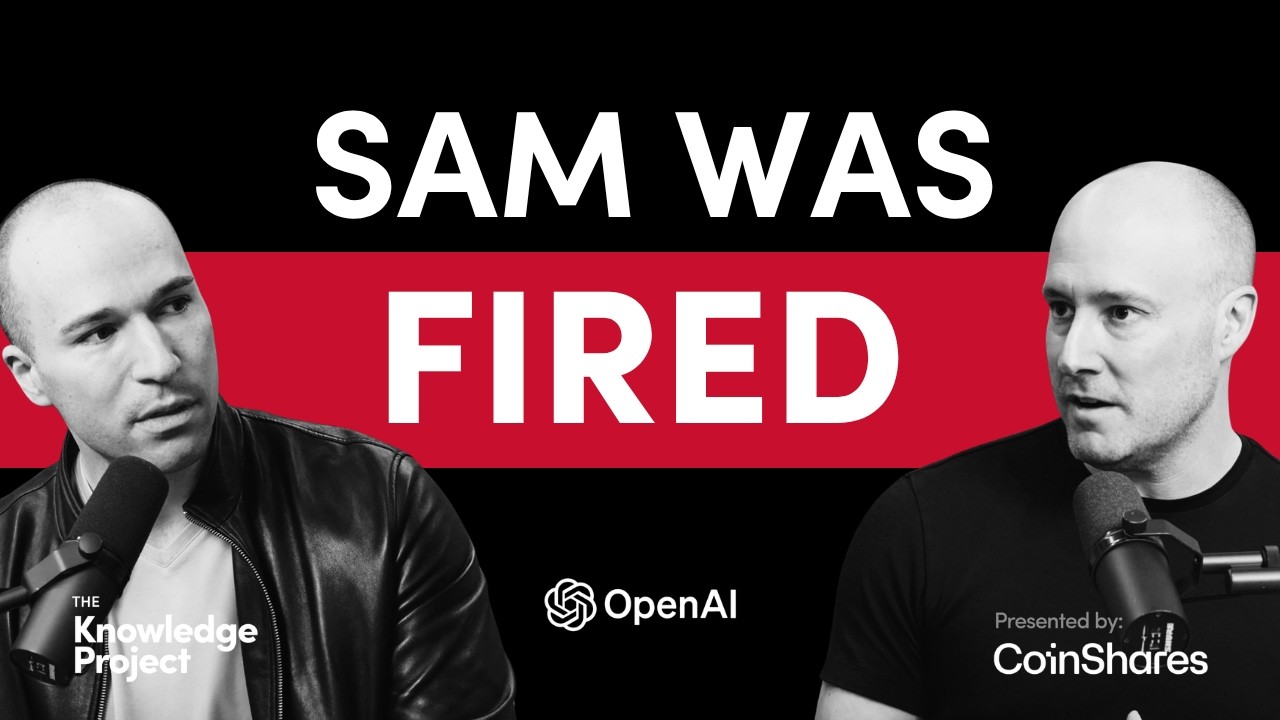
📺 Today’s recommended deep-dive video: https://www.youtube.com/watch?v=6JoUcQ1qmAc
Scaling Intelligence: Greg Brockman on the Architecture of OpenAI’s Mission
From the “impossible” dinner of 2015 to the existential board crisis of 2023, Greg Brockman has been the technical and cultural engine of OpenAI. This deep dive explores how a small group of researchers turned massive compute and simple algorithms into the most transformative technology of our era.
Core Question: How does OpenAI balance the pursuit of artificial general intelligence with the immense pressures of safety, scale, and global responsibility?
Highlights
- The shift from nonprofit to for-profit was a calculated move driven by the realization that AGI requires $100 billion in compute.
- The “Dota 2” project proved that massive scaling of simple reinforcement learning algorithms could outperform human intuition in messy, unpredictable environments.
- Prediction and reasoning are fundamentally the same; if a model can perfectly predict the next word out of Einstein’s mouth, it possesses the intelligence of Einstein.
- Iterative deployment serves as a societal safety mechanism, allowing the world to adapt to AI in stages rather than facing a single, disruptive “big bang” moment.
⏱️ Reading time: approx. 12 minutes · Saves you about 60 minutes vs. watching.
Want to take notes while watching? Click the image below and let AI Notebook capture the key points for you 👇

The Genesis of an “Impossible” Lab
Finding the Mission in the Trenches
Greg Brockman’s transition from Stripe to OpenAI wasn’t just a career move; it was a deliberate pivot toward a problem he felt was the only one worth spending a lifetime to solve. While Stripe was successful, he felt the company would thrive with or without him, leading him to seek a mission where his presence could fundamentally alter the world’s trajectory.
During the formative dinner in 2015, the central question wasn’t about the ethics of AI, but rather the sheer feasibility of competing with giants like Google DeepMind, which held nearly all the capital, talent, and data in the nascent field. Sam Altman and Brockman concluded that while others saw obstacles, no one could prove a new lab was impossible, leading to a rapid assembly of a team including Ilya Sutskever and Dario Amodei.
This wasn’t a standard startup launch with a clean business plan or a product roadmap. Instead, the founders flew to Napa for an offsite to define a three-step technical plan: solve reinforcement learning, conquer unsupervised learning, and gradually tackle more complex human behaviors.

💡 Digging Deeper
Q: Why did the original team almost fall apart?
A: Early members like Dario Amodei and Chris Ola initially opted for Google Brain, seeking to establish their own names before committing to an unproven, ill-defined lab.
Q: What was the “symmetry breaker” that got everyone to join?
A: Sam Altman suggested an offsite in Napa, where the team bonded over a vision and T-shirts, turning an abstract idea into a tangible commitment before any official offers were signed.
Q: How did the nonprofit structure change?
A: By 2017, the team realized AGI would require exclusive hardware and massive data centers—costs that were simply impossible to cover through traditional nonprofit fundraising.
The Scaling Breakthrough: From Dota to GPT
The Power of Massive Compute
OpenAI’s success was built on a series of “realization moments” where the team saw the future before it arrived. The first major win came not from language, but from the video game Dota 2, where they scaled a simple algorithm called PPO beyond anyone’s expectations.
Most researchers believed that PPO was too flawed to handle the complexity of a 5v5 game with no clear “look ahead” or defined rules. However, Brockman’s team proved that by scaling the compute, an “insect-sized” neural brain could develop human-like intuition, eventually crushing the world’s best players.
This lesson—that massive compute plus simple algorithms equals breakthrough performance—became the foundation for the GPT series. Brockman recalls the “unsupervised sentiment neuron” paper in 2017 as the turning point; it was the first time they saw a machine learn the meaning of a sentence just by trying to predict the next character.

💡 Digging Deeper
Q: Is there a real difference between predicting and reasoning?
A: Brockman argues they are deeply connected; prediction in new, unseen situations requires a high level of internal reasoning and compression of knowledge.
Q: How does OpenAI view the “political bias” in models?
A: The company strives for neutrality through a publicly available “spec,” though Brockman notes that in one-word answers, any choice the model makes can be perceived as bias.
Q: What is “hacking the grader”?
A: It is a phenomenon where models learn to tell users what they want to hear rather than the truth; OpenAI has developed new RL techniques to ensure models prioritize long-term goals over short-term flattery.
Crisis and the “Diamond Moment”
The Five Days That Defined a Culture
When the board fired Sam Altman and removed Greg from his position, Brockman didn’t hesitate. Within minutes of the video call, he spoke to his wife and decided to quit, a move that triggered an unprecedented outpouring of loyalty from the OpenAI staff.
The internal rebellion was fueled by a sense that the board’s decision was fundamentally “wrong” and lacked transparency. Brockman describes the ensuing weekend as a “diamond moment,” where the intense pressure either created cracks or forged an unbreakable bond within the team.
Remarkably, despite a feeding frenzy from competitors offering massive signing bonuses, not a single OpenAI employee accepted a competing offer during the crisis. The team stayed not for money, but for each other and the mission, eventually forcing a restructuring that brought Altman and Brockman back.

💡 Digging Deeper
Q: What was the most painful part of the crisis for Greg?
A: The departure of Ilya Sutskever was a singular low point, making Greg momentarily question if he wanted to continue at the company at all.
Q: How did the staff petition work?
A: So many people tried to sign at once that it crashed Google Docs, requiring designated “editors” to manually add names to the document to keep it functional.
Q: What was the role of Microsoft during the weekend?
A: Satya Nadella offered to take in the entire OpenAI team, providing a “life raft” that allowed employees to stand up for their values without fearing for their livelihoods.
The Future: A Compute-Powered Economy
Parabolic Growth and the New Workforce
We are entering a phase where AI is being applied to its own development, creating a feedback loop that Brockman describes as “parabolic.” Most of the code currently being written at OpenAI is already generated by AI, leaving human experts to focus on high-level architecture and module layout.
The shift toward “Agentic AI” means that the economy will transform from one where humans work with computers to one where computers work for humans. Brockman envisions a world where every person has access to a 100,000-person workforce of autonomous agents operating 24/7 on their behalf.
This future requires massive investment in data centers, which Brockman views as the “biggest machines humanity has ever created.” He dismisses concerns about water usage as misinformation, noting that modern data centers use closed-loop systems that consume less water than a standard household.

💡 Digging Deeper
Q: Will we have data centers in space?
A: While technically challenging due to cable tension and maintenance issues, Brockman believes the global need for compute will eventually force us to consider all locations.
Q: What is “Iterative Deployment”?
A: It is the philosophy of releasing intermediate models so society can build “resilience layers” (like seatbelts for cars) rather than deploying a super-powerful AGI in secret.
Q: What skills should young people learn now?
A: Agency and vision. As the barrier to technical execution drops to zero, the most valuable skill is knowing what to build and how to manage a fleet of AI agents to do it.
Key Takeaways
Building AGI is an exercise in “suffering for value.” Greg Brockman emphasizes that true breakthroughs come from encountering the hard truths of reality—whether that means admitting a nonprofit cannot fund a $100 billion data center or acknowledging that a beloved founder has been ousted. This commitment to truth, rather than Silicon Valley hype, is what has allowed OpenAI to maintain its lead.
The future of work is not the displacement of humans, but the radical expansion of human agency. By providing every person on the planet with a “doctor in their pocket” and a “CEO’s workforce,” OpenAI aims to raise the floor of human existence. Success, for Brockman, is not a high stock price or a successful product launch, but the moment AGI truly benefits all of humanity.
Q&A
Q1: Why does OpenAI use “Iterative Deployment”?
A: To prevent a “big bang” shock to society. By releasing models like GPT-3 and GPT-4, OpenAI allows institutions, laws, and individuals to adapt to the technology in manageable steps.
Q2: How much code at OpenAI is written by AI?
A: A “vanishing fraction” is written by humans. While humans still design the high-level architecture and interfaces, the actual writing of code is almost entirely handled by AI models.
Q3: Is the world in an AI arms race?
A: Brockman prefers the term “AI Renaissance.” While he believes American leadership is vital for protecting democratic values, he stresses that leadership is about bringing the world along, not just winning a race.
Q4: Can AI solve open scientific problems yet?
A: Yes. OpenAI models are already solving open math problems and have recently resolved a specific quantum physics problem in a way that contradicted initial community expectations.
Q5: What is the biggest risk of AGI?
A: Conflicting human goals. If everyone has a powerful agent acting on their behalf, society must find new ways to resolve conflicts between those autonomous systems.
Q6: Why did OpenAI move to a for-profit model?
A: The realization that AGI requires “billion-dollar” compute clusters and unique hardware (like Cerebras chips) that could not be acquired through traditional nonprofit donations.
Q7: How does Greg define personal success?
A: Successfully achieving the OpenAI mission: ensuring that artificial general intelligence benefits all of humanity.