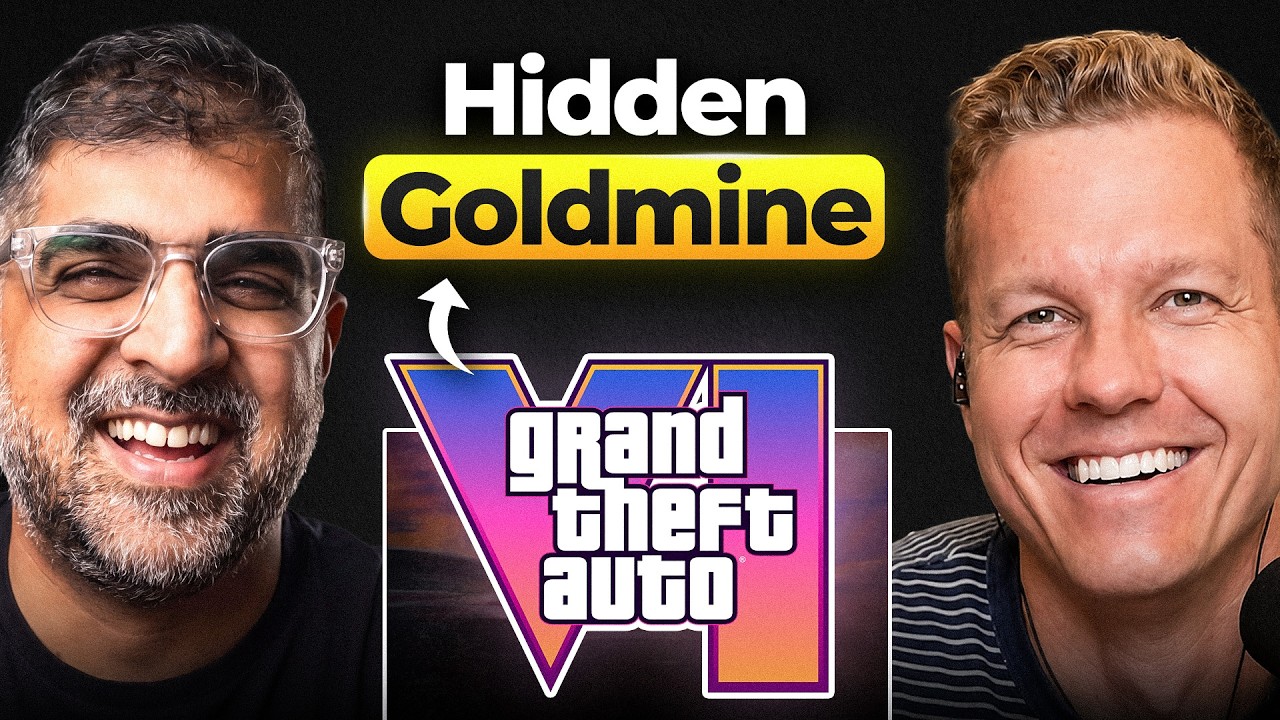
📺 Today’s recommended deep-dive video: https://www.youtube.com/watch?v=wwy0hXK8hQI
The GTA 6 Economy and the Art of the 200-Year Legacy
Most entrepreneurs miss the obvious because they are busy chasing the ghost of the last wave’s opportunity. Whether it is the multi-billion dollar economy emerging around Grand Theft Auto 6 or the century-old secrets of a media tycoon, the real wealth is found where high-conviction “lock-in” meets world-class talent recruitment.
Core Question: How can modern founders identify the next massive wave of opportunity and build a defensible, multi-generational empire?
Highlights
- Grand Theft Auto 6 is projected to generate $3 billion in its first year, spawning a massive secondary economy of creators, modders, and digital asset traders.
- The OpenAI acquisition of TBPN signals a shift in the media playbook where the “clip” becomes the primary product rather than a promotional tool for long-form content.
- William Randolph Hearst’s legacy illustrates how aggressive talent recruitment and “Yellow Journalism” can build a family trust that thrives for over a century.
- Success hinges on either being the world-class “figure-outer” of your core business variable or being an elite recruiter of the talent that can.
⏱️ Reading time: approx. 7 minutes · Saves you about 64 minutes vs. watching.
Want to take notes while watching? Click the image below and let AI Notebook capture the key points for you 👇

The Multi-Billion Dollar Shadow Economy of GTA 6
The Most Defensible Asset in Entertainment
Grand Theft Auto isn’t just a video game; it is a cultural phenomenon that generates $500 million annually a decade after its release, boasting margins that would make a software founder weep. When the next installment finally drops, it is projected to hit $1 billion in pre-orders alone, dwarfing the biggest Hollywood blockbusters by a factor of three while establishing a permanent, recurring revenue stream through its online ecosystem.
You aren’t just buying a game; you are entering a sovereign digital economy where virtual skins, custom tools, and data scrapers represent hundreds of millions in secondary market value.
A close associate of the show even contemplated a hostile takeover of Take-Two Interactive, the parent company, viewing it as a Warren Buffett-style “moat” business. While the stock price eventually surged too high for the bid to make sense, the underlying logic remains: GTA is the “Coke” of gaming with no “Pepsi” in sight.

💡 Digging Deeper
Q: Why is GTA considered a “winner-take-all” business?
A: It relies on massive network effects; players go where the economy and the community are already established, making it nearly impossible for a competitor to start from scratch.
Q: What is the “secondary economy” mentioned?
A: It includes everything from “NoPixel” modders who sell custom servers back to the parent company to influencers who earn millions via Twitch streaming and in-game item trading.
The OpenAI-TBP Deal and the Content Inversion
Why the Clip is the New Flagship
The acquisition of TBPN by OpenAI for a rumored nine-figure sum baffled the industry, but it underscores a massive shift in media consumption habits where the distributed clip is the product. Instead of using social media to drive traffic to a long-form show, TBP used long-form streams as a “farming exercise” to harvest viral moments.
In this new playbook, the four-hour live stream exists solely to manufacture twenty perfect thirty-second insights that populate every user’s feed.
This strategy requires what the hosts call “The Great Lock-in”—a period of relentless, daily output where momentum is prioritized over vanity metrics. By the time the acquisition happened, TBP hadn’t just built a show; they had created a high-frequency communications engine that OpenAI desperately needs to fix its polarizing public image and counter the perceived inauthenticity of its leadership.

💡 Digging Deeper
Q: Why would OpenAI buy a media company?
A: Beyond the talent, it gives them a direct line to tech-savvy executives and helps reshape the public narrative around Sam Altman, which has become increasingly polarizing.
Q: What is “The Great Lock-in”?
A: It is the period where a founder ignores all distractions—including high-level networking events—to focus 100% of their energy on building momentum for a new project.
The Hearst Playbook for a 200-Year Empire
Collecting Talent Like Fine Art
William Randolph Hearst was a larger-than-life character who transformed the boring, factual sheets of early 20th-century news into the emotional, high-stakes narrative style known as Yellow Journalism. His father hit gold in the mines, but Hearst found his gold in the hearts of the American public, eventually controlling the news consumption of 20% of the entire country while spending billions on exotic zoos and water-front mansions.
He didn’t just manage his employees; he “collected” people, providing them with absolute editorial cover to attack the status quo as long as they produced beautiful, compelling prose.
Hearst’s real genius, however, wasn’t just his spending; it was his obsession with recruiting A+ talent, personally knocking on the doors of unknown journalists to offer them massive raises. He understood that a single great writer like Mark Twain or Jack London was worth a hundred average hacks, and he was willing to pay a premium to own that leverage.

💡 Digging Deeper
Q: How does the Hearst company still exist today?
A: Hearst set up a unique trust run by six family members and six non-family members, ensuring the business remains professionalized while keeping the family involved in its $15 billion annual revenue stream.
Q: What is “Yellow Journalism”?
A: It is a style of reporting that prioritizes eye-catching headlines and emotional scandals over dry facts, a precursor to the modern “clickbait” and viral content era.
The Two Paths to Victory: Figure-Outer vs. Recruiter
Maximizing the 100x Talent Arbitrage
Success in business eventually boils down to a simple choice: you either have to be the genius who figures out the core variable, or you have to be the recruiter who finds them.
In a supplement business, the variable might be world-class marketing funnels; in a tech startup, it might be the AI research breakthroughs. The arbitrage lies in the fact that while an A+ player is 100 times more effective than a B player, they usually only command 1.5 times the salary. The founder who closes that gap and aggregates the best “figure-outers” under one roof is the one who builds the multi-billion dollar exit.
This requires a detachment from the outcome while maintaining a deep desire for it—the ability to start over at the bottom of the mountain if the first path fails. Whether you are building a gaming mod or a media conglomerate, the “lock-in” phase is what separates the dreamers from the owners of the next great legacy.

Key Takeaways
The landscape of opportunity is shifting away from traditional venture-backed clones and toward hyper-specialized economies and high-frequency media. To win today, you must identify a “moat” asset—like a dominant gaming franchise or a viral content machine—and commit to a period of total focus. The lesson from both modern gaming and historical media titans is clear: momentum is a founder’s most valuable currency.
Furthermore, the most successful leaders are those who treat talent as a collectible asset. By paying a slight premium for A+ talent that delivers exponential returns, you create an unfair advantage that competitors cannot replicate by simply throwing more capital at a problem. Building for the next 200 years requires a blend of Hearst’s recruitment obsession and the modern agility to leverage new platforms like Twitch and AI.
Q&A
Q1: Is it too late to get into the GTA 6 economy?
A1: No, the game hasn’t even launched. The biggest opportunities will be in content creation, modding tools, and digital communities that haven’t been built yet.
Q2: Why did Hearst spend so much money on art and homes?
A2: He viewed collecting as a form of legacy building, though he often spent so recklessly that the government had to place his companies under receivership to pay off his debts.
Q3: How do you identify the “core variable” of a business?
A3: Look at what makes the most successful player in that field win—if it’s supplements, it’s usually the marketing funnel; if it’s software, it’s usually the engineering breakthrough.
Q4: What is the benefit of a “live show” if no one watches the full stream?
A4: The live show is a “farming exercise” that produces the raw material for viral clips, which actually reach the millions of users who will never sit through a four-hour video.
Q5: Why is recruiting A+ talent considered an “arbitrage”?
A5: Because the market does not yet price the 100x productivity difference into the salary, allowing smart founders to get massive returns by paying only a 50% premium over average talent.
Q6: Should I encourage my kids to take over my business?
A6: The podcast suggests an alternative: offer to be their “intern” when they start their own projects, rather than forcing them to manage an empire they didn’t build.