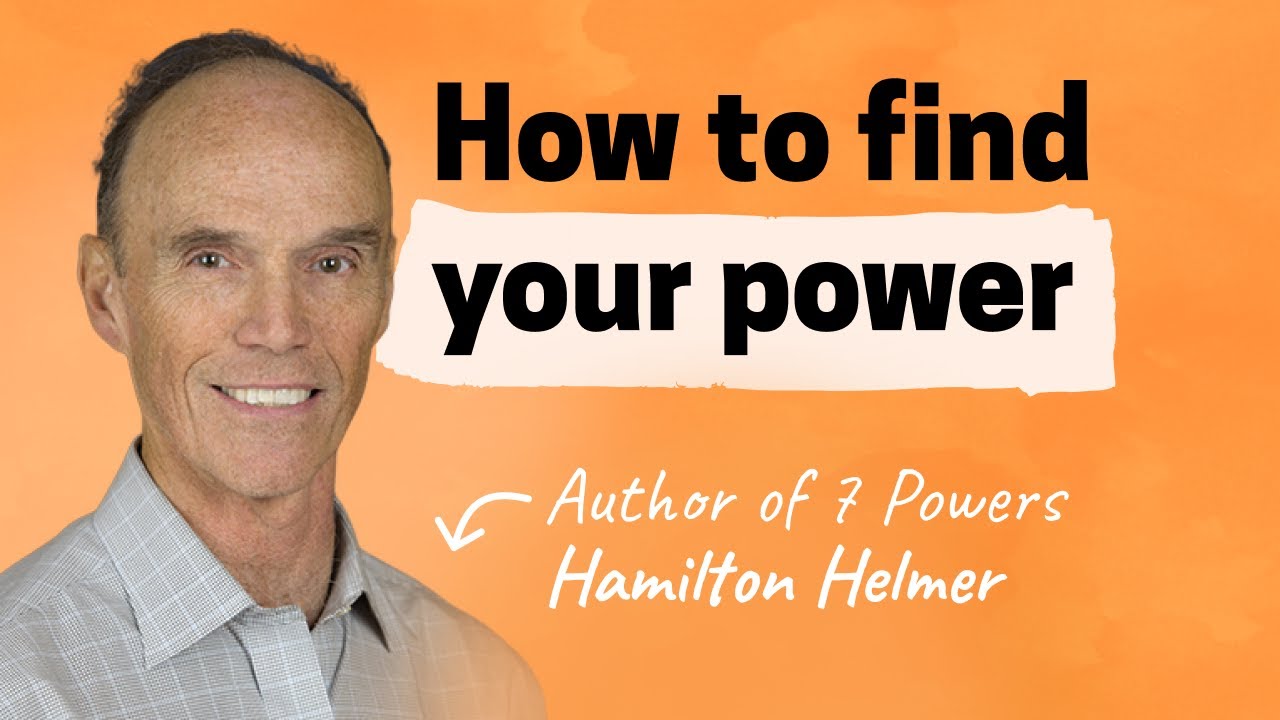
📺 Today’s recommended deep-dive video: https://www.youtube.com/watch?v=hKq1_KPSqy0
Beyond the Shack: Building Economic Castles with Hamilton Helmer
Many founders mistake a fast-moving team for a sustainable moat, but if you are just running faster on a treadmill, you will eventually get overtaken. True strategy isn’t about the next year’s plan; it’s the long-term determination of value through structural advantages that Hamilton Helmer calls the “7 Powers.”
Core Question: How can startups transition from a “shack” of operational efficiency to an “economic castle” of durable power?
Highlights
- Power requires two distinct components: a benefit for the customer and a barrier against competitors.
- Startups should focus early on Counter-positioning rather than Branding or Process Power.
- “Network Economies” are only strategic if they are material enough to fundamentally tilt profit margins.
- Operational excellence is necessary to stay in the race, but it is rarely a source of sustainable power.
⏱️ Reading time: approx. 8 minutes · Saves you about 60 minutes vs. watching.
Want to take notes while watching? Click the image below and let AI Notebook capture the key points for you 👇

The Foundation of Strategic Power
Benefit, Barrier, and the Castle Metaphor
Real power requires two components: a benefit that increases value and a barrier that stops competitors from mimicking your success, creating an unbreachable economic castle for growth.
Founders often mistake a fast-moving team for a sustainable moat, but if you are just running faster on a treadmill, you will eventually get tired and overtaken. Operational excellence is essential for surviving the takeoff phase of a business, yet it rarely constitutes a durable strategic refuge in the long run. The things that drive efficiency, like a great UI or a clever recommendation engine, can almost always be mimicked by a determined incumbent.
Strategy is essentially a long-term concept focused on the net present value of future cash flows, requiring leaders to look far beyond next year’s tactical goals. Hamilton Helmer illustrates this with the distinction between Pearl Harbor—a tactical success for Japan—and the strategic disaster it represented by awakening America’s industrial might. To build value, you must understand the underlying economic structures that protect your margins from withering over time.

💡 Digging Deeper
Q: When should a founder start thinking about strategy?
A: Always. Even before product-market fit, you should consider which business propositions tilt the probabilities toward future power.
Q: Is data scale a reliable moat?
A: Rarely. The curve of data advantage usually flattens quickly, meaning competitors with “enough” data can often compete effectively with those who have “the most” data.
Q: What makes a barrier “unbreachable”?
A: It must be inimitable. If you can hire a consultant to replicate a competitor’s process, that process is not a power.
The Startup’s Path to Power
Sequencing the Seven Powers
Startups must sequence their power development, beginning almost exclusively with counter-positioning—adopting a novel business model that incumbents cannot copy without damaging their existing business. This provides the initial refuge needed to survive while the company begins to build more traditional barriers like scale or network economies.
Brand and process power should be ignored in the early stages because they are typically rewards of stability rather than tools for origination. You cannot buy a “power” brand with a Super Bowl ad; true branding power is an organic, long-term accumulation of trust that lowers customer acquisition costs or allows for premium pricing.
While “Network Effects” are a popular pitch in Silicon Valley, they only become “Network Economies” when the impact is material enough to significantly tilt margins in your favor for the long haul. Uber and Lyft have network effects, but they lack network economies because the competitive pressure remains so high that neither company can easily extract outsized profits.

💡 Digging Deeper
Q: Why is counter-positioning so effective for startups?
A: It exploits the incumbent’s “rational” desire to protect their current cash cow, making them slow to react to a new, disruptive model.
Q: What is the “To Be or Not to Be” test?
A: It is the simple check of whether your business has both a benefit (lower cost/higher price) and a barrier (inimitability).
AI and the Future of Competitive Advantage
The Electricity Analogy for Generative AI
AI is likely a general-purpose technology similar to electricity; it will allow every factory floor to be reconfigured, but it won’t necessarily grant a new “8th Power” to the average business. Most companies will use AI to improve accounting, HR, and R&D, but because everyone has access to the same models, these improvements will eventually become the new baseline of operational excellence rather than a unique source of power.
There are three ways to play a technology wave: the technology providers (like Intel/Nvidia), the companies that couldn’t exist without it (like Microsoft/Google), and the companies that existed before and after but use the tech to get better (like Ford). Most businesses will fall into the third category, where AI becomes a standard tool rather than a structural moat.
Action remains the first principle of business. While theorizing about AI is popular, the winners will be those who redesign their internal processes to capture the 50% efficiency gains in programming or operations before their competitors do.

💡 Digging Deeper
Q: Could AI create new switching costs?
A: Yes, if an AI psychiatrist or assistant learns so much about a specific user that the “cost” of moving to a new provider becomes emotionally or practically prohibitive.
Q: Is there an eighth power?
A: Not yet. The current seven seem to be an empirical exhaustive set, but the search for a new one continues.
Key Takeaways
There are only three fundamental pillars that create value in a company: Market Size, Power, and Operational Excellence. While most of a leader’s day is spent on operational excellence—running the treadmill—the ultimate value of the company is determined by whether they have built a structural power that protects their margins.
Action is the ultimate requirement. Strategy should serve as a set of guideposts during the journey, not a substitute for doing the work. Founders must be optimistic enough to take risks, but rigorous enough to identify when their “moat” is actually just a shack that any competitor could build.
Q&A
Q1: How does strategy relate to Net Present Value (NPV)?
A: Strategy is the study of the long-term drivers of NPV. It focuses on the durability of cash flows far into the future.
Q2: Why is “moving fast” not a power?
A: Because speed is an operational trait. If you stop moving fast, you lose your lead. A power is a structural advantage that persists even if you aren’t sprinting.
Q3: What is the difference between Network Effects and Network Economies?
A: Materiality. A network effect exists if a product gets better with more users, but it only becomes an “economy” if it results in a significant, defensible profit margin.
Q4: Can a company have more than one power?
A: Yes. Iconic businesses like Apple or Amazon often have a “second act” where they establish new sources of power in different market segments.
Q5: Why is process power so rare?
A: Because most processes are documented or can be learned by hiring a competitor’s employees. It only becomes power when the process is so complex and opaque that it cannot be easily copied.
Q6: How did Netflix beat Blockbuster using these concepts?
A: Netflix used scale economies (spreading content costs over more subs) and counter-positioning (Blockbuster couldn’t move to mail-order without killing their profitable retail stores).
Q7: What is the “dry powder” concern regarding the U.S. economy?
A: It is the fear that high national debt will prevent the government from deficit spending during the next major crisis, potentially leading to a lock-up in capital markets.