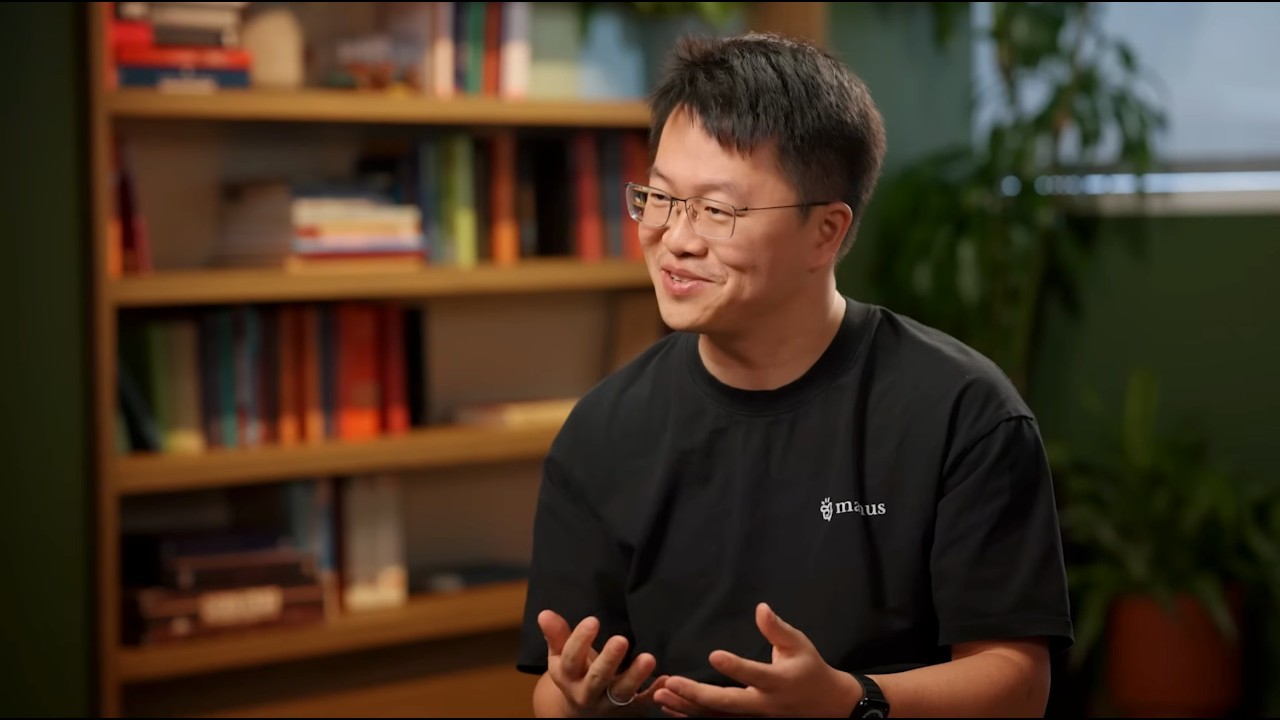
📺 Today’s recommended deep-dive video: https://www.youtube.com/watch?v=dTyL3T3_G-o
Beyond the Chatbot: How Manus AI Scaled to $100M ARR in Eight Months
In the current AI gold rush, speed is the only currency that matters. Tao, the founder of Manus AI, shares how a small team bypassed the traditional “answer machine” model to build a fully autonomous agent that thinks, executes, and scales without human intervention.
Core Question: How can startups transition from text-generating chatbots to autonomous agents that handle end-to-end execution while maintaining explosive revenue growth?
Highlights
- Manus AI reached $100M ARR in eight months with zero initial marketing budget.
- The “Mind and Hand” philosophy: Pairing LLMs with virtual sandboxes for real-world task execution.
- A reversed development cycle where prompts serve as the primary product requirements document.
- Why transparency and asynchronous workflows are the keys to building user trust in agentic AI.
⏱️ Reading time: approx. 6 minutes · Saves you about 32 minutes vs. watching.
Want to take notes while watching? Click the image below and let AI Notebook capture the key points for you 👇

The Anatomy of an Autonomous Agent
Bridging the Gap Between Mind and Hand
Most AI tools act like smart advisors that leave the hard work to you, but Manus was built on the Latin principle of Mens et Manus—combining the brain with the physical capability of hands.
By providing the Large Language Model with its own virtual machine, the AI gains the ability to interact with the digital world exactly like a human would, whether that involves running complex Python scripts or navigating a browser to research resumes. This shift from “thinking” to “doing” is the fundamental differentiator; the virtual sandbox isn’t just a feature, it is the bedrock that allows an agent to move beyond mere conversation and into the realm of true productivity.
This infrastructure allows users to step away from the screen entirely. Because the compute happens in a secure cloud environment rather than a local laptop, the agent operates asynchronously, notifying the user only once the final deliverables are ready for review.

💡 Digging Deeper
Q: Why is the virtual machine considered “the hand” of the AI?
A: Without it, an LLM is trapped in its own head. The virtual machine gives the AI a computer to browse, code, and store files, turning thoughts into actual digital actions.
Q: How does the “Async” feature change user behavior?
A: It removes the “babysitting” requirement of AI. Users can assign a task, close their laptop, and go for a coffee, trusting the agent to notify them when the job is done.
Q: Why show the AI’s internal “thinking” and browser steps?
A: Transparency builds trust. Since agents are new and unpredictable, showing the work step-by-step helps users understand how the AI arrived at a specific result.
The Viral Growth and the $100M Strategy
Turning Product Utility into a Marketing Engine
While many founders obsess over marketing agencies, Tao’s team went viral with a raw, one-minute screen recording that simply showed the product working without any flashy stage productions or scripted keynotes.
The product’s inherent “shareability” was bolstered by a session replay feature, allowing new users to witness the step-by-step logic of the AI’s execution rather than just seeing a finished result.
Reaching $100M ARR in eight months required a strict focus on “Realized Value” and PMF signals; for example, observing users who were willing to pay $5,000 a month revealed a massive underserved market for small businesses needing virtual engineers. By monitoring user ratings on a granular level—from one to five stars—the team can iterate on technical bottlenecks in real-time based on actual utility rather than just engagement metrics.

💡 Digging Deeper
Q: How did Manus AI reach $100M ARR with zero marketing spend?
A: It relied on word-of-mouth viral loops, specifically influencers in Egypt and Brazil who discovered the tool organically and shared screen recordings of its capabilities.
Q: What is the benefit of “usage-based billing” for high-end users?
A: It serves as a price discovery mechanism. Finding users willing to pay $5,000/month signals that the AI is providing high-value business outcomes, not just casual entertainment.
Q: Why focus on user ratings (1-5 stars) over simple retention?
A: Ratings provide a qualitative signal of where the AI is failing to execute. It allows the team to segment data by feature or country to find specific bugs.
Reimagining Software Development in the AI Era
The Prompt as the New Interface
The traditional sequence of product development—moving from Figma designs to PRDs and then to engineering—has been completely inverted at Manus AI to prioritize functional prototypes over aesthetic interfaces. In this new paradigm, the prompt itself is the interface; Tao argues that product managers should write the core prompts themselves because these instructions now dictate the entire user experience more than a button color ever could.
This lean approach extends to their engineering culture, where a general pool of fifty developers is assigned to projects dynamically rather than being siloed into permanent feature teams.
To maintain this velocity, the team relies on AI to bridge context gaps. A new engineer can join a complex project and use AI to parse the codebase in ten minutes, a process that previously would have required days of manual onboarding.

💡 Digging Deeper
Q: How does the “engineering pool” model work?
A: Instead of fixed teams, the CTO assigns available engineers to high-priority projects. Once finished, they return to a general pool to be deployed elsewhere.
Q: Why is the designer the last step in the process?
A: In AI, the logic and the conversation flow (the prompt) matter more than the visual wrapper. The design is simply the final polish on a working prototype.
Q: Does AI change how engineers read code?
A: Yes. AI tools allow developers to digest entire codebases in minutes, making it possible for engineers to switch between vastly different projects without a productivity drop.
Key Takeaways
The success of Manus AI highlights a fundamental shift in the startup playbook: the era of the “chat interface” is giving way to the era of “agentic execution.” By focusing on the outcome—delivering a finished website, a screened list of candidates, or a functional piece of software—rather than just an answer, AI companies can unlock massive revenue from non-technical users who were previously underserved.
Internally, this requires a total overhaul of the development lifecycle. Startups must move toward prompt-driven prototyping and flexible engineering structures that leverage AI to maintain high velocity. As the bottleneck shifts from “how to code” to “how to define a problem,” the most successful leaders will be those who can manage an army of digital agents with the same precision they manage human teams.
Q&A
Q1: What was the main reason the Manus launch video went viral?
A: It focused entirely on “showing the work.” Instead of flashy graphics, it used a raw screen recording to show the AI actually performing tasks, which was a “magical” moment for users tired of chatbots.
Q2: How does the Stripe Sandbox integration help Manus users?
A: It allows non-technical users to build functional e-commerce websites. They can set up payments in a safe environment and then transition to a live business without needing to understand API tokens or backend code.
Q3: Why does Tao believe everyone will become a manager in the future?
A: As AI takes over tedious execution, the human’s role becomes defining the problem and managing 10 to 100 agents to solve it. Management skills will be the primary lever for productivity.
Q4: How does Manus handle global offices without losing culture?
A: By keeping product, engineering, and research integrated and ensuring that leadership decisions are transparent. Tao aligns the team on the “message level” so every office represents the brand consistently.
Q5: What is the “Session Replay” feature?
A: It is a growth feature that allows users to share the entire process of how the AI solved a task. Seeing the AI “think” and “act” in replay mode is much more impressive to potential users than just seeing a final result.
Q6: Why is AI software development inherently different from traditional software?
A: Because the “conversation” is the interface. There are fewer buttons and more logic-driven prompts, meaning the product manager’s job is now to design the AI’s behavior through prompts rather than UI wireframes.
Q7: Is Tao worried about AI taking human jobs?
A: He views it through the lens of history, comparing AI to the invention of cars or heavy machinery. While it eliminates tedious labor, it frees humans to focus on higher-level pursuits like art and new business models.