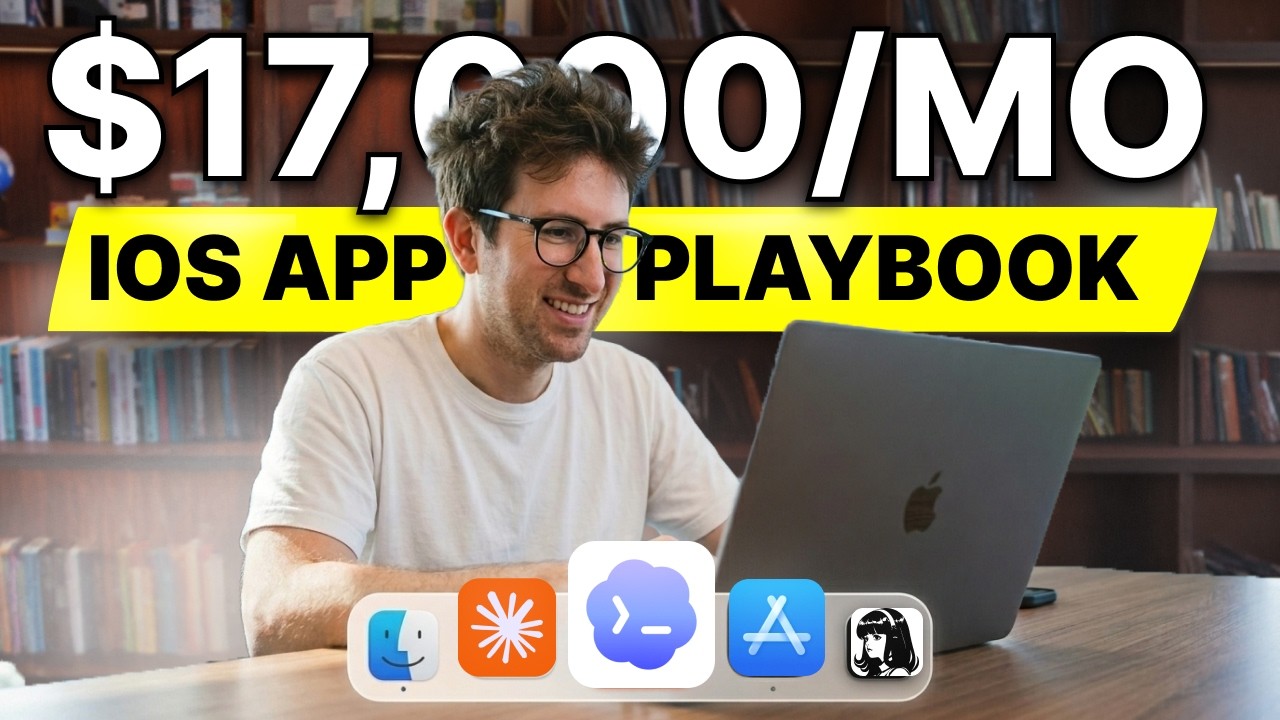
📺 Today’s recommended deep-dive video: https://www.youtube.com/watch?v=LYomocq6Dpo
From TJ Maxx to $200K Revenue: The AI App Playbook for Non-Technical Founders
19-year-old George quit his retail job to build a portfolio of mobile apps using “Vibe Coding” and generative AI. By leveraging niche influencer marketing and AI-integrated features, he’s generating hundreds of thousands in revenue without writing a single line of code.
Core Question: How can non-technical creators use AI tools and strategic distribution to build, scale, and monetize niche mobile apps?
Highlights
- The “Vibe Coding” revolution: Building full-featured Swift apps in 14 days using AI models like Claude and dedicated tools like Roark.
- The “Gotcha” Feature: Why every viral app needs a 3-second hook that explains its entire utility instantly to a scrolling user.
- Influencer Arbitrage: Using social skills and professional social proof to secure 50/50 equity partnerships or low-cost CPM deals.
- The “Mom Test”: A simple UX litmus test to ensure your app is accessible to non-technical users without a manual.
⏱️ Reading time: approx. 8 minutes · Saves you about 40 minutes vs. watching.
Want to take notes while watching? Click the image below and let AI Notebook capture the key points for you 👇

The Foundation of a Viral App Idea
Solving Your Own Problems
The transition from retail employee to successful app founder began with a simple realization: the most successful products solve problems the creator understands intimately. George, a lifelong wrestler, built “WrestlAI” because he knew exactly what high school wrestlers needed but didn’t have access to—affordable, instant video analysis of their matches. When you build for yourself, your passion becomes a recruitment tool, allowing you to convince influencers and partners of your mission because you genuinely resonate with the audience you are targeting.
Ideas should be simple, specific, and sellable today.
AI has democratized this process by lowering the capital requirements to zero, meaning you no longer need a venture-backed budget or a team of developers to enter a niche market. In the past, a “wrestling-specific” app might have been laughed at by investors for being too small, but in the era of AI, a niche audience is an advantage. It allows you to reverse-engineer social media algorithms—like tailoring your TikTok “For You Page” (FYP) to only show wrestlers—so you know exactly who to contact for distribution.

💡 Digging Deeper
Q: Why is passion more important than just “market size”?
A: Passion acts as social proof; if you don’t believe in the mission, you won’t be able to convince influencers to join you for lower rates or equity.
Q: What is the “Gotcha” feature?
A: It is a core functionality that is so simple it can be understood in three seconds, like taking a photo of food to get calories instantly.
Q: How do you validate if an idea is sellable?
A: You ask if people are willing to pay for the solution today, not after six months of development.
The “Vibe Coding” Workflow & UX
Building Without a Developer
“Vibe Coding” is the process of using high-level AI models to write and debug code through natural language prompts. George advocates for a strict 14-day build cycle for the core functionality and branding, followed by several days focused exclusively on perfecting the onboarding experience. While skeptics call this “AI slop,” the reality is that with enough iterative prompting and manual tweaking, AI can produce professional-grade Swift code that is both functional and scalable for consumer use.
Code is code; with enough prompts, you can build software that rivals traditionally developed apps.
Design is equally critical. The “Mom Test” serves as the ultimate UX barometer: if you can hand the app to your non-technical mother and she can use it without instruction, the UI is ready. A cluttered interface kills conversion rates, especially when users are coming from fast-paced social media platforms. The onboarding must perform three tasks: educate the user, personalize their experience to increase “sunk cost” commitment, and create FOMO (Fear Of Missing Out) right before the paywall appears.

💡 Digging Deeper
Q: Do AI-built apps have scalability issues?
A: For consumer apps not collecting massive amounts of sensitive personal data, scalability issues are largely theoretical and haven’t hindered growth to 100k+ users.
Q: What is the most important part of onboarding?
A: Creating FOMO by showing the user the result they want (e.g., a match analysis) behind a paywall after they’ve already invested time.
Q: How does personalization help monetization?
A: By asking the user 20 questions, you trigger the sunken cost fallacy; they’ve spent so much time setting it up that they are more likely to start a free trial.
Distribution: Influencers and Paid Ads
The DM Wizardry Strategy
Distribution is a numbers game that requires you to be a “DM wizard.” To get your first win, George suggests partnering with creators on a 50/50 revenue split, which eliminates the need for upfront marketing capital. To close these deals, your own brand’s Instagram page must look professional—this means having clean product demos, a verified badge, and even purchased followers for social proof to ensure influencers take your DM seriously.
Influencer marketing is 90% sales and 10% product.
Once the initial traction is built, you can transition into paid ads by using the Meta Ads Library to spy on competitors. By identifying winning ad formats in adjacent niches, you can have your high-performing influencers recreate those videos one-to-one for your app. The goal is to move from manual outreach to a systematic approach, eventually hiring a Virtual Assistant (VA) to handle the lead generation and initial outreach while you focus on closing deals and high-level strategy.

Key Takeaways
The barrier to entry for building a software business has never been lower. We are currently in an “app boom” similar to the early days of drop-shipping, where niche markets are underserved and AI allows for rapid prototyping and deployment. However, the window for this easy-mode entry is likely limited to the next three years as more people realize that coding skills are no longer the gatekeeper to the App Store.
Success in this space requires a shift in mindset from “technical founder” to “product-led salesperson.” You must be willing to iterate on your product’s utility—like adding a calorie tracker to a wrestling app to fix retention—while maintaining high-volume outreach to influencers. The combination of a “gotcha” feature and a high-authority social presence creates a fly-wheel that can take a simple idea to $10k per month with minimal weekly maintenance.
Q&A
Q1: How do you find influencers if you don’t know where to start?
A: Tailor your own social media “For You Page” to act as your ideal customer. Scroll, like, and comment on niche content until the algorithm feeds you every relevant creator in that space automatically.
Q2: What should you do if your app has high downloads but low revenue?
A: Check your “Gotcha” feature. If the core value proposition isn’t immediately obvious within the first three seconds of a marketing video, users will download but won’t convert on the paywall.
Q3: Is it worth botting or buying followers for a brand account?
A: While controversial, George argues it provides necessary social proof so influencers don’t ignore your DMs. A page with zero followers looks like a scam; a page with motion looks like a partnership opportunity.
Q4: How much should you pay a Virtual Assistant?
A: If a VA asks for $800 a month to handle all your outreach and lead generation, pay it. The mental clarity you gain is worth far more than the cash outlay.
Q5: Why did the “Green” rizz app fail despite having millions of views?
A: The idea was generic and lacked passion. Viewers recognized it as a low-value product they had seen before, leading to 1.8 million views but only $35 in revenue.
Q6: What is a healthy ARPU (Average Revenue Per User) for a mobile app?
A: Aim for at least a $2 ARPU in the first month. If it’s lower, your content might be too broad or your paywall isn’t enticing enough.
Q7: How do you handle creators who ask for outrageous rates?
A: Get them on a call. It’s much harder for them to demand $10,000 for a video when you’re face-to-face, showing them the conversion data and offering a long-term partnership “homie discount.”