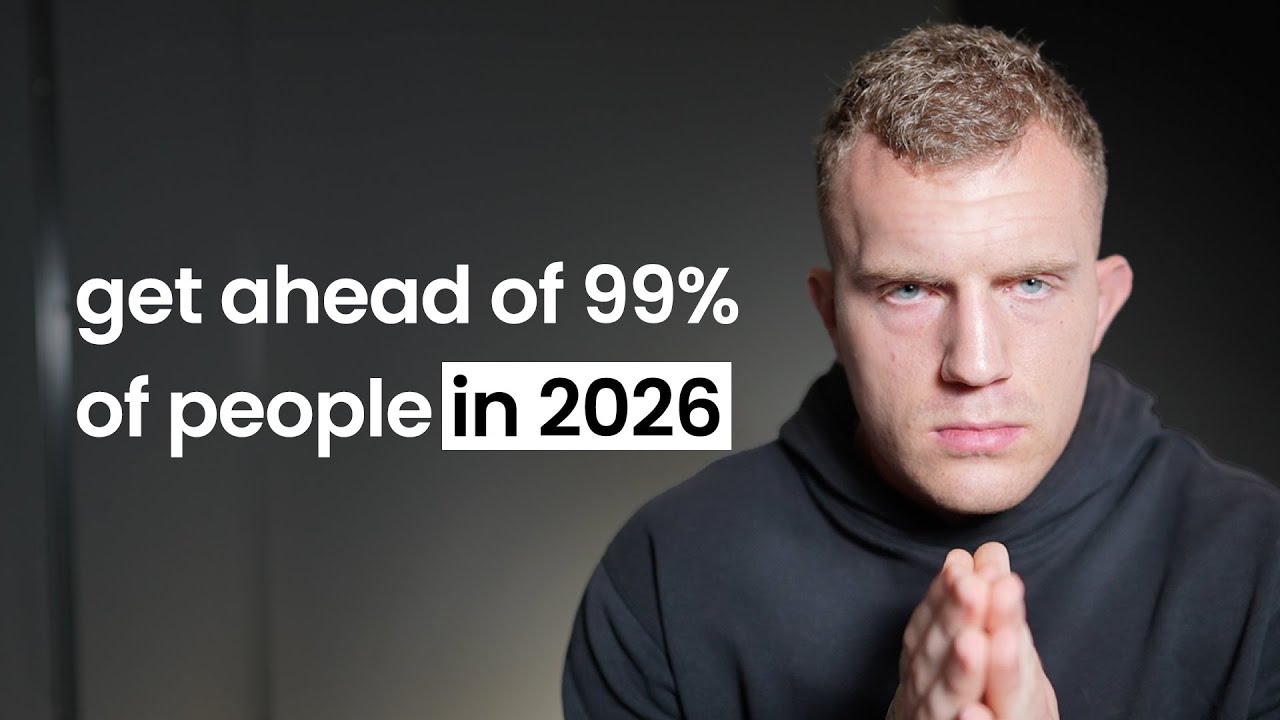
📺 Today’s recommended deep-dive video: https://www.youtube.com/watch?v=K8K09g9XR4s
The Identity Reset: How to Reprogram Your Mind for 2026
Most people fail their New Year’s goals because they try to change their habits without changing who they actually are. True transformation isn’t about willpower; it’s about a deep psychological excavation that aligns your internal identity with your desired future.
Core Question: How can you reprogram your unconscious mind to make success a natural byproduct of your identity rather than a forced struggle?
Highlights
- The difference between first-order identity change and second-order behavior change.
- Why 80% to 90% of resolutions fail by February due to “status games.”
- The “Anti-Vision” protocol for generating intense motivational tension.
- How to gamify your life using cybernetic feedback loops and daily levers.
⏱️ Reading time: approx. 8 minutes · Saves you about 32 minutes vs. watching.
Want to take notes while watching? Click the image below and let AI Notebook capture the key points for you 👇

The Trap of Surface-Level Change
Identity Over Action
Stop trying to brute-force your way into new habits through discipline alone.
Most resolutions are second-order changes, meaning you are trying to change the output without addressing the source code of your personality. If your identity is that of a person who struggles with health, eating a salad feels like a chore, whereas a professional athlete views skipping a workout as the actual struggle. The behavior follows the person you believe yourself to be.
To achieve any specific outcome, you must adopt the lifestyle that creates that outcome long before the results manifest in the physical world. If you are constantly looking forward to the day you can stop your diet and return to your “old self,” you have already failed. The old self is the gravity that will eventually pull you back to your starting point unless you fundamentally alter your internal landscape and the core reasons for your existence.

💡 Digging Deeper
Q: Why do I always quit after two weeks?
A: You are likely trying to impress others or play a status game rather than pursuing a goal that aligns with your deep internal desires.
Q: Is discipline irrelevant then?
A: Not irrelevant, but secondary; discipline is the bridge you cross until the new behavior becomes a natural part of your identity.
Q: How do I know if my identity has actually changed?
A: When the old, unproductive habits start to feel “disgusting” or foreign to you, your identity has successfully shifted.
The Cybernetics of the Mind
Unconscious Goals and Intelligent Systems
Every action you take is goal-oriented, even the ones that seem self-sabotaging, lazy, or entirely counterproductive to your success.
Procrastination isn’t a lack of character; it is your mind pursuing the unconscious goal of protecting your ego from potential judgment or failure. You stay in the dead-end job because your mind has a high-priority goal of “safety and predictability,” which overrides your conscious desire for “risk and entrepreneurship.” To change your life, you must first unearth these hidden directives that are running in the background of your psyche.
Intelligence is simply the ability to get what you want out of life through a process of constant iteration and feedback.
Borrowing from the science of cybernetics, the mind acts as a steering mechanism that senses feedback and adjusts its course toward a target. If you hit a roadblock and quit, it is a sign of “low intelligence” in the system because you are refusing to learn and adapt to the data provided by the environment. High intelligence recognizes that every obstacle is just data intended to help you refine your process, eventually making the achievement of any goal a mathematical certainty over time.

💡 Digging Deeper
Q: What is the “anatomy of identity”?
A: It is a cycle: You set a goal, act, receive feedback, repeat until it’s automatic, and then defend that automatic behavior as “who you are.”
Q: How do I break a disadvantageous identity cycle?
A: You must interrupt the process between the behavior becoming automatic and the moment you begin to defend it as your permanent self.
Q: Can I really achieve any goal?
A: Yes, provided you have the “intelligence” to iterate through enough failures until the correct path reveals itself.
The Life Reset Protocol
Vision, Anti-Vision, and Gamification
The most potent way to trigger change is to develop a “minimal viable vision” alongside a brutal, honest “anti-vision.”
By vividly describing the average Tuesday you will have in ten years if you don’t change—the stagnation, the physical decay, and the people who gave up on you—you create a source of psychological tension. This negative energy acts as a propellant, pushing you away from the life you hate and toward the one you truly desire. Most people fail because their “vision” is too blurry to act upon and their “anti-vision” is ignored entirely.
Once you have clarity, you must interrupt your daily autopilot by setting specific reminders to question your current motivations throughout the afternoon.
Treat your life like a high-stakes video game: your vision is the win condition, and your daily tasks are the quests that grant experience points. When you view a one-month project as a “boss fight,” the mundane work takes on a new level of meaning and excitement. This framing creates a “force field” of focus that protects your mind from the distractions of the modern world.

💡 Digging Deeper
Q: How long does this protocol take to complete?
A: It requires one full day of deep reflection, pen-and-paper journaling, and intentional isolation from digital distractions.
Q: What are “daily levers”?
A: These are the two or three priority tasks that move the needle toward your one-month project; everything else is secondary.
Q: Why include “constraints” in the plan?
A: Constraints are the rules of the game that encourage creativity and prevent you from sacrificing things you value, like health or family.
Key Takeaways
Real change is a first-order problem. You cannot fix a rotting foundation by painting the walls; you must address the identity that perceives the current lifestyle as acceptable. By shifting your perspective from “I am trying to do this” to “I am the type of person who does this,” you remove the friction that causes most resolutions to fail by February.
Intelligence is not an IQ score but a functional ability to steer your life toward a desired destination. This requires an embrace of the “unknown” and a willingness to see failure as necessary feedback in a cybernetic system. When you stop protecting your old self and start experimenting with new versions of your identity, growth becomes an inevitable byproduct of your daily actions.
Finally, the use of an anti-vision provides the necessary “gravitational pull” to break away from old patterns. When the pain of staying the same finally exceeds the pain of changing, transformation happens almost instantly. By gamifying the process, you turn the struggle of self-improvement into an engaging mission that provides its own intrinsic rewards.
Q&A
Q1: Why is the “anti-vision” so important for motivation?
A: Humans are biologically wired to move away from pain more urgently than we move toward pleasure; a clear anti-vision utilizes this survival instinct to drive you forward when you feel lazy.
Q2: How do the stages of ego development affect my goals?
A: Your “level of mind” determines what you can see. If you are in a conformist stage, you will only set goals that your social group approves of, whereas higher stages allow for more independent, system-wide thinking.
Q3: What if I don’t know what my vision is yet?
A: Start with a “Minimum Viable Vision.” It doesn’t have to be perfect; it just has to be a direction you can move in while you gather more data about what you actually enjoy.
Q4: How can I stop “identity protection” from ruining my progress?
A: You must become “construct-aware,” realizing that your current identity is just a useful fiction. When you stop taking your “self” so seriously, you become free to change it.
Q5: What is a “cybernetic” approach to productivity?
A: It’s the process of acting, sensing where you are, comparing that to your goal, and correcting your course. It treats “failure” as a simple navigation error rather than a personal flaw.
Q6: Why do you suggest quitting more goals than I set?
A: Quitting is a form of filtering. By trying many things and quitting the ones that don’t resonate, you narrow in on the specific goals that align with your deepest identity.
Q7: How do reminders throughout the day help with change?
A: They interrupt your “autopilot” mode. Most of our bad habits are unconscious; bringing conscious awareness to them at 1:30 PM or 5:00 PM forces you to choose your actions rather than just reacting.