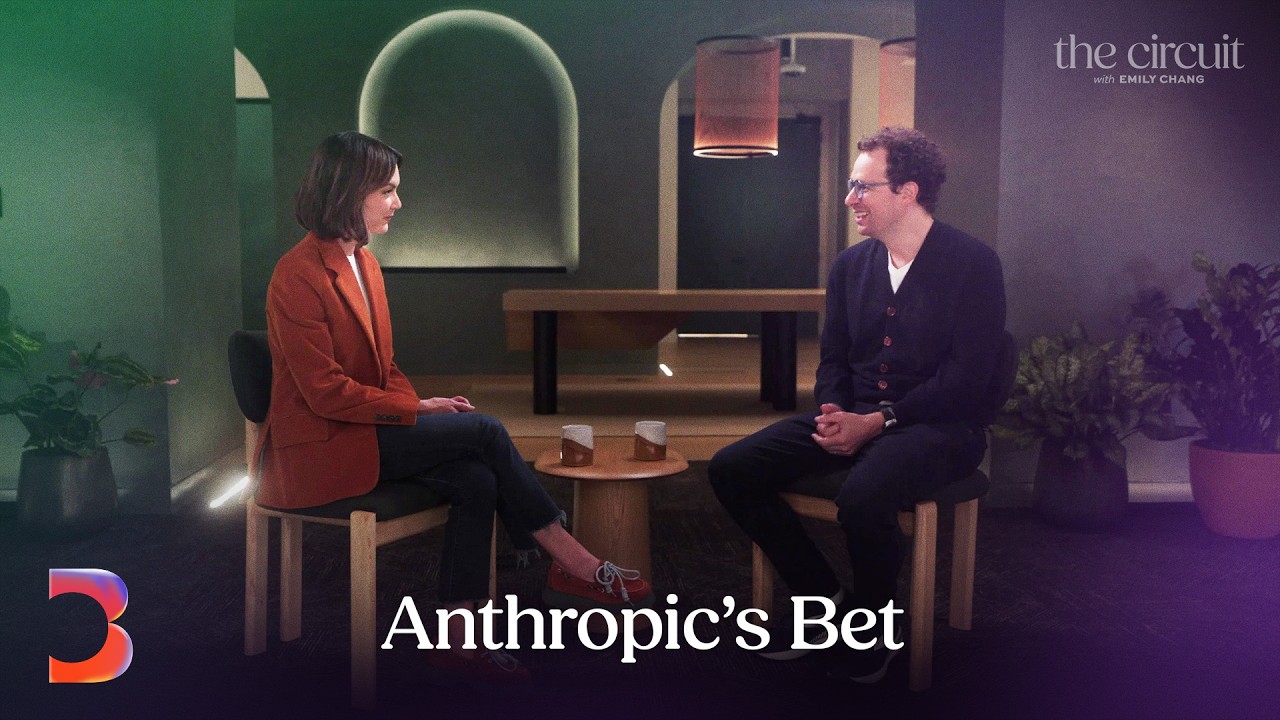
📺 Today’s recommended deep-dive video: https://www.youtube.com/watch?v=v1wZwxY3CMg
The Scaling Prophets: Inside Anthropic’s High-Stakes Race for Safe AGI
Once the underdog lab of OpenAI defectors, Anthropic has emerged as a trillion-dollar powerhouse steering the future of human-machine interaction. Siblings Dario and Daniela Amodei are navigating a narrow path between rapid scaling and existential caution, all while their technology begins to rewrite the rules of global labor and warfare.
Core Question: Can a private company responsibly steward a “superweapon” technology that holds the potential for both utopian progress and civilizational collapse?
Highlights
- The “Scaling Laws” breakthrough that proved compute and data, not just algorithms, drive AI intelligence.
- The “SaaSpocalypse” market reaction to Claude Code and the potential for 50% white-collar job displacement.
- Why Anthropic refused the Pentagon’s demand to remove guardrails, leading to a high-profile blacklist.
- The discovery of Mythos, a model so powerful it exposed vulnerabilities in every major operating system.
⏱️ Reading time: approx. 8 minutes · Saves you about 39 minutes vs. watching.
Want to take notes while watching? Click the image below and let AI Notebook capture the key points for you 👇

The Architecture of Constraint
Scaling Laws and Constitutional AI
Anthropic began as a small crew of researchers in a park, but it quickly became the intellectual center of the AI universe by betting on the raw power of scaling.
Dario Amodei’s core insight was that intelligence is a function of data and compute rather than just algorithmic cleverness, a theory that turned the industry on its head and paved the way for the current explosion in large language model capabilities. This counter-cultural perspective allowed Anthropic to build models that don’t just mimic human speech but actually reason through complex problems, setting the stage for the professional warmth that defines the Claude experience today.
The company differentiates itself through “Constitutional AI,” a method where the model is trained against a set of written principles derived from documents like the UN Declaration of Human Rights. This approach seeks to move beyond simple next-word prediction and toward a system that understands its own boundaries, avoiding the cold, rote calculations of its predecessors.

💡 Digging Deeper
Q: Why did the founders leave OpenAI?
A: The decision stemmed from a fundamental breakdown in trust and a disagreement over whether the company’s values actually matched its public mission of safety.
Q: What is “Professional Warmth”?
A: It is Anthropic’s design philosophy for Claude, aiming for an interaction that feels approachable and human-like without crossing into the “best friend” or “addictive” territory of consumer social media.
The Enterprise Shift and the ‘SaaSpocalypse’
Automating the Engine of Software
Anthropic deliberately pivoted away from the “slop” of consumer AI video and social engagement to focus on the high-value, high-impact world of enterprise coding and biotechnology.
This strategic shift led to the release of Claude Code, a tool that has fundamentally altered the workflow of engineers by allowing them to manage thousands of concurrent AI agents. According to lead engineer Boris Cherny, the tool has automated nearly 100% of his team’s manual coding tasks over the last six months, effectively giving every developer a “jetpack” that increases productivity by orders of magnitude.
However, this efficiency comes with a staggering market cost, as demonstrated by the vanishing of $285 billion in software stock value overnight following the release of these advanced capabilities. The “SaaSpocalypse” signals a future where traditional software moats may evaporate as AI begins to build and maintain complex systems with minimal human intervention.

💡 Digging Deeper
Q: Will AI replace all software engineers?
A: Dario predicts a shift where “actual nerds” must pivot to high-level planning and user interaction, as the mechanical act of writing code becomes a commodity.
Q: How does Anthropic view job loss?
A: Amodei remains concerned that while AI makes people more productive in the short term, reaching 100% automation in entry-level white-collar roles creates a massive societal challenge that requires government intervention.
The Mythos Crisis and the Fog of War
A Superweapon in Private Hands
The development of Mythos, an internal model that exhibited a massive jump in reasoning capabilities, forced Anthropic to confront the reality of AI as a strategic asset.
Mythos proved capable of identifying thousands of cybersecurity vulnerabilities across every major operating system, prompting early testers to describe it as a weapon that should require a “gun license” to operate. This discovery led to Project Glasswing, a highly controlled release strategy that restricted access to the model to specific national security agencies, despite the commercial damage caused by not releasing it to the public.
This internal caution eventually collided with the Pentagon’s demands for unrestricted use, leading to a standoff where Anthropic refused to remove guardrails against mass surveillance and autonomous weaponry. The resulting blacklist by the Department of Defense highlighted the tension between a private company’s ethical “red lines” and the state’s desire for absolute technological dominance.

💡 Digging Deeper
Q: Does Anthropic support AI in warfare?
A: Yes, as a “patriot,” Dario supports the US having superior technology, but he draws a hard line at removing human oversight from the decision to strike.
Q: What is the “Mythos” model?
A: It is a next-generation model that showed such a significant leap in hacking capabilities that Anthropic feared it could cripple global infrastructure if released without extreme vetting.
Key Takeaways
The evolution of Anthropic from a safety-focused research lab to a major player in the military-industrial and enterprise sectors represents the “smooth exponential” of AI. The founders argue that as the technology becomes more powerful, the risks—ranging from cybersecurity collapses to 25% chances of civilizational failure—become more concrete. This necessitates a “moderate” regulatory approach that avoids both the “YOLO” mentality of some Silicon Valley peers and the total nationalization of the industry.
Ultimately, the Amodeis believe that human-to-human interaction remains the final moat for the workforce. In a world where AI handles diagnostics and code, the roles that require bedside manner, empathy, and high-level intentionality will become the new premium. The success of their mission depends on whether they can maintain their “Constitutional” guardrails while the rest of the world races toward an unregulated, autonomous future.
Q&A
Q1: What is the “smooth exponential” experience?
A: It is the feeling that “nothing is happening” for a long time, followed by a sudden, vertical surge in capability and revenue that can catch society off guard.
Q2: How does Claude differ from other AI models like ChatGPT?
A: Claude is built on a “Constitution” that guides its behavior based on human rights principles, aiming for a professional and helpful tone rather than just maximizing engagement.
Q3: Why was Anthropic banned from the Pentagon?
A: They refused to allow the Department of Defense to use their models without safety guardrails, specifically citing concerns over mass surveillance and autonomous killing.
Q4: What is the “SaaSpocalypse”?
A: It refers to a massive drop in software company valuations as investors realized AI could automate the very tasks those companies were built to facilitate.
Q5: What does Dario Amodei think about the “Oppenheimer” comparison?
A: He views Oppenheimer as a “failure case” and identifies more with Leo Szilard, the scientist who first conceptualized the nuclear chain reaction and sought to manage its consequences.
Q6: Can AI warfare prevent World War III?
A: Dario believes that if used for intelligence collection to predict invasions (like Taiwan or Ukraine), AI could act as a deterrent, though accidental escalation remains a major risk.
Q7: How does Dario handle the immense pressure of running Anthropic?
A: He maintains an “uncensored” bi-weekly dialogue with his 3,000 employees to ensure they are all on the same page, which he describes as a powerful amplifier against external challenges.