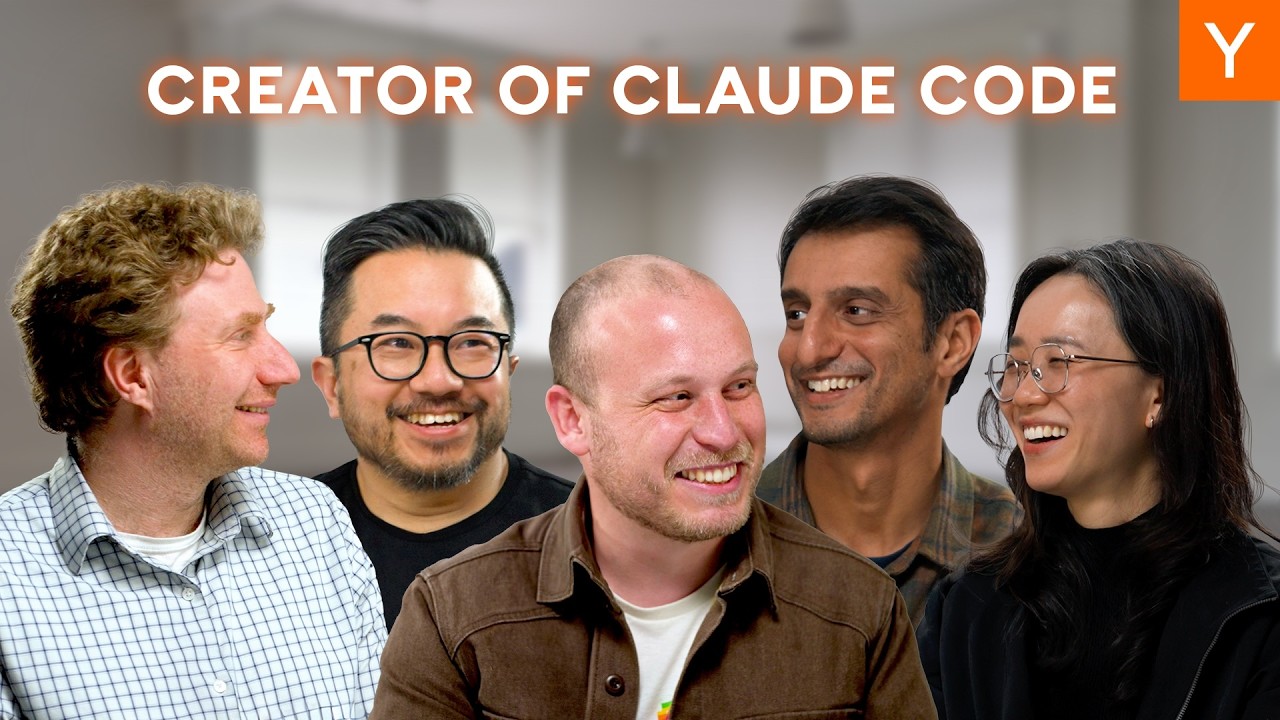
📺 Today’s recommended deep-dive video: https://www.youtube.com/watch?v=PQU9o_5rHC4
The 6-Month Rule: How Claude Code and Agentic Swarms are Rewriting the Developer Playbook
In this deep dive, Boris Cherny, the creator of Claude Code, explains why building for today’s AI models is a losing strategy and how “product overhang” is creating a new class of 1000x builders. From accidental terminal apps to agents that manage their own sub-agent swarms, the frontier of software development is moving faster than any IDE can keep up with.
Core Question: How can developers and founders leverage the “Bitter Lesson” to build tools that aren’t rendered obsolete by the next model release?
Highlights
- The 6-Month Mandate: Why you must build for the frontier where current models struggle, as that is where the next model will excel.
- Agentic Swarms: How Anthropic used a “Mama Claude” to build its entire plugins system over a weekend without human intervention.
- The Terminal Paradox: Why a “temporary” CLI became the most addictive developer interface by focusing on tool-use rather than chat.
- Productivity Explosion: The internal data showing a 150% increase in engineer output and the shift from “Software Engineer” to “Generalist Builder.”
⏱️ Reading time: approx. 6 minutes · Saves you about 44 minutes vs. watching.
Want to take notes while watching? Click the image below and let AI Notebook capture the key points for you 👇

Building for the Model of Tomorrow
Navigating Product Overhang
Boris Cherny’s central advice to founders is counter-intuitive: don’t build for what the model can do today. Instead, focus on the frontier where the model is currently failing, because that is exactly where the next iteration will become proficient. This strategy addresses “product overhang,” a state where model capabilities exist but haven’t been properly harnessed by interfaces.
If you build complex scaffolding to fix a current model’s weakness, you are building technical debt. The intelligence jump in the next model will likely render that scaffolding useless.
At Anthropic, the team prefers thin, elegant wrappers that allow the model to interact directly with tools like Bash and the file system. By staying close to the raw capabilities and focusing on “latent demand”—identifying what users are already trying to do and making it easier—they create tools that scale automatically with the underlying intelligence. This approach allowed Claude Code to transition from a prototype that wrote 10% of code to one that now handles 100% of Boris’s own development work.

💡 Digging Deeper
Q: What is the “Bitter Lesson” mentioned in the talk?
A: It’s the principle that general methods that leverage computation (like scaling laws) eventually always outperform methods that rely on human-expert knowledge or specific “scaffolding.”
Q: How does Boris define “latent demand”?
A: It is the observation of what users are already doing through manual workarounds. If you make that existing behavior easier, you have a winning product.
Q: Why did Claude Code start in the terminal?
A: It was an accident of speed. Boris wanted to test tool-use without building a UI, and it turned out the terminal was the perfect high-density feedback environment for engineers.
The Evolution of Agentic Swarms
Beyond Plan Mode
For many users, “Plan Mode” is a vital safety net to keep the model from heading down a “bug farm” path. However, Cherny predicts that Plan Mode has a limited lifespan, perhaps as short as a few months, as models become better at self-correction and staying on track. Currently, Boris uses Plan Mode for 80% of his sessions to spec out ideas, but once the execution begins, modern models like Opus 4.5 rarely need babysitting.
We are moving toward a world of “Agent Topologies,” where multiple agents with uncorrelated context windows work in parallel to solve complex problems.
One of the most striking examples of this was the development of Claude Code’s plugins feature. An engineer provided a spec, and a “Mama Claude” agent spawned sub-agents to pick up tickets, write code, and run tests. The entire feature was shipped over a weekend with minimal human intervention. This recursive automation is now standard at Anthropic, where agents handle everything from security reviews to labeling GitHub issues.

💡 Digging Deeper
Q: What are “uncorrelated context windows”?
A: It is a form of test-time compute where multiple agents work on parts of a problem without their context being “polluted” by the others’ previous mistakes.
Q: How do sub-agents improve debugging?
A: You can prompt Claude to spin up one agent to look at logs and another to trace the code path in parallel, significantly speeding up the identification of memory leaks or race conditions.
Q: What is the shelf-life of code in the Claude Code era?
A: Extremely short. Boris notes that almost no part of the Claude Code codebase from six months ago still exists; it is constantly rewritten to leverage new model strengths.
The Death of the “Software Engineer” Title
From Syntax Specialist to Systems Builder
The metrics for productivity at Anthropic are unprecedented in the history of software engineering. While a 2% gain in productivity is considered a massive win at companies like Meta or Google, Anthropic has seen a 150% increase in PR output per engineer since the rollout of Claude Code. This isn’t just about writing code faster; it’s about shifting the nature of the work itself.
The title “Software Engineer” is becoming vestigial, replaced by the role of the “Builder” or “Generalist.”
On Boris’s team, every function—including finance, design, and product management—codes. The barriers to entry have collapsed because the model handles the “how,” allowing the human to focus on the “what” and the “why.” This democratization means that visionaries can now execute at 50x speed, while those who refuse to adopt an agentic mindset are left behind. The future belongs to those who think scientifically, maintain a “beginner’s mindset,” and aren’t afraid to let the model delete their old code.

💡 Digging Deeper
Q: How has productivity changed for non-technical teams?
A: Teams like Finance and Sales are using “Cowork” (a GUI for Claude Code) to build their own internal tools, bypassing the traditional engineering bottleneck.
Q: What is the current model-written code percentage at Anthropic?
A: It ranges from 70% to 90% across the company, with Boris claiming 100% of his own PRs are now model-generated.
Q: What is ASL4?
A: Anthropic’s Safety Level 4, which refers to models capable of recursive self-improvement, necessitating extreme safety protocols to prevent catastrophic misuse.
Key Takeaways
The most successful developers of the next decade will be those who internalize the “Bitter Lesson”: computation and scale will always beat human-coded heuristics. If you are building a tool today, ask yourself if the problem you are solving will still exist when the next model release happens. If the answer is no, you are building a “bridge to nowhere.” Focus instead on the interfaces that allow these models to act as agents in the real world.
The shift toward agent swarms and the democratization of coding means that “Product Sense” is now the most valuable skill for an engineer. When everyone can code, the only differentiator is knowing what to build. This requires engineers to act more like founders—talking to users, identifying latent demand, and thinking from first principles rather than relying on senior-level opinions that may no longer be relevant.
Finally, the transition to the terminal and then back to specialized GUIs like Cowork shows that form factor follows function. Don’t get attached to your tools; get attached to the feedback loop. Whether it’s a CLI or a Slack bot, the goal is to reduce the friction between a human’s intent and the model’s execution. As we approach models capable of self-improvement, the human role will increasingly move toward safety, ethics, and high-level specification.
Q&A
Q1: How do you handle a claude.md file that gets too long?
A: Boris suggests deleting it and starting fresh. People often over-engineer their instructions, but as models get better, they actually need fewer prompts to stay on track.
Q2: What was the most surprising use case for Claude Code?
A: A user who used it to monitor tomato plants, and another who recovered wedding photos from a corrupted hard drive. It highlights that people will jump through hoops to use agentic tools for non-coding tasks.
Q3: Why is React used for a terminal application?
A: It allows for a delightful, iterative UX. Using “Ink” (React for CLI), the team can prototype 20 different spinner animations or layouts in a few hours to see what feels “joyous” to use.
Q4: Will we still need IDEs in the future?
A: Boris predicted in May 2024 that IDEs would become unnecessary. He has since uninstalled his own and works entirely through Claude Code and the terminal.
Q5: What is the hiring criteria for this new era of engineering?
A: Humility and scientific thinking. The team looks for people who can admit when they are wrong and who are willing to experiment with the model rather than relying on “expert” biases.
Q6: What is “Mama Claude”?
A: It is the internal nickname for a primary Claude agent that manages a recursive SDK to spawn, task, and review the work of multiple sub-agents.
Q7: How does Anthropic balance speed with safety?
A: They use “ASL” (AI Safety Levels). As models reach higher levels of recursive capability, they must pass increasingly stringent tests to ensure they cannot be misused for creating bio-viruses or zero-day exploits.