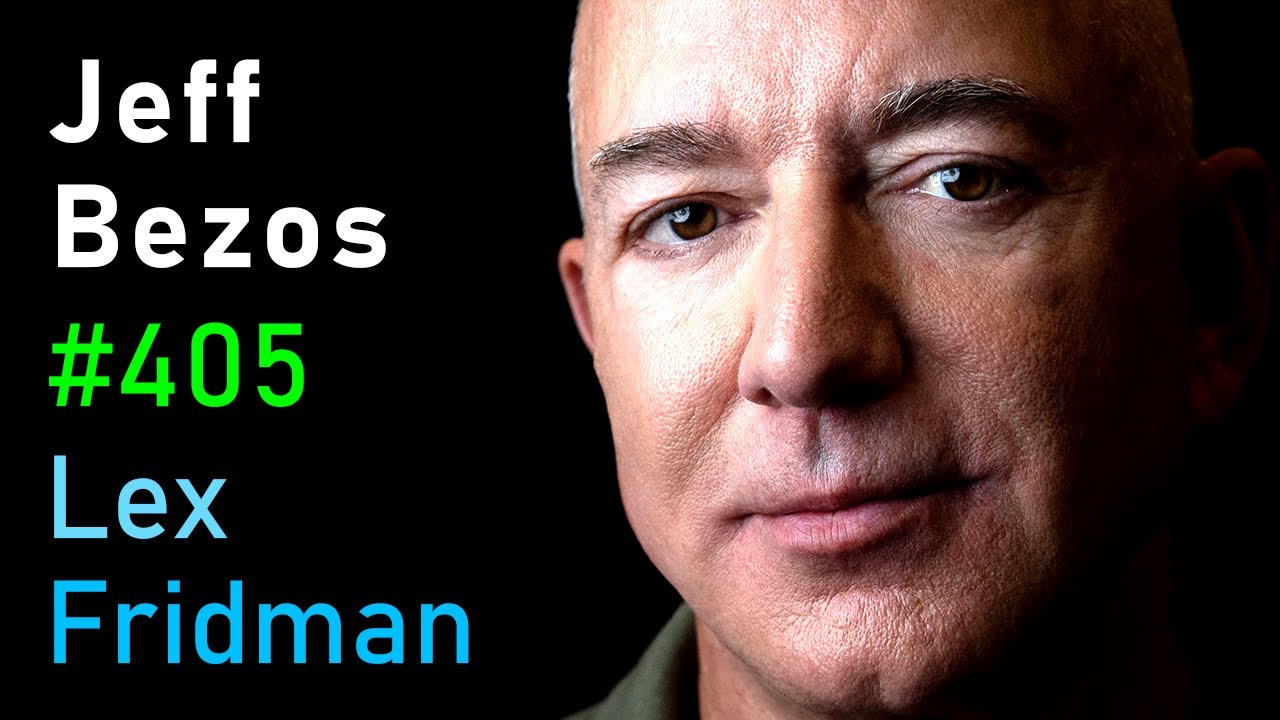

📺 Today’s recommended deep-dive video: https://www.youtube.com/watch?v=DcWqzZ3I2cY
Jeff Bezos: Building the Road to Space and the “Day One” Mindset
In a rare, expansive dialogue, Jeff Bezos explores the fundamental principles of resourcefulness learned on a Texas ranch and how they scale to galactic ambitions. He details the cultural mechanics behind Amazon’s success and his current mission to lower the cost of access to the solar system through Blue Origin.
Core Question: How can humanity leverage long-term thinking and high-velocity decision-making to preserve Earth and enable a trillion humans to live in space?
Highlights
- The “Resourcefulness Loop”: How a broken bulldozer taught Bezos the value of self-reliance.
- Decision Architecture: Why distinguishing between “One-Way” and “Two-Way” doors is the key to corporate speed.
- The Vision for O’Neill Colonies: Moving heavy industry off-planet to transform Earth into a residential “gem.”
- The Six-Page Memo: Why Amazon banned PowerPoints to prioritize truth-seeking over salesmanship.
⏱️ Reading time: approx. 12 minutes · Saves you about 119 minutes vs. watching.
Want to take notes while watching? Click the image below and let AI Notebook capture the key points for you 👇

The Foundations of Resourcefulness
Lessons from the Ranch
Jeff Bezos attributes his foundational mindset to summers spent on his grandfather’s Texas ranch, where “calling someone” for help wasn’t an option.
Whether they were repairing a 1950s-era D6 Caterpillar bulldozer or fabricating veterinary tools from scrap wire, the environment demanded total self-reliance. This upbringing instilled a deep conviction that any technical or logistical hurdle can be overcome with enough persistence, ingenuity, and a willingness to wander into the unknown.
His grandfather, a former high-level bureaucrat turned rancher, modeled a powerful problem-solving mentality that Bezos carried into the founding of Amazon. The process of building a crane simply to move gears for a transmission was not an annoyance; it was the work itself. This “builder” identity remains the core of how he views his role today, identifying primarily as an inventor rather than a traditional executive.

💡 Digging Deeper
Q: Why did Bezos abandon theoretical physics?
A: He encountered a student from Sri Lanka who solved complex partial differential equations in his head, realizing that elite physics requires a specific brain wiring he didn’t possess.
Q: What is the “Childlike Wonder” Isaacson mentions?
A: It is the ability to maintain curiosity and open-ended wandering even when managing trillion-dollar infrastructures.
Q: Is resourcefulness a learned trait?
A: Bezos suggests it is a habit developed by being forced to solve problems without external help, leading to the realization that most things are “figure-out-able.”
Engineering the Road to Space
New Glenn and Heavy Lift
The New Glenn rocket represents a massive leap in heavy-lift capability, designed to take 45 metric tons to Low Earth Orbit using Seven BE-4 engines.
Size in rocketry is a paradox; while large machines are a “pain in the butt” to manufacture, the physics of turbo-pumps and parasitic mass actually favor larger scales.
By utilizing liquified natural gas (LNG) for the booster and liquid hydrogen for the upper stage, Blue Origin balances density for lift-off and high specific impulse for space maneuvers. The ultimate goal isn’t just to launch rockets, but to build the “heavy infrastructure” that will allow the next generation of space entrepreneurs to start companies in their dorm rooms, just as Bezos used the postal service to start Amazon.
💡 Digging Deeper
Q: Why move heavy industry to space?
A: Earth is a finite “gem” with a delicate ecosystem; space offers infinite energy and materials that can support industry without damaging our home planet.
Q: What are O’Neill Colonies?
A: Giant rotating space stations that can provide normal Earth gravity and house millions of people, positioned near Earth for easy travel.
Q: What is the “Blue Ring”?
A: A multi-mission spacecraft that acts as a set of “APIs for space,” providing compute, power, and transport for payloads up to 3,000kg.
High-Velocity Culture and Decision Making
One-Way vs. Two-Way Doors
Bezos argues that most corporate stagnation occurs because companies use a “one-size-fits-all” heavyweight decision process for reversible choices.
He classifies decisions as Type 1 (One-Way Doors) or Type 2 (Two-Way Doors). One-way doors are irreversible, high-stakes moves like changing a core propellant or launching a prime membership, requiring slow, deliberate scrutiny. Two-way doors are most decisions—if they fail, you simply walk back through—and these should be made quickly by individuals or small teams to maintain velocity.
To keep a company at “Day One” status, leadership must resist the pull of “Day Two,” which Bezos describes as stasis and eventual death. This involves an obsession with the customer over the competitor and a skeptical view of “proxies”—metrics that once represented truth but have become bureaucratic inertia. When the data and the customer anecdotes disagree, the anecdotes are usually right, signaling that the data collection is measuring the wrong thing.

💡 Digging Deeper
Q: What does “Disagree and Commit” mean?
A: It is a teammate behavior where, after a dispute, a person supports a decision they disagree with to avoid a “war of attrition” and maintain speed.
Q: Why are PowerPoints banned at Amazon?
A: PowerPoints are “sales tools” that hide sloppy thinking; six-page narrative memos force authors to connect ideas through verbs and nouns.
Q: Why start meetings with 30 minutes of silence?
A: It ensures everyone has actually read the memo deeply, creating an “elevated discussion” where even the most junior person can challenge a senior based on the text.
Long-Term Thinking and the 10,000-Year Clock
The Horizon of Human Impact
As humanity gains the power of nuclear weapons and AI, our capacity for unintended consequences necessitates a shift toward millennial-scale thinking.
The 10,000-Year Clock is a monumental mechanical project in West Texas designed to tick once a year and chime every century. It serves as a physical symbol to remind us that we are currently in the “industrial revolution” phase of a much longer human story. By slowing down our perspective, we can solve problems that are impossible to address within a standard five-year institutional window.
Bezos views AI not as a traditional invention, but as a “discovery” akin to the moons of Jupiter. While it poses risks, he is firmly optimistic, believing these tools will likely save us from ourselves by solving complex medical and technological challenges. The key is ensuring our maturity as a species evolves at the same rate as our tools, moving away from petty, short-term grievances toward the “Overview Effect” seen by astronauts.

💡 Digging Deeper
Q: Is Bezos afraid of mortality?
A: Not anymore; he is focused on “health span”—staying active and curious as long as possible before a “square wave” exit.
Q: What is the “Overview Effect”?
A: The profound realization that Earth is a fragile, singular gem in a void of nothingness, which often turns astronauts into environmentalists.
Q: How does Bezos start his day?
A: He practices “puttering”—drinking coffee, reading the news, and moving slowly for the first few hours to allow for mental wandering.
Key Takeaways
The transition from a trillion-dollar retail empire to the “road to space” is fueled by a consistent philosophy: truth-seeking. Whether it is through the silence of a six-page memo or the cold physics of a rocket engine, Bezos emphasizes that progress only happens when organizations prioritize reality over social cohesion or bureaucratic proxies.
Culture is not an accident; it is an engineered set of behaviors. By rewarding “Disagree and Commit” and maintaining “Day One” urgency, leaders can prevent the slow rot of “Day Two” stasis. This requires an almost fanatical focus on the customer and the willingness to be misunderstood for long periods while building infrastructure that won’t bear fruit for decades.
Ultimately, the 10,000-year clock and Blue Origin share the same goal: stretching the human imagination. We are currently “small” in the context of the solar system, but with the right heavy lifting, we can enable a future of a thousand Einsteins and a thousand Mozarts, ensuring that Earth remains the residential paradise it was meant to be.
Q&A
Q1: What is the most important measure of human advancement according to Bezos?
A: Energy usage per capita. He believes that to continue improving the human condition without destroying the planet, we must move our energy-intensive industries into space.
Q2: How does Bezos handle a meeting where everyone is “polite” but clearly disagrees?
A: He encourages escalation. He views “compromise” and “wars of attrition” as low-energy traps that don’t lead to truth. He prefers a “crisp document and a messy meeting” where people are forced to be vulnerable and state their actual views.
Q3: Does Blue Origin compete with SpaceX?
A: Bezos views the industry as “big enough for many winners.” He compares the current state of space to the early internet; he wants to build the infrastructure so that many “dorm room” space startups can exist.
Q4: What is a “paper cut” in the Amazon ecosystem?
A: These are small, minor customer experience deficiencies that are often ignored by teams working on “big” problems. Bezos creates dedicated teams specifically to hunt down and fix these small points of friction.
Q5: Why does Bezos speak last in meetings?
A: To avoid polluting the room with his opinion. Even smart, strong-willed executives will subconsciously align their views if the most senior person speaks first, destroying the opportunity for an unfiltered, multi-perspective discussion.
Q6: What is his view on AI’s power efficiency?
A: He finds it fascinating that the human brain performs complex tasks on 20 watts of power, while current AI requires kilowatts for the same output. This suggests there are still “tricks” of the brain we have yet to discover.