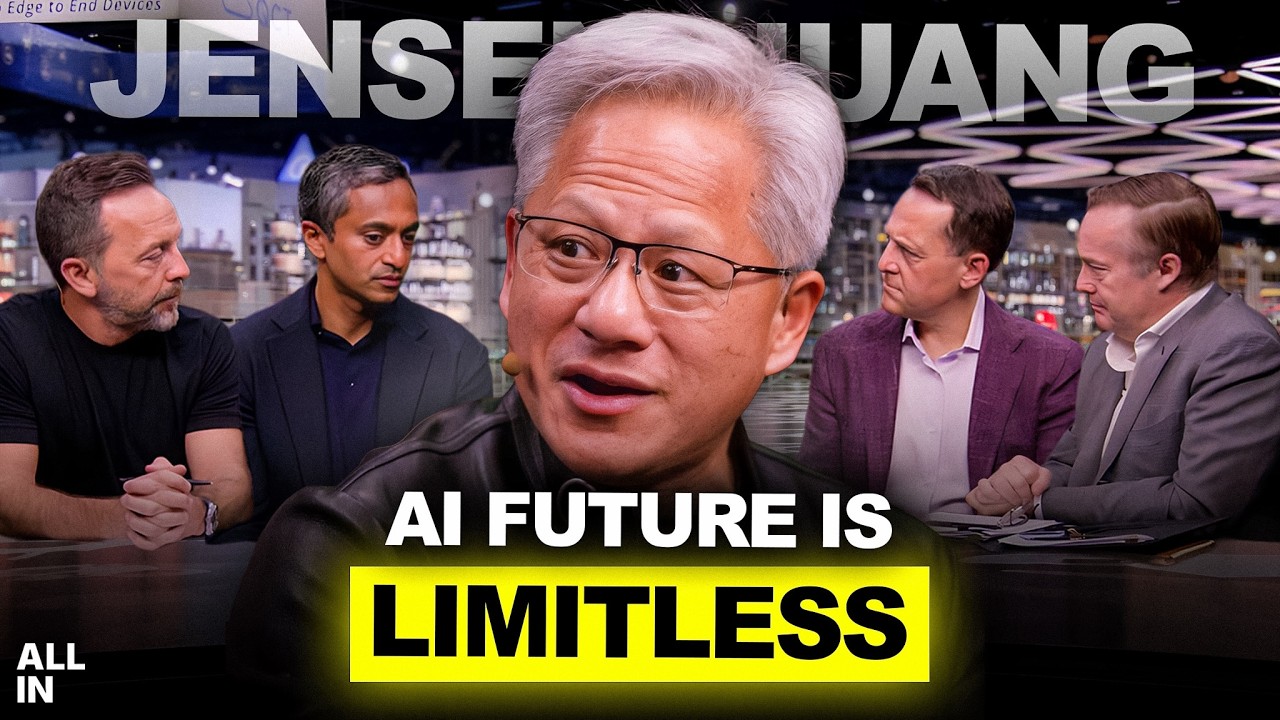
📺 Today’s recommended deep-dive video: https://www.youtube.com/watch?v=gwW8GKwHB3I
NVIDIA’s Pivot to the AI Factory: Jensen Huang on the Next Industrial Revolution
NVIDIA CEO Jensen Huang joins the All-In Podcast to discuss why the world is moving beyond simple GPUs into the era of “AI Factories.” From the mechanics of disaggregated inference to the geopolitical stakes of the semiconductor race, Huang outlines a future where agents perform the heavy lifting of global industry.
Core Question: How is NVIDIA transforming data centers into “AI Factories” to power a million-fold increase in computing efficiency?
Highlights
- The Dynamo OS: A new operating system for AI factories that leverages disaggregated inference to split complex math across heterogeneous chips.
- Token Economics: Why a $50 billion data center is more cost-effective than a $30 billion one when measured by token throughput and efficiency.
- Agentic Explosion: The shift from simple chatbots to “Reasoning Agents” that use tools, manage memory, and perform autonomous work.
- The Human Element: Why “English” is the ultimate programming language and how AI will create more jobs, using the radiologist paradox as proof.
⏱️ Reading time: approx. 8 minutes · Saves you about 58 minutes vs. watching.
Want to take notes while watching? Click the image below and let AI Notebook capture the key points for you 👇

The Operating System of the Next Industrial Revolution
From GPUs to AI Factories
NVIDIA is no longer just a chipmaker; it has transformed into the primary architect of the next industrial revolution’s factories.
Jensen Huang introduces “Dynamo,” an operating system named after Siemens’ machine that converted water to electricity. This new version turns data into intelligence, utilizing disaggregated inference to split complex processing pipelines across diverse hardware components like GPUs, CPUs, and networking switches.
The transition from simple GPUs to an integrated AI factory allows for heterogeneous computing where the right workload finds the right chip. By acquiring companies like Mellanox and optimizing for scale-out switches, NVIDIA is scaling the complexity of mathematics to match the sheer size of modern data problems, effectively turning their data centers into massive, unified computing instruments.

💡 Digging Deeper
Q: What exactly is “disaggregated inference”?
A: It is the process of breaking down the incredibly complicated pipeline of an AI model’s response so that different parts of the math run on the most efficient hardware available, rather than forcing one chip to do everything.
Q: Why rename the data center an “AI Factory”?
A: Because, like the factories of the last century that took in raw materials and produced electricity, these facilities take in data and produce “tokens”—the fundamental units of intelligence.
The Hard Math of AI ROI
Efficiency Over Price Tags
Critics often focus on the upfront cost of hardware, but Huang argues that a $50 billion factory is actually cheaper than a $30 billion one if the throughput is significantly higher.
Land, power, and infrastructure represent fixed costs that don’t change based on the chip brand. Therefore, the premium paid for state-of-the-art technology is justified by the massive efficiency gains in token production. If a chip cannot keep pace with the current rate of technological acceleration, it remains too expensive even if the hardware is free.
Huang views tokens as the primary fuel for human productivity, suggesting that high-value engineers should be consuming hundreds of thousands of dollars in AI compute annually. This investment transforms a standard researcher into a “superhuman” capable of solving problems that previously felt too heavy or time-consuming.

💡 Digging Deeper
Q: How much should a company spend on AI tokens per employee?
A: Huang suggests that for a $500,000-a-year engineer, a company should be alarmed if they aren’t spending at least $250,000 on tokens to augment their work.
Q: Is inference scaling as fast as training?
A: Yes, it is moving from 1,000x to a predicted 1,000,000x scaling as we move from simple generation to complex reasoning.
Agents and the Rise of Physical AI
The Three-Computer Framework
The shift from generative AI to reasoning agents represents a massive leap in computational requirements, jumping by factors of 10,000 in just two years.
Agents aren’t just chatbots; they are sophisticated systems that manage memory, use tools like Excel or Blender, and decompose complex tasks into manageable sub-goals. Huang envisions three distinct computers in the AI landscape: one for training the model, one for physical simulation in a “virtual gym” like Omniverse, and a third robotics computer at the edge.
This framework applies to everything from self-driving cars and hospital surgical robots to digital biology, where we are nearing a “ChatGPT moment” for genetic and protein representation. Robotics will eventually reach a one-to-one ratio with the human population, providing a massive unlock for global prosperity and economic mobility.

💡 Digging Deeper
Q: Why is “Open Claude” or “Claude Code” so significant?
A: It represents the first agentic system that functions like a personal artificial intelligence computer, possessing its own memory, scheduling, and I/O subsystems.
Q: Will robots replace the human workforce?
A: Huang argues we are currently “millions of people short” in labor, and robotics will fill the gap, allowing humans to focus on higher-level creative and strategic tasks.
Geopolitics and the Future of Work
National Security and the Human Purpose
National security is at risk if the United States allows fear or “doomerism” to slow the domestic diffusion of AI technology.
Regarding the loss of market share in China, Huang notes that NVIDIA is working closely with the U.S. government to secure licenses and supply chain resilience. He emphasizes that the goal should be an American tech stack being used by 90% of the world to build local applications.
Jensen addresses job displacement with the example of radiologists, noting that while AI now scans images better than humans, the number of radiologists has actually increased. By automating the mechanical task of scanning, doctors can treat more patients and perform more complex diagnoses, proving that AI changes the task but often preserves or expands the underlying purpose of the profession.

💡 Digging Deeper
Q: What is the biggest threat to US AI leadership?
A: Not the technology itself, but the lack of diffusion—if other countries adopt AI faster while the US remains paralyzed by regulatory fear.
Q: What should students study today?
A: Deep science, math, and language. Because English is now the primary programming language, the ability to specify complex ideas clearly is the most valuable skill.
Key Takeaways
The transition from GPUs to AI Factories marks the end of general-purpose computing as we knew it. In this new paradigm, the value is not in the silicon itself, but in the “operating system” that coordinates thousands of chips to act as a single unit of production for intelligence. NVIDIA’s strategy relies on being the only full-stack provider that can span from the cloud to the edge, ensuring that their architecture remains the global standard for both proprietary and open-source development.
Furthermore, the “agentic” shift means we are moving from asking AI questions to delegating AI work. This will fundamentally re-index the enterprise software market, turning every software company into a value-added reseller of specialized agents. While concerns about job displacement remain, the historical precedent suggests that increasing productivity leads to an expansion of the “economic pie,” creating more demand for specialized human experts who know how to direct these bionic tools.
Ultimately, the goal is “Physical AI”—bringing intelligence into the $50 trillion world of heavy industry, biology, and robotics. By creating a feedback loop between virtual simulation and real-world execution, NVIDIA is positioning itself at the center of a world where everything that moves is autonomous, and every human worker is amplified by a fleet of digital assistants.
Q&A
Q1: How does Jensen Huang define NVIDIA’s current identity?
A: He defines it as an “AI Factory” company. NVIDIA has evolved from making GPUs to creating the entire infrastructure—including the “Dynamo” operating system—to produce intelligence tokens at industrial scale.
Q2: Why is NVIDIA unconcerned about competitors offering cheaper chips?
A: Because hardware price is a small fraction of total data center costs. Huang argues that NVIDIA’s superior efficiency and throughput result in the lowest “cost per token,” making even “free” competing chips more expensive in the long run if they are less efficient.
Q3: What is the significance of “agentic” processing over generative AI?
A: Generative AI answers questions, but agentic AI does work. Agents have memory, use tools, and can decompose complex problems, representing a 10,000x increase in computational demand and a much higher ROI for users.
Q4: What is Huang’s view on the “Radiologist Paradox”?
A: He notes that even though AI is better at reading scans, the number of radiologists is growing. AI automates the task (reading the scan) but scales the purpose (diagnosing and treating patients), leading to more scans and better healthcare.
Q5: How does NVIDIA view the open-source vs. proprietary model debate?
A: Huang believes both will coexist. Proprietary models offer top-tier general intelligence as a service, while open-source models allow industries to capture and control their specific domain expertise.
Q6: What are the “Three Computers” of the AI future?
A: 1. The Training Computer (developing the AI), 2. The Simulation Computer (Omniverse/virtual gyms for physics), and 3. The Edge/Robotics Computer (the AI inside the car, robot, or device).
Q7: What is the most important skill for the next generation?
A: Being an expert at using AI. Because natural language has become the programming language of the future, the ability to specify, iterate, and guide AI toward a specific outcome is the new “artistry” of work.