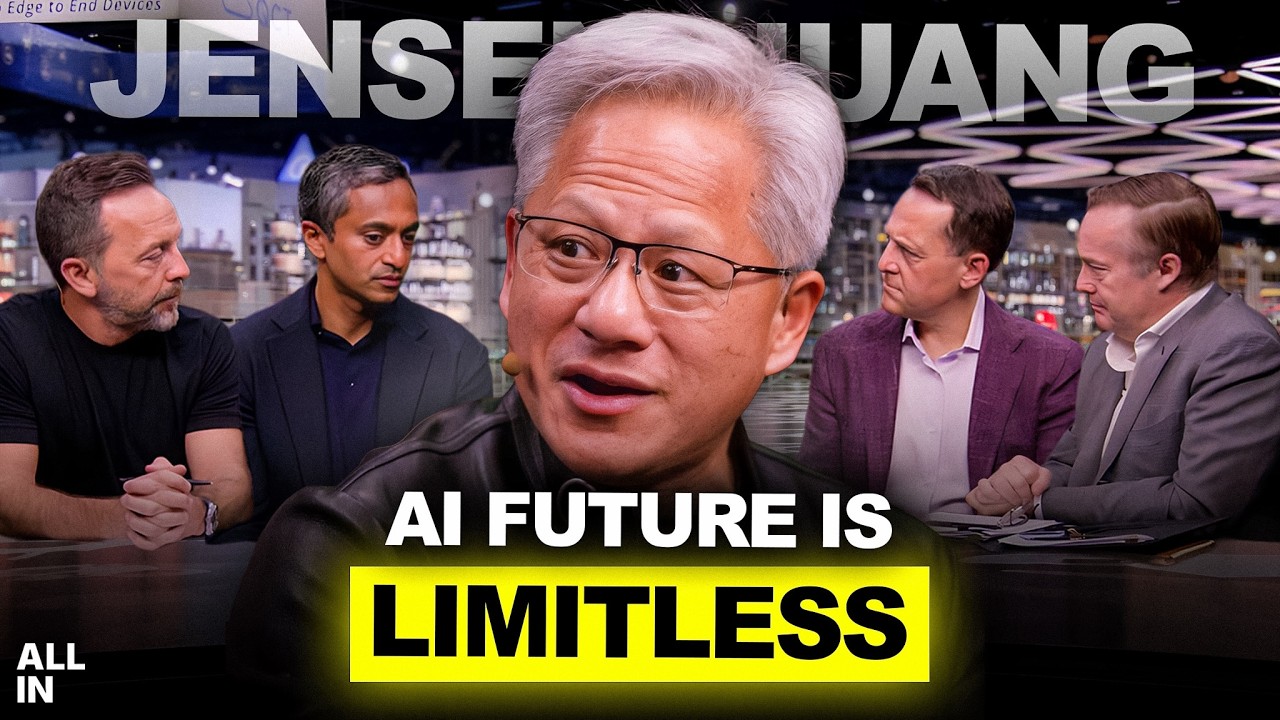
📺 Today’s recommended deep-dive video: https://www.youtube.com/watch?v=gwW8GKwHB3I
The Industrial Revolution of Intelligence: Jensen Huang on the AI Factory Era
NVIDIA CEO Jensen Huang joins the All-In podcast to break down the fundamental shift from silicon chips to “AI Factories.” He explains why the future of productivity isn’t about human displacement, but about empowering every individual with a fleet of autonomous digital agents.
Core Question: How is NVIDIA evolving from a graphics hardware company into the essential operating system for the next industrial revolution?
Highlights
- The transition from selling GPUs to building “Dynamo,” the operating system for AI factories.
- Why $50 billion data centers actually produce the cheapest tokens compared to lower-cost alternatives.
- The “ChatGPT moment” for digital biology and the 3-5 year timeline for mainstream robotics.
- A new hiring paradigm: Why top-tier engineers should be spending $250,000 a year on AI tokens.
⏱️ Reading time: approx. 10 minutes · Saves you about 56 minutes vs. watching.
Want to take notes while watching? Click the image below and let AI Notebook capture the key points for you 👇

Building the Operating System for the AI Factory
From Disaggregated Inference to “Dynamo”
Jensen Huang describes the current tech landscape as the next industrial revolution, anchored by a new operating system called Dynamo. This name harks back to the machines that converted water into electricity, signifying NVIDIA’s shift from selling chips to providing the infrastructure for the factory of the future.
The fundamental technology powering this shift is disaggregated inference, which Huang identifies as the most complex computing problem today. By breaking down the processing pipeline across heterogeneous components—GPUs, CPUs, and networking processors like Bluefield and Groq—the system optimizes workloads with surgical precision. This allows NVIDIA to move beyond simple graphics processing toward a comprehensive “AI Factory” model that scales exponentially across data centers.
This architectural complexity is necessary because the industry is moving rapidly from simple large language models to complex, self-directed agentic systems.
These agents require massive working memory, long-term storage access, and the ability to use external tools. To meet this demand, NVIDIA’s Vera Rubin platform expands the data center footprint, potentially increasing the total addressable market by up to 50% compared to previous generations of hardware.

💡 Digging Deeper
Q: Why is NVIDIA focusing on “disaggregated inference”?
A: Because inference pipelines are now too complex for a single chip; they require a heterogeneous mix of processors to handle mathematics of different shapes and sizes.
Q: What is the significance of the “Vera Rubin” platform?
A: It is designed to run “extraordinarily diverse workloads,” specifically the agentic processing that requires high-speed access to both short-term and long-term memory.
The Economics of Scale and the Token Economy
Why Performance Trumps Upfront Cost
There is a persistent misunderstanding in the market regarding the upfront cost of AI infrastructure versus the long-term value of its output. While critics argue that NVIDIA’s $50 billion factory designs are twice as expensive as custom ASIC alternatives, Huang proves that these high-end systems generate the lowest cost per token. Efficiency at scale is the only metric that truly matters for enterprises competing in a high-throughput, intelligence-driven economy.
Even if a competitor’s chips were free, they wouldn’t be cheap enough if they can’t match NVIDIA’s pace of innovation.
This perspective shifts the focus from capital expenditure to operational efficiency and throughput. When $20 billion of a project’s cost is tied up in land, power, and building shells, the performance delta between the computing hardware becomes the deciding factor for ROI.
💡 Digging Deeper
Q: Is NVIDIA worried about losing market share to cheaper ASICs?
A: No, because they are gaining share in the “full-stack” infrastructure market, where companies want entire AI factories, not just individual chips.
Q: What is the “Free Chip” fallacy?
A: The idea that if hardware efficiency is low, the cost of power and space will still make the total operation more expensive than using premium, high-performance hardware.
The Agentic Explosion and the Future of Work
The Rise of the “Personal AI Computer”
We are entering an era where every knowledge worker will be supported by a fleet of a hundred digital agents. These agents are not just chatbots; they are functional components of a personal artificial intelligence computer that manages memory, schedules tasks, and utilizes specialized skills to complete actual work.
Huang highlights the emergence of open-source agentic systems, such as the “OpenHands/OpenClaw” movement, as a fundamental blueprint for modern computing. Unlike enterprise-locked software, these open models allow for a decentralized architecture where individuals can build custom agents for specific workflows, from chip design to genomic research. This shifts the bottleneck of productivity from “butts in seats” to the creative capacity of the individual managing their digital workforce.
In the future, we will no longer write code; we will specify architectures and iterate on ideas with our agent teams.

💡 Digging Deeper
Q: How much should a company spend on AI tokens per employee?
A: Huang suggests that for a $500,000 engineer, spending $250,000 on tokens is a logical investment to grant them “superhuman abilities.”
Q: Will AI agents destroy the enterprise software industry?
A: No, they will likely become the primary users of it, increasing the number of “agents banging on tools” by 100x and driving massive license consumption.
National Security and the Global Supply Chain
Navigating Geopolitics and “Doomerism”
National security remains a top priority, but Huang warns that “doomerism” and over-regulation could inadvertently cripple American leadership in the AI race. He points to the collapse of the U.S. solar and rare-earth mineral industries as cautionary tales of what happens when domestic innovation is stifled by fear. The goal should be to ensure the American tech stack remains the global standard, reaching 90% of the world.
Our national security is diminished when we lose control over the core technologies that power our modern communication and energy networks.
Regarding the supply chain, NVIDIA is actively re-industrializing the United States through partnerships in Arizona and Texas. While diversifying manufacturing to Japan and Europe is essential for resilience, Huang emphasizes that the strategic friendship with Taiwan remains the bedrock of the global semiconductor ecosystem.

💡 Digging Deeper
Q: What is the status of NVIDIA in China?
A: They previously had 95% market share, dropped to 0% due to regulations, but are now working with the administration to secure licenses for specific Chinese companies.
Q: Is the Middle East still a focus for NVIDIA?
A: Yes, Huang remains “100% in” on Israel and the Middle East, believing the region will eventually reach greater stability and become a hub for AI expansion.
Key Takeaways
The shift from GPUs to AI Factories marks a point of no return for the global economy. Jensen Huang makes it clear that we are no longer just “using” computers; we are building factories that manufacture intelligence at a scale that was previously inconceivable. This transformation is driven by a hundred-fold increase in compute requirements for reasoning, followed by another hundred-fold increase for agentic systems.
The impact on the workforce will be profound, but not in the way many fear. Using the historical example of radiologists, Huang explains that while tasks are automated, the purpose of the profession remains and often expands. As AI makes scans faster and cheaper, the demand for doctors to diagnose and treat patients actually skyrockets. The lesson for the next generation is simple: don’t fear AI—become an expert at directing it.
Finally, the battle for AI supremacy is as much about geopolitics and supply chain resilience as it is about software. By re-industrializing the U.S. and maintaining a “full-stack” architectural advantage, NVIDIA aims to keep the American tech stack at the center of the world’s digital infrastructure. The next five years will see this technology move from the cloud into physical robotics, digital biology, and every instrument in our hospitals.
Q&A
Q1: How does Jensen decide which hard problems to solve?
A1: He looks for the confluence of three things: a problem that is “insanely hard,” something never done before, and something that taps into NVIDIA’s unique “superpowers.”
Q2: What is the timeline for the “robotics revolution”?
A2: Huang predicts that within 3 to 5 years, we will see robots performing high-functioning tasks across various industries, from factories to households.
Q3: Is digital biology really at a “ChatGPT moment”?
A3: Yes, Huang believes that in the next 2-5 years, we will fully understand how to represent and predict the dynamics of genes, proteins, and cells.
Q4: What happens to jobs like chauffeurs when cars become fully autonomous?
A4: They may transition into “mobility assistants” who manage luggage, security, and personal logistics while the car handles the driving.
Q5: Should students still learn to code?
A5: While coding is changing, deep science, math, and language skills are more important than ever because language is becoming the primary programming language for AI.
Q6: Is open source better than proprietary models?
A6: Huang views them as “A and B,” not “A or B.” Proprietary models provide world-class general intelligence as a service, while open models allow industries to capture and control their domain expertise.
Q7: Why is “token throughput” the most important metric?
A7: Because in the future, people won’t just pay for information; they will pay for “work done” by agents, and work is measured in the efficiency of token generation.