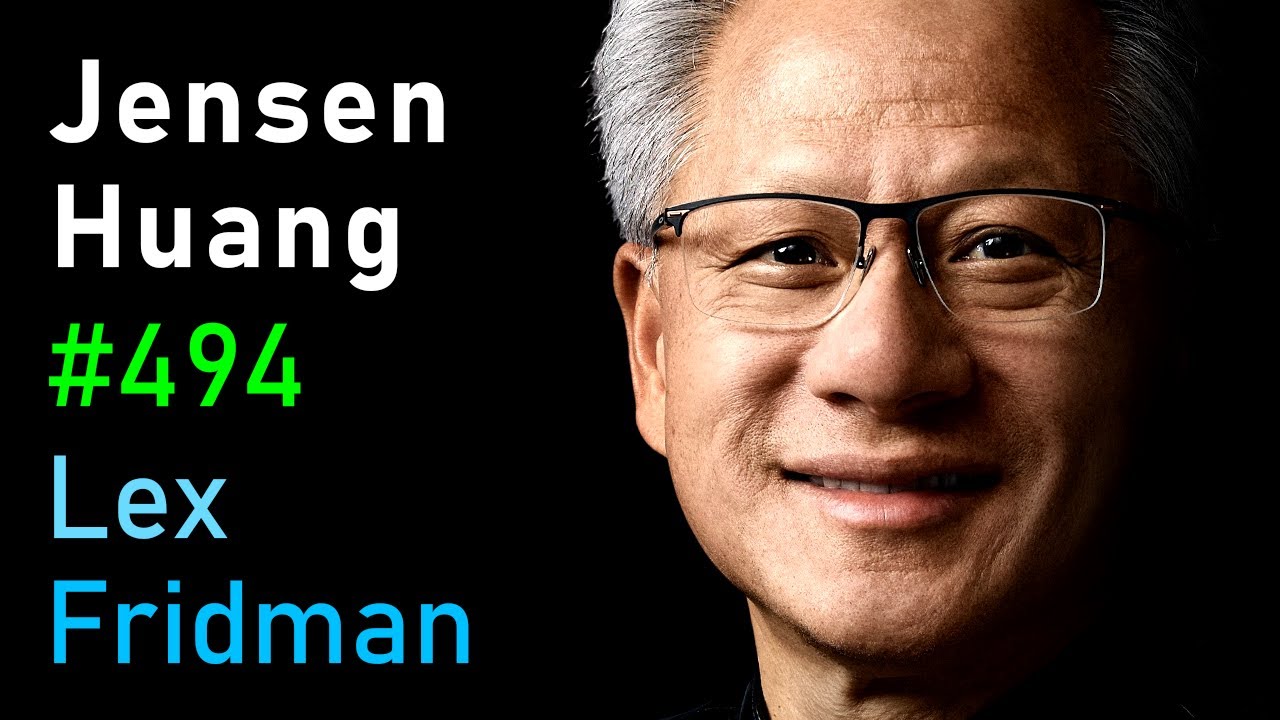
📺 Today’s recommended deep-dive video: https://www.youtube.com/watch?v=vif8NQcjVf0
Architecting the AI Factory: A Conversation with Jensen Huang
NVIDIA’s CEO explores the radical shift from designing individual chips to building rack-scale “AI factories” that function as a single unit of computation. He outlines the strategic evolution of CUDA, the four laws of scaling intelligence, and why the “iPhone of tokens” has finally arrived.
Core Question: How does NVIDIA manage the extreme co-design of physical and digital systems to keep pace with the exponential demand for global intelligence?
Highlights
- The transition from retrieval-based computing to generative token production.
- Four scaling laws: Pre-training, Post-training, Test-time (Thinking), and Agentic scaling.
- Why NVIDIA puts 60 direct reports in one room instead of holding one-on-one meetings.
- The “Speed of Light” philosophy: measuring engineering success against the laws of physics rather than competitors.
⏱️ Reading time: approx. 10 minutes · Saves you about 136 minutes vs. watching.
Want to take notes while watching? Click the image below and let AI Notebook capture the key points for you 👇

The Era of Extreme Co-Design
From Chips to Planetary Computing
NVIDIA has transitioned from designing individual chips to architecting entire data centers as single units of computation. This shift is a response to the reality that modern AI problems no longer fit inside a single computer, necessitating a radical refactoring of algorithms across thousands of interconnected nodes.
When problems exceed the capacity of a single GPU, you must shard data and algorithms across thousands of nodes to maintain performance. This requires optimizing every layer—from the physics of cooling and power delivery to the complex software stacks that manage networking and memory. If the networking isn’t perfectly co-designed with the silicon, Amdahl’s Law dictates that the entire system’s speedup will be bottlenecked by the slowest component. By controlling the entire stack, NVIDIA ensures that 10,000 computers act as one giant engine.
Jensen manages over 60 direct reports without single one-on-one meetings, preferring collective brainstorming sessions. This transparency ensures that experts in optics, memory, and software hear each other’s constraints simultaneously. By eliminating the hierarchy of secret information, the organization adapts as quickly as the environment demands. It is a flat, high-bandwidth communication structure designed for speed and technical truth.

💡 Digging Deeper
Q: Why was putting CUDA on GeForce an “existential” risk?
A: It increased the cost of consumer GPUs by 50% while gross margins were low, risking the company’s profit for a developer ecosystem that didn’t yet exist.
Q: How does Jensen manage 60 direct reports?
A: He avoids one-on-ones to prevent information silos, ensuring all 60 experts are present to solve problems together in real-time.
Q: What is the primary purpose of the “AI Factory”?
A: Unlike traditional data centers that store files (warehouses), AI factories generate valuable tokens (production lines) that directly drive revenue.
The Four Laws of Scaling
Intelligence as a Commodity
The industry initially feared that a lack of high-quality human data would stall AI progress, but synthetic data generation has effectively broken that ceiling. We are moving toward a future where the amount of data used for training is limited only by the compute power available to generate and process it.
Inference is “thinking,” and thinking is compute-intensive. While many predicted that inference chips would be small and commoditized, Jensen argues that reasoning, planning, and search require massive computational scale during “test-time.”
The final frontier is agentic scaling, where a single model spawns a team of sub-agents to conduct research, use tools, and solve multi-step problems. This “iPhone moment” for tokens allows AI to function as a digital worker rather than a simple chatbot. As these agents interact with the world, they produce a new cycle of high-quality data that feeds back into the pre-training loop, creating a perpetual motion machine of intelligence.

💡 Digging Deeper
Q: Is pre-training over?
A: No, but it is evolving; synthetic data now augments human data, allowing models to learn from ground-truth logic rather than just internet text.
Q: What is “test-time scaling”?
A: It is the process of giving a model more compute time to “think” or “search” for a better answer before responding.
Q: Why are agents compared to the iPhone?
A: Because agents (like OpenClaw) represent a shift from a tool you talk to, to a system that acts autonomously on your behalf.
Engineering at the Speed of Light
The Physics of Manufacturing
NVIDIA uses a mental model called “Speed of Light” to evaluate every engineering process against the theoretical limits of physics. Instead of asking how to improve a process by 10%, Jensen asks what is physically possible if all friction were removed, often revealing that a 70-day process could theoretically take six.
Building a Blackwell rack involves managing 1.3 million components and coordinate a supply chain of 200 partners to deliver 200 pods per week. This logistical feat is only possible because NVIDIA treats the supply chain as an extension of its own engineering team. Trust serves as the ultimate “intangible” technology, allowing multi-billion dollar deals with partners like TSMC to proceed without the friction of legal bureaucracy.
The power grid is currently designed for worst-case scenarios, leaving massive amounts of “idle power” available 99% of the time. Jensen advocates for “gracefully degrading” data centers that can throttle their workload during peak demand to utilize this excess energy. This would allow for rapid scaling of AI infrastructure without waiting years for new power plants to be built.
💡 Digging Deeper
Q: How does NVIDIA deal with supply chain bottlenecks like HBM memory?
A: By forecasting demand years in advance and convincing CEOs of DRAM companies to invest billions in new memory types before the market exists.
Q: What is the “Speed of Light” for a data center?
A: It is a system where every watt is converted into the maximum number of useful tokens with zero waste in cooling or networking overhead.
Q: Will we put compute in space?
A: NVIDIA is already at the edge in satellites, but Earth still offers “low-hanging fruit” like waste energy and grid optimization.
The Future of Work and Humanity
Coding as Specification
The definition of coding is shifting from writing lines of syntax to providing high-level specifications for AI agents to execute. Jensen predicts the number of programmers will grow from 30 million to 1 billion as every professional becomes an “architect” of their own AI-driven workflows.
Radiologists were famously predicted to be replaced by AI, yet the profession has grown because the “purpose” of a radiologist—diagnosing disease—remains human-centric. Tools simply allow them to process more scans and help more patients, shifting the bottleneck from human vision to human judgment. We should expect similar outcomes in software engineering, where the focus moves from “writing code” to “solving problems.”
Intelligence is becoming a commodity, but humanity—character, compassion, and grit—is not. Jensen views his own success as a product of these human traits rather than raw IQ, noting that he is often the least intelligent person in a room of his own specialists. By commoditizing intelligence, we allow the world to focus on the higher-order problems of ending disease and cleaning the environment.
Key Takeaways
NVIDIA has successfully navigated multiple existential threats by betting on a future that did not yet exist. From the early days of GeForce to the massive scale of the Blackwell architecture, the company’s strategy has remained consistent: build a flexible, programmable platform and cultivate an massive install base that developers can trust. By vertically integrating the entire hardware and software stack, they have created a moat built on execution velocity and ecosystem loyalty.
The arrival of agentic AI marks a fundamental turning point in human productivity. As tokens become cheaper and intelligence scales through the four laws, the computer transforms from a passive storage device into an active participant in the economy. This evolution requires a new way of thinking about engineering, where physical limits replace market benchmarks and “humanity” becomes the most valuable differentiator in a world of abundant intelligence.
Q&A
Q1: How does Jensen handle the immense pressure of leading a company that nations depend on?
A1: He decomposes complex problems into manageable steps and shares the burden by communicating anxieties immediately to the experts who can solve them.
Q2: Will AI replace software engineers?
A2: No, but it will change their task from “coding” to “specification.” The purpose of the job—solving problems—remains identical, but the tools are infinitely more powerful.
Q3: What is the “iPhone of tokens”?
A3: Agentic systems like OpenClaw, which allow AI to use tools, conduct research, and perform multi-step tasks autonomously.
Q4: Why does NVIDIA avoid traditional succession planning?
A4: Jensen believes in passing on knowledge and reasoning steps continuously to his entire team, ensuring the company’s culture is distributed rather than held by one person.
Q5: What is the significance of “synthetic data”?
A5: It allows AI to learn from ground-truth logic and simulations, effectively bypassing the limit of how much text humans have written on the internet.
Q6: How does NVIDIA view the competition?
A6: They focus on the “Speed of Light” (physical limits) rather than market share. If an engineering feat is physically possible, they treat its achievement as inevitable.
Q7: Is AGI already here?
A7: By some definitions, yes. If AGI is an agent capable of creating a viral web service or performing specialized tasks, those systems are starting to manifest today.