📺 Today’s recommended deep-dive video: https://www.youtube.com/watch?v=Hrbq66XqtCo
Electrons to Tokens: Jensen Huang on the Future of the AI Industrial Revolution
NVIDIA CEO Jensen Huang reveals the company’s internal mental model: a machine that transforms raw energy into valuable intelligence. By positioning the GPU as an “F1 racer” for a new era of accelerated computing, Huang explains why NVIDIA’s moat extends far beyond silicon into global energy policy and software ecosystems.
Core Question: How can NVIDIA sustain its dominance while navigating supply chain bottlenecks, specialized competition, and the geopolitical complexities of the Chinese market?
Highlights
- NVIDIA’s primary value proposition is the “electrons-to-tokens” transformation, turning energy into high-value digital intelligence.
- The company’s moat is built on a 360-degree ecosystem where upstream supply chain partners and downstream demand are synchronized through Jensen’s direct “educational” keynotes.
- AI agents will not commoditize software but will instead skyrocket the usage of existing tools as digital workers replace human bottlenecks.
- Conceding the Chinese market is a strategic error that risks creating a parallel, non-American tech stack optimized for the world’s second-largest economy.
⏱️ Reading time: approx. 12 minutes · Saves you about 91 minutes vs. watching.
Want to take notes while watching? Click the image below and let AI Notebook capture the key points for you 👇

The Mental Model of the Token Factory
Transforming Electrons into Intelligence
NVIDIA operates on a simple but profound mental model: the input is electrons and the output is tokens. While many view the company as a hardware manufacturer, Jensen Huang views NVIDIA as the orchestrator of an incredibly complex journey where energy is transformed into digital value. This transformation is an “artistry” involving engineering, science, and invention that remains far from being commoditized.
NVIDIA’s strategy is to do as much as necessary but as little as possible. By partnering with a massive ecosystem of computer companies, model makers, and application developers, NVIDIA ensures its architecture remains the universal standard. This allows them to focus internal resources on the “insanely hard” parts of the stack while letting the market handle the rest.
We are currently seeing the rise of a “five-layer cake” of AI where NVIDIA occupies every tier through its partners. This structure is designed to make the transformation of electrons to tokens as efficient as possible. As tokens become more valuable over time, the science behind making one token more valuable than another becomes the ultimate competitive frontier.

💡 Digging Deeper
Q: Why won’t software be commoditized by AI?
A: People expect AI to devalue software, but the opposite is likely. The number of AI agents will grow exponentially, and these agents will need tools like Excel, PowerPoint, or Synopsys. This creates a skyrocket in tool usage as digital workers replace human-limited bottlenecks.
Q: What does “doing as little as possible” mean for NVIDIA?
A: It means NVIDIA focuses only on the core architectural problems that no one else can solve. If a partner can build a rack, an ODM can assemble a system, or a cloud can host the service, NVIDIA lets them. This maximizes their reach without overextending their internal operations.
Q: How does Jensen view the value of a token?
A: He compares it to making one molecule more valuable than another. It is the result of immense engineering; the “tokens per watt” metric is the ultimate measurement of industrial efficiency in the new economy.
Prefetching the Global Supply Chain
The Trillion-Dollar Moat
NVIDIA’s true moat is not just the H100 or Blackwell chips, but the massive purchase commitments and upstream relationships they have secured. With commitments reaching toward $250 billion, Jensen spends a significant portion of his time “educating” the CEOs of suppliers like TSMC, SK Hynix, and Micron. He must inspire them to invest in capacity years before the demand is fully realized by the rest of the market.
This process involves a “full 360-degree” alignment at events like GTC. By bringing the upstream suppliers together with the downstream AI natives, Jensen ensures that every player in the chain sees the same future he does. This alignment allows the supply chain to “swarm” bottlenecks, such as the recent scaling of CoWoS (Chip on Wafer on Substrate) packaging.
While silicon capacity is a two-to-three-year problem that can be solved with capital, Jensen identifies downstream infrastructure as the more stubborn challenge. Energy policy and the availability of “plumbers and electricians” to build data centers are the real constraints. You cannot reindustrialize a nation or build AI factories without a fundamental expansion of the energy grid.

💡 Digging Deeper
Q: Is the bottleneck logic, memory, or packaging?
A: It shifts. For the last two years, it was CoWoS, but NVIDIA “swarmed” it by doubling capacity multiple times. Now, the bottleneck is moving downstream toward energy and physical data center construction.
Q: How does NVIDIA handle the “shortage” of GPUs?
A: It is not a matter of the highest bidder. NVIDIA operates on a “first-in, first-out” basis based on purchase orders and, crucially, data center readiness. If a customer’s facility isn’t ready to receive the chips, NVIDIA redirects the supply to maximize the industry’s total throughput.
Q: Why do suppliers like Micron invest so heavily in NVIDIA’s vision?
A: Because NVIDIA has the downstream demand to guarantee that the supplier’s investment will result in sold products. Jensen reasons through the industry’s growth with these CEOs, often predicting the exact scale of HBM and LPDDR memory needs years in advance.
Architectures and the Efficiency of General Programmability
The F1 Racer vs. The Cadillac
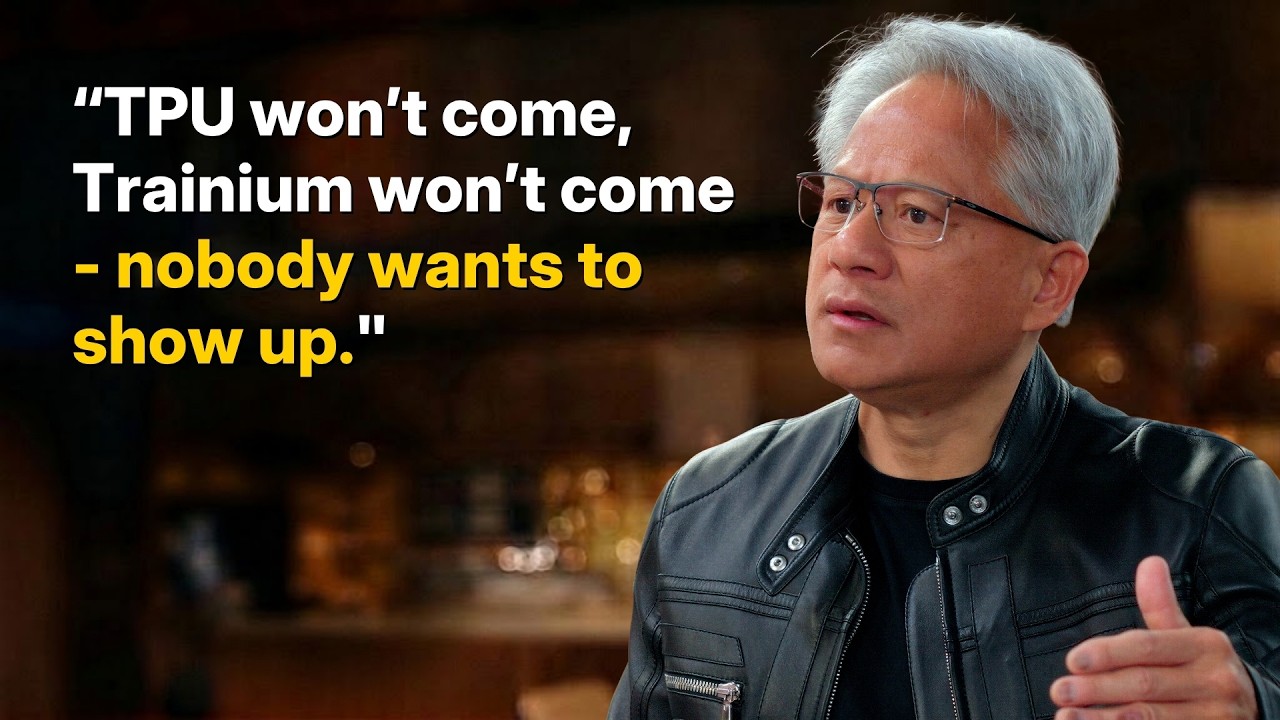
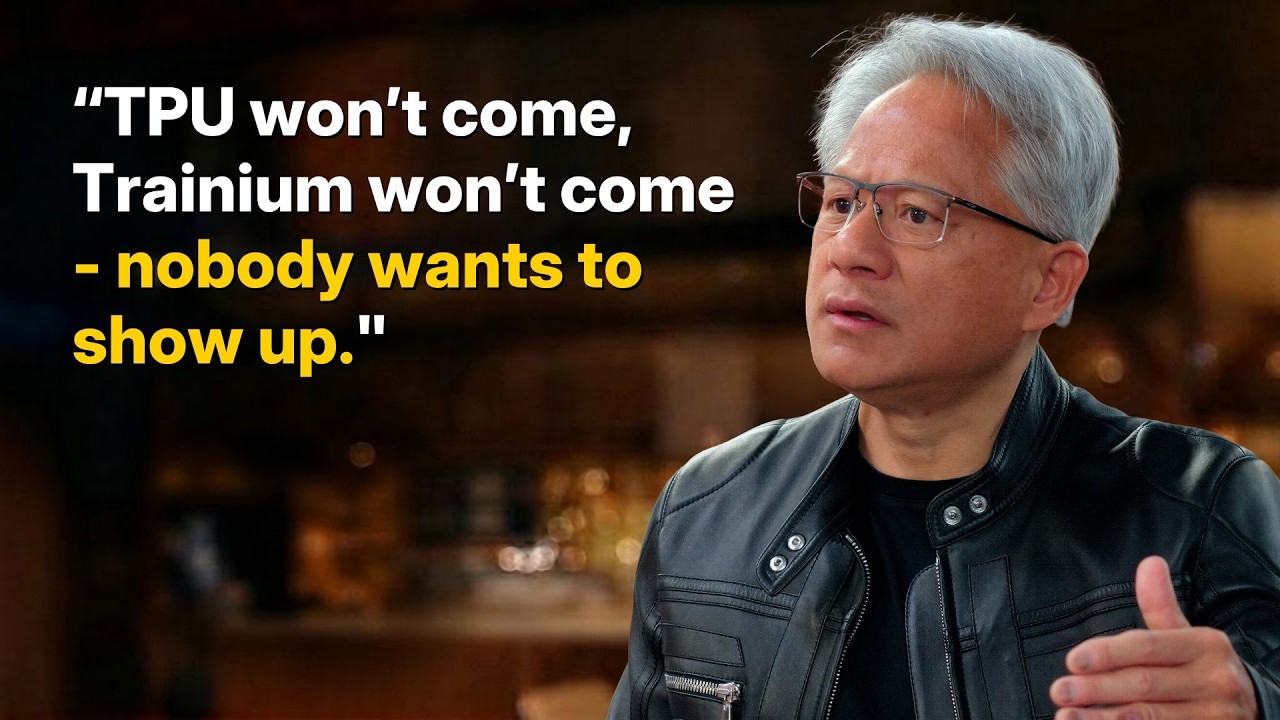
NVIDIA builds accelerated computing platforms, not just ASICs (Application-Specific Integrated Circuits) or TPUs. Jensen describes the CPU as a “Cadillac”—reliable and easy to drive—whereas the NVIDIA GPU is an “F1 racer.” It requires extreme expertise to push to the limit, but it delivers performance-to-TCO (Total Cost of Ownership) ratios that specialized chips cannot match.
The core advantage of CUDA is its flexibility. AI is constantly evolving with new mechanisms like Mixture of Experts (MoE), hybrid SSMs, and reinforcement learning. A specialized TPU is optimized for predictable matrix multiplies, but it struggles when the “algorithm of the year” changes. NVIDIA’s programmable architecture allows for 50x leaps in efficiency by changing the software kernels, not just waiting for Moore’s Law.
Furthermore, the “flywheel” of the NVIDIA ecosystem is the install base. There are hundreds of millions of CUDA-compatible GPUs across every cloud and edge device. For an AI startup, writing code for the most abundant architecture is the only logical choice. This ensures that even if a hyperscaler builds their own chip, the majority of the world’s developers will still prefer NVIDIA.

💡 Digging Deeper
Q: Why do some labs like Anthropic use TPUs if NVIDIA is better?
A: Early on, foundation labs needed massive investments that NVIDIA wasn’t in a position to provide. Google and AWS provided that capital in exchange for the labs using their internal compute. Jensen admits he didn’t initially realize that these labs couldn’t be funded by VCs alone.
Q: Is Moore’s Law dead?
A: In terms of raw transistor scaling, it is advancing only 25% per year. However, through “extreme co-design” of the architecture, networking, and software, NVIDIA achieved a 50x efficiency gain from Hopper to Blackwell.
Q: What is the significance of the “InferenceMAX” benchmark?
A: It is a challenge to the industry. Jensen claims that while competitors make big claims about cost, no one has been able to prove a better performance-TCO ratio than NVIDIA in public, transparent benchmarks.
Geopolitics and the American Tech Stack
The Danger of Conceding Markets
The debate over export controls to China is often framed in absolutes, but Jensen argues for a more nuanced approach. He warns that by forcing NVIDIA out of China, the U.S. is inadvertently accelerating the Chinese domestic chip industry. China is already the second-largest computing market and the largest contributor to open-source software; conceding this territory creates a massive opening for non-American standards.
Jensen disputes the “nuclear bomb” analogy for AI. While AI models can find software vulnerabilities, they are also the primary tool for patching them. The safest world is one where researchers are in a constant dialogue and the global AI ecosystem remains built on a transparent, American-led technology stack rather than a fragmented one.
If Chinese researchers are forced to optimize their models for domestic hardware like Huawei’s, those models will eventually diffuse to the “Global South.” This could lead to a future where the world’s AI standards are set by a non-American ecosystem. Jensen believes the U.S. must stay ahead by being the first and the best, rather than by trying to create a total vacuum of compute elsewhere.

💡 Digging Deeper
Q: Does China have a compute bottleneck?
A: They are bottlenecked on the most advanced chips, but they have an abundance of energy. Because AI is a parallel problem, China can gang together older 7nm chips to achieve massive throughput. Energy abundance is a massive advantage that offsets their lithography disadvantage.
Q: Is 7nm “good enough” for modern AI?
A: Today’s most powerful models were largely trained on the Hopper generation, which is comparable to what 7nm can achieve. Great computer science and better algorithms can provide a 10x lever, which is much more impactful than the difference between process nodes.
Q: Why should we sell chips to an adversary?
A: To maintain the “stickiness” of the American ecosystem. If 50% of the world’s researchers use CUDA, the U.S. retains technological leadership. If they are forced to switch, the U.S. loses its influence over the world’s most important software layer.
Key Takeaways
NVIDIA has transcended the role of a chip vendor to become the foundational layer of a new industrial revolution. By defining their mission as the transformation of “electrons to tokens,” they have created a vertically integrated stack that leverages both silicon and software. Their dominance is maintained not just through Moore’s Law, but through a massive ecosystem that prioritizes TCO and programmability over fixed-function specialization.
The primary challenges moving forward are physical and geopolitical rather than purely technical. The availability of energy and the ability to build massive data center infrastructures will determine the speed of AI deployment more than transistor density. Simultaneously, the U.S. must balance national security with the need to maintain global leadership in the AI stack, avoiding a fragmentation that could empower non-American standards in the Global South.
Ultimately, Jensen Huang sees a world where AI agents become the primary users of software, driving an exponential increase in tool usage. This shift from human-limited work to agent-driven productivity represents the true “scaling law” of the future economy. NVIDIA’s strategy is to remain the indispensable engine of this transition, providing the most efficient “tokens per watt” on the planet.
Q&A
Q1: Is NVIDIA becoming a cloud provider to compete with its customers?
A1: No. NVIDIA’s philosophy is “do as much as needed, as little as possible.” They help “neoclouds” like CoreWeave and Crusoe exist to ensure the ecosystem thrives, but they have no desire to be in the financing or hosting business themselves.
Q2: Why is NVIDIA investing in OpenAI and Anthropic now?
A2: Jensen admits it was a mistake not to realize earlier that these labs required multi-billion dollar capital commitments that VCs couldn’t provide. Now that NVIDIA has the resources, they are investing to ensure these critical “layers” of the AI cake continue to scale.
Q3: How does NVIDIA handle the threat of custom ASICs from hyperscalers?
A3: NVIDIA focuses on performance-per-TCO. While a hyperscaler can build a chip, they cannot easily build the 20-year ecosystem of CUDA-X libraries or the massive install base that makes NVIDIA the first choice for every developer.
Q4: What is the most significant bottleneck for AI growth?
A4: Energy. Jensen argues that you cannot reindustrialize or build AI factories without a massive expansion of energy capacity. While chip shortages are a 2-3 year problem, energy infrastructure is a long-term policy challenge.
Q5: Will AI kill software engineering jobs?
A5: Jensen dismisses this as “doomerism.” He notes that the same was said about radiologists 10 years ago, yet we now have a shortage of radiologists. AI changes tasks, not jobs; it will make software engineers more productive, leading to more code being written.
Q6: Why does Jensen emphasize “education” in his keynotes?
A6: He needs the entire supply chain—from TSMC to power companies—to understand the scale of what is coming. By educating them on the “why” and “when,” he inspires them to make the massive capital investments necessary to support NVIDIA’s growth.
Q7: What would NVIDIA be doing if the deep learning revolution hadn’t happened?
A7: They would still be pursuing accelerated computing for physics, molecular dynamics, and computer graphics. However, Jensen admits he would be “very sad” because deep learning has democratized science by making powerful computation accessible to every student with a GPU.