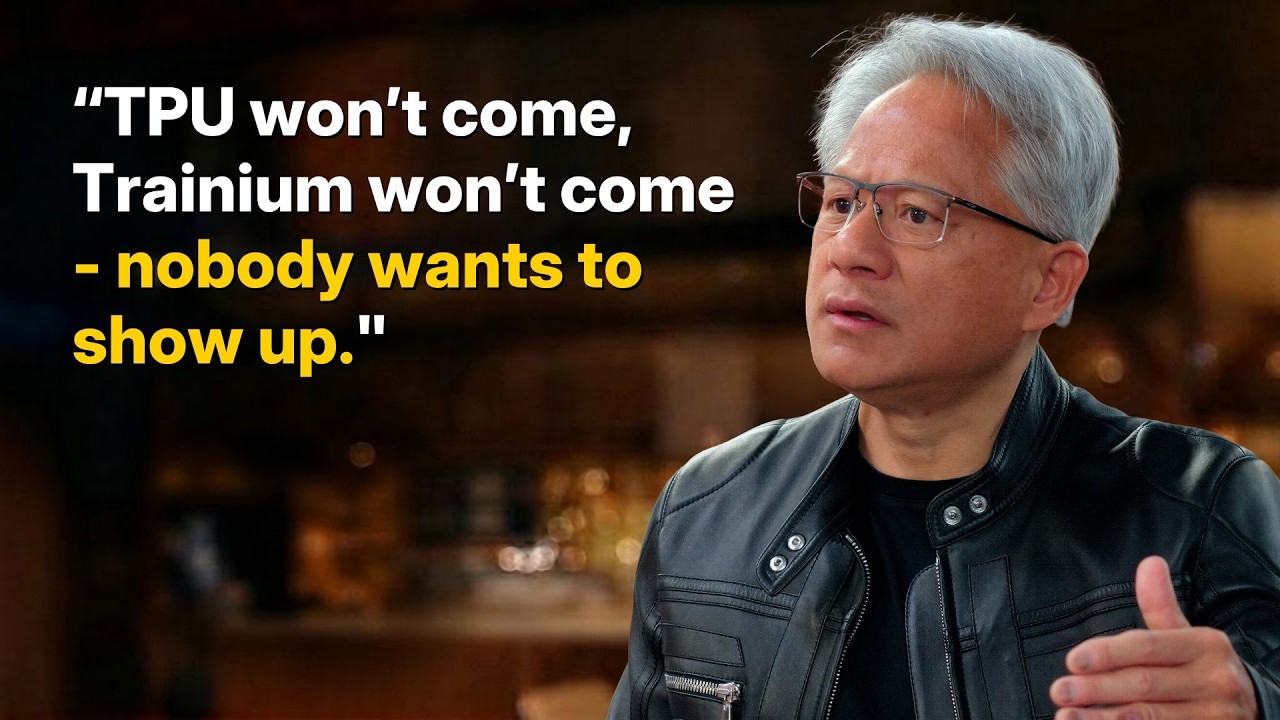
📺 Today’s recommended deep-dive video: https://www.youtube.com/watch?v=Hrbq66XqtCo
From Electrons to Intelligence: Jensen Huang on the Nvidia Flywheel
Nvidia CEO Jensen Huang outlines a future where electricity is the raw material and digital tokens are the finished product of a new industrial revolution. He argues that Nvidia’s dominance isn’t just about silicon, but a deep-rooted ecosystem that spans from energy policy to high-level software libraries.
Core Question: Can Nvidia maintain its staggering growth and high margins as hyperscalers build their own chips and geopolitical tensions threaten global markets?
Highlights
- The “Five-Layer Cake” model defines Nvidia’s strategy to enable the entire industry while doing “as little as possible” themselves.
- Why general-purpose “accelerated computing” provides a superior total cost of ownership (TCO) compared to specialized ASICs like TPUs.
- A massive supply chain moat built on $100B+ purchase commitments and a unique, trust-based relationship with TSMC.
- The controversial case for China: Why Jensen believes conceding the Chinese market poses a long-term risk to American technology leadership.
⏱️ Reading time: approx. 8 minutes · Saves you about 95 minutes vs. watching.
Want to take notes while watching? Click the image below and let AI Notebook capture the key points for you 👇

The Alchemy of Tokens
Transforming Electrons into Value
Nvidia’s core mission is the transformation of electrons into tokens, a process Jensen describes as “insanely hard” to commoditize. This isn’t just a manufacturing step; it is a journey involving immense artistry, engineering, and science.
The company views its role within a “five-layer cake” of AI: energy, chip manufacturing, system architecture, models, and applications. By focusing on the hardest parts of this stack—the foundational hardware and the CUDA software layer—Nvidia allows a massive ecosystem of partners to build the rest. This philosophy of doing “as little as possible” ensures they don’t compete with their own customers, yet remain the indispensable foundation for everyone from garage startups to national governments.
Software companies are often seen as tool makers, but Jensen predicts a skyrocket in tool usage. As AI agents begin to outnumber human engineers, the demand for instances of software like Excel or Cadence design tools will grow exponentially, fueled by the sheer volume of “agentic” workers.

💡 Digging Deeper
Q: Why does Jensen say Nvidia does “as little as possible”?
A: To avoid unnecessary friction with partners; if a task can be handled by the ecosystem (like cloud hosting or specific app dev), Nvidia lets them do it to focus on the “insanely hard” architectural problems.
Q: What is a “token” in this context?
A: It is the fundamental unit of AI output—a word, a pixel, or a piece of code—that represents the processed intelligence derived from raw electrical input.
Q: How will AI affect software tool makers?
A: It will increase the “user base” by orders of magnitude as AI agents, rather than just humans, become the primary operators of professional software.
The Supply Chain and the “Plumber” Problem
Managing the Trillion-Dollar Flow
Nvidia’s moat is often described as its software, but its physical supply chain is equally formidable. With purchase commitments reaching toward $250 billion, Jensen has effectively locked up the world’s supply of high-bandwidth memory (HBM) and advanced packaging for years.
This scale allows Nvidia to “prefetch” bottlenecks. While the world was worried about CoWoS packaging capacity, Nvidia had already “swarmed” the problem years prior, working with TSMC to scale it from a specialty technology to a mainstream manufacturing staple. Jensen spends a significant portion of his time educating the entire supply chain—from CEOs of memory companies to the “plumbers and electricians” of data centers—about the scale of the coming demand.
The real bottleneck for the next decade isn’t just silicon; it’s energy. You cannot reindustrialize the United States or build “AI factories” without a massive increase in power capacity.

💡 Digging Deeper
Q: Is Nvidia worried about running out of EUV machines?
A: No; Jensen argues that once you can build one, you can build a million, provided there is a clear demand signal and 2-3 years of lead time.
Q: Why do suppliers choose to invest for Nvidia specifically?
A: Because Nvidia’s downstream demand is so massive and consistent that it de-risks the multi-billion dollar investments suppliers must make.
Q: What is the most difficult bottleneck to solve?
A: Physical infrastructure—specifically energy policy and the “plumbers and electricians” needed to build the physical data centers.
The Architecture War: CUDA vs. The World
Why General Programmability Wins
Hyperscalers like Google and Amazon are building their own AI chips (TPUs and Trainium), but Jensen remains unfazed. He argues that while a TPU is a “systolic array” optimized for simple matrix multiplication, AI is moving toward more complex, branching, and irregular architectures.
Nvidia’s strength lies in “accelerated computing,” which is far more flexible than a simple AI accelerator. It handles the entire lifecycle of data processing, from structured data frames to the latest hybrid State Space Models (SSMs). This flexibility is what allows for a 50x leap in efficiency from one generation to the next—a leap that Moore’s Law alone could never provide.
Furthermore, the “install base” of CUDA is a treasure that cannot be easily replicated. Developers want their code to run everywhere: in the cloud, on-prem, and inside a robot. Because Nvidia is the only architecture that spans every cloud and every edge device, it becomes the default “safe” choice for any developer looking to maximize their reach.

💡 Digging Deeper
Q: Why do hyperscalers still use Nvidia if they have their own chips?
A: Nvidia offers better “performance per TCO” (Total Cost of Ownership) and a much larger ecosystem of external customers who demand Nvidia-compatible instances.
Q: How does Nvidia achieve a 50x performance jump?
A: Through “extreme co-design”—simultaneously changing the processor, the interconnect (NVLink), the libraries, and the algorithms.
Q: Is CUDA still a moat if OpenAI uses Triton?
A: Yes; Jensen notes that Nvidia contributes heavily to Triton’s backend and that the underlying stability of the Nvidia hardware stack is what developers ultimately rely on.
The Geopolitical Chessboard
The China Dilemma
The conversation shifts to the high-stakes world of export controls and Chinese competition. Jensen pushes back against the “loser mindset” of conceding the Chinese market, which currently accounts for a massive portion of global technology demand.
He argues that 50% of the world’s AI researchers are in China, and many of the world’s best open-source models are being built there. If these researchers are forced off the American tech stack, they will spend their immense talent optimizing for domestic Chinese architectures (like Huawei’s). This could lead to a future where the global standard for AI is no longer American.
Jensen acknowledges the need for the US to stay ahead—Vera Rubin and Blackwell chips are prioritized for US labs—but he warns that over-regulating “marginal compute” could inadvertently accelerate the birth of a formidable, independent Chinese silicon ecosystem.

💡 Digging Deeper
Q: Doesn’t shipping chips to China help them build cyber-weapons?
A: Jensen argues that China already has “mountains of compute” and that the real solution is dialogue between researchers, not just cutting off hardware.
Q: Is China really limited to 7nm chips?
A: While they lack EUV, Jensen points out they have an abundance of energy and can “gang together” older chips to achieve high performance, making architecture more important than raw transistor size.
Q: What is the risk of losing the Chinese market?
A: It’s a “disservice to national security” because it reduces the reach of American technology standards and stops American companies from benefiting from Chinese developer contributions.
Key Takeaways
The shift from general-purpose computing to accelerated computing is not a temporary trend but a fundamental change in the physics of the industry. As Moore’s Law slows, the only way to continue the “10x per year” improvement in AI is through the tight integration of hardware, software, and networking. Nvidia has positioned itself as the only company capable of “extreme co-design” at a global scale, making its architecture the de facto laboratory for the next decade of AI discovery.
Nvidia’s success is rooted in its ability to maintain a “flywheel” effect: it has the largest install base, which attracts the most developers, who build the richest ecosystem, which in turn drives more demand for the hardware. This cycle is supported by a “dependable” business model where prices are consistent, supply is forecast years in advance, and the company actively invests in its most promising customers rather than trying to compete with them.
Finally, the geopolitical landscape remains the biggest wildcard. While Nvidia is racing to keep the US at the frontier, Jensen warns against a simplistic “zero-sum” view of global markets. Maintaining American leadership requires not just building the best chips, but ensuring that the entire world—including adversaries—remains tethered to the American technology ecosystem.
Q&A
Q1: Why doesn’t Nvidia become its own cloud provider to capture more margin?
A: Jensen adheres to the philosophy of doing “as little as possible” to let the ecosystem thrive. Since many clouds already exist, Nvidia prefers to support them (and “neoclouds” like CoreWeave) rather than compete with them.
Q2: Is Moore’s Law actually dead?
A: In terms of raw transistor scaling, it has slowed to about 25% per year. However, through architectural innovation and “extreme co-design,” Nvidia is delivering 30x to 50x improvements, effectively keeping the spirit of the law alive through different means.
Q3: Why did Nvidia invest in OpenAI and Anthropic?
A: Jensen admitted he initially underestimated the scale of capital these labs would need. He realized VCs couldn’t provide the $10B+ required for their compute needs, so Nvidia stepped in to ensure these essential “frontier” companies could scale.
Q4: Can China catch up using older 7nm technology?
A: Jensen suggests they can. By utilizing their “abundance of energy” and smart computer science, they can compensate for less advanced transistors by “ganging together” massive arrays of older chips.
Q5: What happened to the “GPU shortage”?
A: Nvidia “swarmed” the bottlenecks like CoWoS packaging and HBM memory several years ago. While demand remains high, the industry has now moved past the “instantaneous crisis” phase as suppliers have aligned with Nvidia’s long-term forecasts.
Q6: Why is CUDA so hard for competitors to displace?
A: It isn’t just code; it’s an “install base” of hundreds of millions of GPUs. Developers write for CUDA because they know their software will run on everything from a gaming laptop to a massive supercomputer across every major cloud.
Q7: What would Nvidia be doing if the AI revolution hadn’t happened?
A: They would still be pursuing accelerated computing for physics, molecular dynamics, and graphics. Jensen notes that even without AI, the world would eventually have to move away from general-purpose CPUs to sustain performance gains.