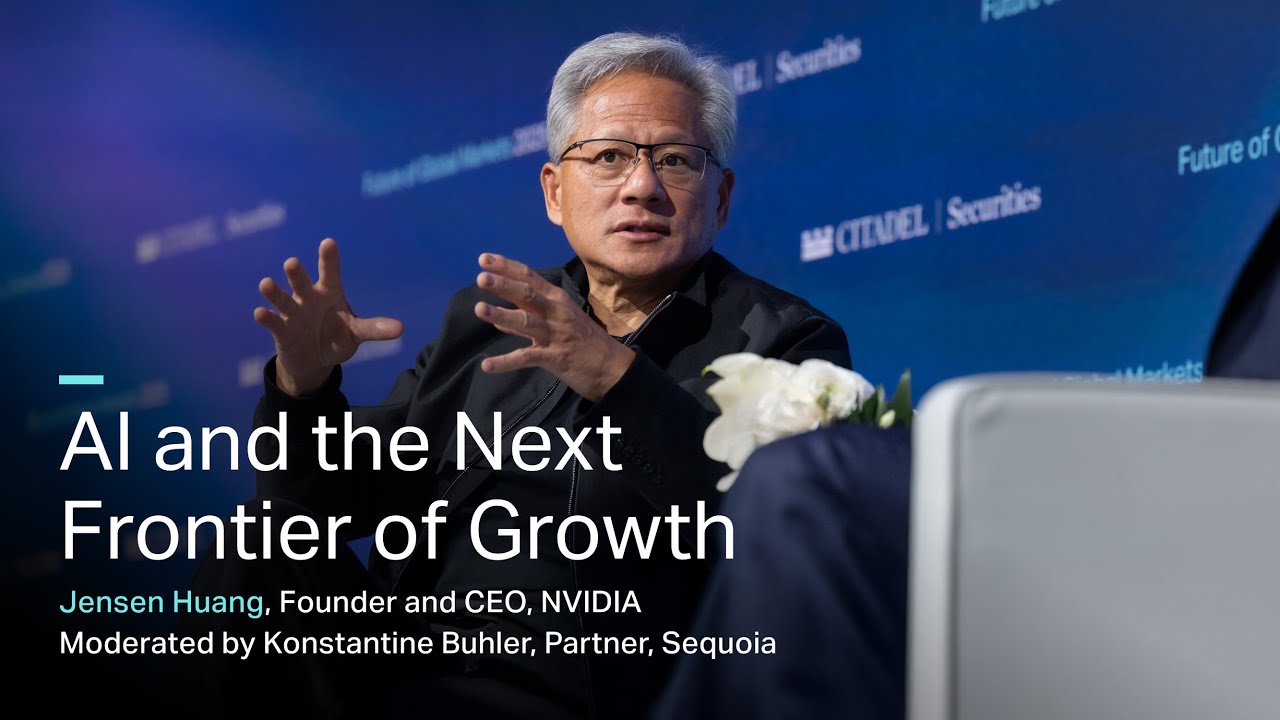
📺 Today’s recommended deep-dive video: https://www.youtube.com/watch?v=m1wfJOqDUv4
Beyond the Chip: Jensen Huang on the Generative Revolution and the Rise of AI Factories
In a wide-ranging conversation with Sequoia Capital’s Constantine Buer, NVIDIA CEO Jensen Huang discusses the fundamental transition from specific graphics accelerators to the foundational infrastructure of the modern world. He argues that we are shifting from a retrieval-based computing model to one where every pixel and piece of logic is generated in real-time by “AI Factories.”
Core Question: How did a company built for video games become the architect of the multi-trillion-dollar generative economy?
Highlights
- The shift from general-purpose CPUs to domain-specific accelerated computing as the solution to the end of Moore’s Law.
- The evolution of the “AI Factory” as a complete, rack-scale infrastructure integrated via software.
- The transition from retrieval-based search to 100% generative, real-time “thinking” computers.
- The emergence of “Physical AI” and the role of digital agents in the future workforce.
⏱️ Reading time: approx. 8 minutes · Saves you about 53 minutes vs. watching.
Want to take notes while watching? Click the image below and let AI Notebook capture the key points for you 👇

The First Principles of Accelerated Computing
Breaking the General-Purpose Paradigm
Jensen Huang founded NVIDIA in 1993 based on a single, contrarian observation: general-purpose CPUs would eventually hit a wall.
While the rest of Silicon Valley remained fixated on Moore’s Law and the miniaturization of transistors, Huang realized that specific, mathematically intense problems—starting with 3D graphics—required a new architectural approach. This led to the development of accelerated computing, a strategy designed to complement the CPU by offloading complex, parallel tasks to a dedicated processor.
This wasn’t just about building better hardware; it required inventing a market where none existed. By betting on the gaming industry, NVIDIA found the high-volume application necessary to fund the development of what would eventually become a universal platform for scientific research and artificial intelligence.

💡 Digging Deeper
Q: Why was the “Chicken and Egg” problem so difficult for NVIDIA?
A: To create a new platform, you need a market, but to have a market, you need the technology. NVIDIA had to invent both the 3D graphics hardware and the gaming ecosystem simultaneously to survive.
Q: What is the fundamental math behind this shift?
A: It is rooted in linear algebra and physical simulation. By mastering the simulation of reality for games, NVIDIA inadvertently built the perfect engine for the neural networks that define modern AI.
From Chips to AI Factories
The Rack as the Unit of Computation
The DGX-1, delivered personally to OpenAI in 2016, marked the birth of the modern AI factory.
Huang emphasizes that NVIDIA no longer just sells components; they design entire data centers from a blank sheet of paper. This full-stack integration—encompassing networking, CPUs, GPUs, and the CUDA software layer—allows them to break through the limitations of traditional hardware scaling and deliver 10x performance leaps annually.
Modern AI infrastructure is less like a traditional data center and more like a manufacturing plant designed to produce intelligence. By treating the entire rack as the unit of computation, NVIDIA enables hyperscalers to process recommendation algorithms and generative models at a scale that produces immediate ROI. Huang cites Meta’s recovery after Apple’s privacy changes as the ultimate proof of AI’s economic value.

💡 Digging Deeper
Q: Why does Huang call these “factories” instead of data centers?
A: Data centers traditionally store and retrieve data; factories produce something. AI factories consume electricity and data to produce “tokens” of intelligence that generate revenue.
Q: How does NVIDIA maintain its lead against competitors?
A: It is the “compatibility of software.” Because NVIDIA controls the entire stack, they can iterate on hardware every year while ensuring all existing software continues to run perfectly, providing unmatched speed to market.
The Generative Future and Physical AI
Moving Toward 100% Generated Experiences
We are rapidly approaching a paradigm shift where digital experiences are generated in real-time rather than retrieved from a storage drive.
In the past, computing was based on retrieval—clicking a link to open a pre-written file. In the generative future, as seen with platforms like Perplexity or Sora, the computer “thinks” and creates the content on the fly based on user context. This shift requires a massive increase in continuous processing power because the computer is always active, never just idling between retrievals.
Beyond the screen, Huang predicts that “Physical AI” is the next frontier. This involves intelligence embodied in robots and autonomous vehicles that can manipulate the physical world. This requires a “three-computer” architecture: one to train the AI, one to simulate a virtual world (Omniverse) for the AI to practice in, and one onboard the robot to execute functions in reality.

💡 Digging Deeper
Q: What is “Agentic AI”?
A: These are digital workers—AI nurses, lawyers, or engineers—that don’t just answer questions but perform complex workflows. Huang suggests companies will soon “hire” and “onboard” these digital agents just like biological employees.
Q: What role does the “Omniverse” play in this?
A: It is a digital twin of the world that obeys the laws of physics. It allows an AI to play a “video game” of its task billions of times until it is safe enough to perform that task in the real world.
Sovereign AI and Global Policy
The Rise of National Intelligence
Sovereign AI represents the urgent desire of nations to produce their own intelligence using their own national data.
Huang argues that no country can afford to outsource its intelligence production. While global trade remains necessary, the ability to build local models based on specific cultural and linguistic data is becoming a matter of national security and economic independence. From the UK to Japan, nations are now investing in their own domestic AI factories.
Regarding China, Huang advocates for a nuanced approach. He warns that a total lack of engagement could lead to the loss of a major market and, more importantly, a loss of influence over the global developer community. He believes the goal should be to keep the world building on American technology stacks while maintaining a lead in performance.
Key Takeaways
The transition NVIDIA has undergone reflects a broader shift in the global economy. We have moved from a world where computers were tools for calculation and storage to a world where they are engines of cognition. This “Generative Revolution” means that the infrastructure built today must be capable of constant “thinking” and real-time creation, which fundamentally changes how we value hardware and energy.
NVIDIA’s success is not merely the result of having the fastest chips; it is the result of a thirty-year commitment to a full-stack vision. By controlling everything from the silicon to the specialized software libraries like cuDNN, NVIDIA has created a flywheel effect. This ecosystem makes it nearly impossible for competitors to catch up, as the entire global community of AI researchers is already fluent in the NVIDIA language.
Q&A
Q1: What is the most undervalued part of NVIDIA’s platform?
A: The specialized libraries like cuDNN. While everyone talks about CUDA, there are over 350 specific libraries that act as a “treasure chest” for developers in fields ranging from litography to quantum computing.
Q2: How should a CIO spend $10 billion on AI today?
A: Invest immediately in “onboarding” digital agents. IT departments must evolve into the “HR for Digital Employees,” learning how to fine-tune and integrate AI agents into the company’s proprietary culture and data.
Q3: What is the future of AI safety?
A: It will mirror cibersecurity. We shouldn’t expect one AI to be perfectly safe on its own; instead, we will surround every functional AI with thousands of “guardrail” AIs that monitor and protect the system.
Q4: Will Moore’s Law continue to matter?
A: In its traditional sense, it is slowing down. However, by co-designing hardware and software, NVIDIA is achieving performance gains that far exceed what transistor scaling alone could provide.
Q5: What is “Physical AI”?
A: It is AI that is embodied in a physical form, such as a robot or a car. If an AI can generate a video of a person opening a bottle, it has shown it understands the physics of that action; the next step is simply engineering that intelligence into a robotic arm.
Q6: Why is the ROI of AI already proven?
A: Look at the hyperscalers. Companies like Meta and Google have seen billions in revenue growth by switching from classical machine learning to deep learning for their recommendation engines and ad targeting.
Q7: What was the point of the “Fried Chicken” comment?
A: Jensen used it as a metaphor for simplicity and focus—sometimes the answer to a complex problem is as straightforward as a well-executed, fundamental solution.