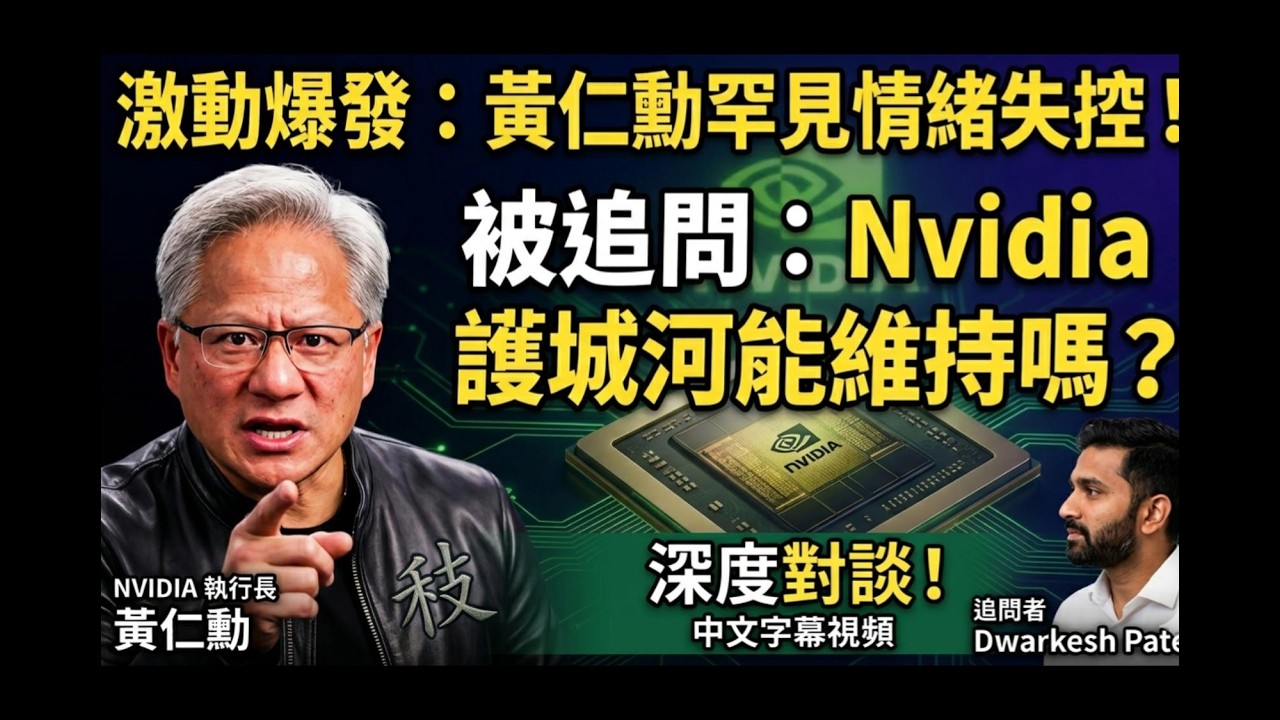
📺 Today’s recommended deep-dive video: https://www.youtube.com/watch?v=PJe-S5ScpFM
The Intelligence Foundry: Jensen Huang on the Physics of the AI Economy
NVIDIA CEO Jensen Huang breaks down why AI is not a commodity, how he manages a multi-billion dollar supply chain through “inspiration,” and why he believes the U.S. shouldn’t concede the Chinese market. He reframes the company’s mission as a fundamental transformation of energy into value.
Core Question: How does NVIDIA maintain a high-margin monopoly in a world of specialized ASICs and tightening geopolitical constraints?
Highlights
- NVIDIA’s core business is the transformation of “electrons into tokens,” a process Huang argues is resistant to commoditization.
- The company manages supply chain bottlenecks by providing “demand signals” that encourage partners to invest in capacity years in advance.
- Huang prioritizes “as little as possible” internal development, preferring to nurture a massive ecosystem of partners across a five-layer AI “cake.”
- Total Cost of Ownership (TCO) and “performance per watt” are cited as the primary reasons why NVIDIA beats specialized competitors like Google’s TPU.
⏱️ Reading time: approx. 8 minutes · Saves you about 90 minutes vs. watching.
Want to take notes while watching? Click the image below and let AI Notebook capture the key points for you 👇

The Transformation of Electrons to Tokens
The Intelligence Factory
NVIDIA is not a chip company in the traditional sense; it is a transformer that turns raw electricity into intelligent tokens.
Jensen Huang argues that this transformation is an incredible journey of engineering and science that cannot be easily commoditized. Just as one molecule can be more valuable than another due to its arrangement, making a token more valuable through “artistry and invention” is the core value proposition of the company.
The manufacturing and the science behind this process are far from being deeply understood or finished. Huang views the company as a factory where the input is electrons and the output is tokens, and his job is to enable that transformation at incredible scales while doing “as little as possible” of the peripheral work that partners can handle.
The Five-Layer Cake
AI is described as a five-layer cake consisting of energy, chips, software, models, and applications.
Huang’s philosophy is to focus only on the “insanely hard” parts while partnering with an ecosystem of supply chain providers, computer companies, and application developers. By doing only what is absolutely necessary, NVIDIA keeps its business model lean while ensuring its architecture remains the foundation for the other layers.

💡 Digging Deeper
Q: Will software commoditize NVIDIA?
A: No, because the transformation of energy into valuable intelligence requires constant invention that goes beyond simple logic manufacturing.
Q: Why does NVIDIA partner so much?
A: To focus on the hardest engineering challenges while letting the ecosystem scale the broader infrastructure.
Q: Are software companies in trouble?
A: On the contrary, Huang believes the number of AI agents using software tools will grow exponentially, skyrocketing the value of companies like Synopsys and Microsoft.
Scaling the Unscalable Supply Chain
Managing the Multi-Billion Dollar Moat
NVIDIA has secured purchase commitments worth hundreds of billions of dollars to lock up logic dies, memory, and packaging.
This massive capital outlay acts as a moat, but Huang explains that the real secret is the “implicit” commitment from the supply chain. He spends his time “informing, inspiring, and aligning” with the CEOs of companies like TSMC and ASML, convincing them that the AI industry’s scale is real so they are willing to invest in their own capacity.
Suppliers are willing to make these bets for NVIDIA because they see the massive downstream demand. By bringing the “entire universe of AI” together at events like GTC, Huang allows his upstream suppliers to see the downstream startups and “AI natives” who will eventually consume their production.
Solving the “Plumber” Problem
While the world worries about EUV machines and CoWoS packaging, Huang views these as temporary two-to-three-year engineering hurdles.
The real bottlenecks, in his view, are “plumbers and electricians”—the physical infrastructure and energy policies required to build data centers. You can manufacture more chips in a few years with a clear demand signal, but you cannot build an entirely new manufacturing industry without a stable, long-term energy strategy.
NVIDIA actively “pre-fetches” bottlenecks by investing in silicon photonics and double-sided probing technology years before they become mainstream. They even license patents back to the supply chain to keep the ecosystem open and ready to support NVIDIA’s rapid velocity of one major architecture release per year.

💡 Digging Deeper
Q: Is the AI compute growth rate slowing due to upstream limits?
A: No, because any bottleneck like CoWoS can be “swarmed” and solved within two to three years if the demand signal is strong enough.
Q: How does NVIDIA handle the energy crisis?
A: By focusing on “performance per watt” so that a limited 1-gigawatt data center produces the maximum possible number of tokens and revenue.
Q: Does Huang talk directly to ASML?
A: He influences them both directly and indirectly; if TSMC is convinced of the demand, ASML will inevitably follow suit.
Why General Purpose Beats the ASIC
The Myth of TPU Superiority
Competitors like Google’s TPU or custom ASICs are often cited as more efficient for matrix multiplication, but Huang dismisses this as narrow thinking.
Accelerated computing is much broader than just AI; it encompasses molecular dynamics, fluid physics, and data processing. Because NVIDIA’s GPUs are programmable and flexible, they allow researchers to invent new algorithms like Mixture of Experts (MoE) or new attention mechanisms that fixed ASICs struggle to support.
The “installed base” is NVIDIA’s greatest treasure. A developer writing code for an NVIDIA GPU knows it will run on millions of devices across every cloud and on-premise data center. This ubiquity creates a flywheel where the best software is built for NVIDIA first, which in turn makes the hardware even more valuable.
Performance per TCO
NVIDIA’s margins are high because their Total Cost of Ownership (TCO) is the best in the world.
Huang challenges competitors to show their “Inference Max” benchmarks, arguing that no other platform can deliver tokens at a lower cost when power and infrastructure are factored in. Even if a custom chip is 30% cheaper to make, the 70% margin NVIDIA commands is justified by the massive software optimization and ecosystem support they provide to partners.
The company assigns an “insane” number of engineers to help AI labs like OpenAI and Anthropic optimize their stacks. This “extreme co-design” can often squeeze an extra 2x or 3x performance out of the existing hardware, which directly translates to doubled revenue for the customer.
💡 Digging Deeper
Q: Why use a GPU if a TPU is “perfect” for matrix multiplies?
A: Because AI is more than matrix multiplies; it requires flexible memory access and the ability to run evolving algorithms that aren’t yet hard-coded into silicon.
Q: Is NVIDIA worried about “Neo-clouds” like CoreWeave?
A: No, NVIDIA helped them exist to ensure there were alternative “off-takers” for their chips beyond the big five hyperscalers.
Q: Why not build an NVIDIA cloud?
A: NVIDIA follows the philosophy of “doing as little as possible” and would rather support a thriving ecosystem of clouds than compete with them.
Geopolitics and the Logic of Competition
The China Debate
The U.S. export controls on China are a point of contention, but Huang warns against a “loser mindset” that concedes the second-largest market in the world.
He argues that 50% of the world’s AI researchers are Chinese and that they are already contributing significantly to the open-source ecosystem. If American companies are forced to leave China, it simply accelerates the development of a domestic Chinese tech stack that will eventually compete with American standards globally.
Huang points out that AI is not a “nuclear bomb” and that the best way to ensure safety is through dialogue and research collaboration. He believes the U.S. must stay ahead by innovating faster—launching architectures like Vera Rubin and Feynman—rather than relying solely on withholding older technology.
The Energy Advantage
China has an abundance of energy and “ghost data centers” that can compensate for less efficient, older chips.
Even if China is stuck at 7-nanometer processes, they can “gang together” more chips to achieve high compute levels because their energy costs are so low. In contrast, the U.S. is energy-scarce, making NVIDIA’s high-efficiency Blackwell architecture even more vital for domestic leadership.

💡 Digging Deeper
Q: Should we worry about AI “zero-day” exploits from China?
A: The best defense is a vibrant open-source ecosystem where thousands of AI agents monitor and protect the primary agents.
Q: Is China stuck at 7nm?
A: Architecture and networking matter more than just the transistor node; Huawei and others are finding ways to innovate around lithography limits.
Q: Why not concede the Chinese market for national security?
A: Because conceding the market allows a foreign tech stack to become the global standard in the “Global South,” harming long-term American leadership.
Key Takeaways
NVIDIA’s dominance is built on a foundation of “Accelerated Computing” that far exceeds the scope of simple AI acceleration. By maintaining a programmable, flexible architecture, they have created a platform that adapts to new scientific breakthroughs faster than any specialized ASIC. The company’s “flywheel” is fueled by the largest installed base of developers in the world, ensuring that every new AI model is optimized for NVIDIA first.
The strategy of “doing as little as possible” allows NVIDIA to remain the lean orchestrator of a massive global ecosystem. Whether it is managing the supply chain through “inspiration” or investing in neo-clouds to diversify their customer base, Huang has positioned the company as the “foundation of the industry.” They aren’t just selling chips; they are selling the most efficient Total Cost of Ownership (TCO) for the production of intelligence.
Geopolitically, the message is one of aggressive innovation over defensive retreat. Huang believes the U.S. wins not by building walls, but by running faster. By releasing new architectures every year and staying at the forefront of the “five-layer cake,” NVIDIA aims to keep the world—including its rivals—tethered to the American tech stack.
Q&A
Q1: Did Larry Ellison and Elon Musk really “beg” Jensen for GPUs at dinner?
A1: No. While they had a wonderful dinner, Huang clarifies that they simply had to place an order like everyone else. NVIDIA doesn’t use a “highest bidder” system; it’s a standard business process.
Q2: Why does NVIDIA invest in its own customers, like OpenAI?
A2: Huang admits he initially didn’t realize that VCs wouldn’t fund the multi-billion dollar scale these labs needed. He now sees it as essential to help these “extraordinary companies” scale because the world needs them to exist.
Q3: How much better is Blackwell than Hopper?
A3: While Moore’s Law only provided a ~75% transistor improvement, the Blackwell architecture is 50 times more efficient than Hopper due to new numerics, interconnects, and co-design.
Q4: Is NVIDIA worried about the “death of the software engineer”?
A4: No. Huang believes that if we scare people away from software engineering or radiology, we will face critical labor shortages. AI will handle tasks, but the “jobs” will remain and evolve.
Q5: What is the “plumber” bottleneck?
A5: It refers to the physical infrastructure—power, cooling, and labor—required to build data centers. Huang notes these are harder to scale than chip manufacturing, which can be solved in a 2-3 year cycle.
Q6: Why doesn’t NVIDIA make a wafer-scale chip like Cerebras?
A6: NVIDIA simulates these alternative architectures constantly but finds their current approach superior for the specific workloads and market flexibility they target.
Q7: What would NVIDIA do if the deep learning revolution hadn’t happened?
A7: They would still be a massive company focused on “Accelerated Computing” for graphics, molecular dynamics, and physics, as general-purpose CPUs have reached their scaling limits.