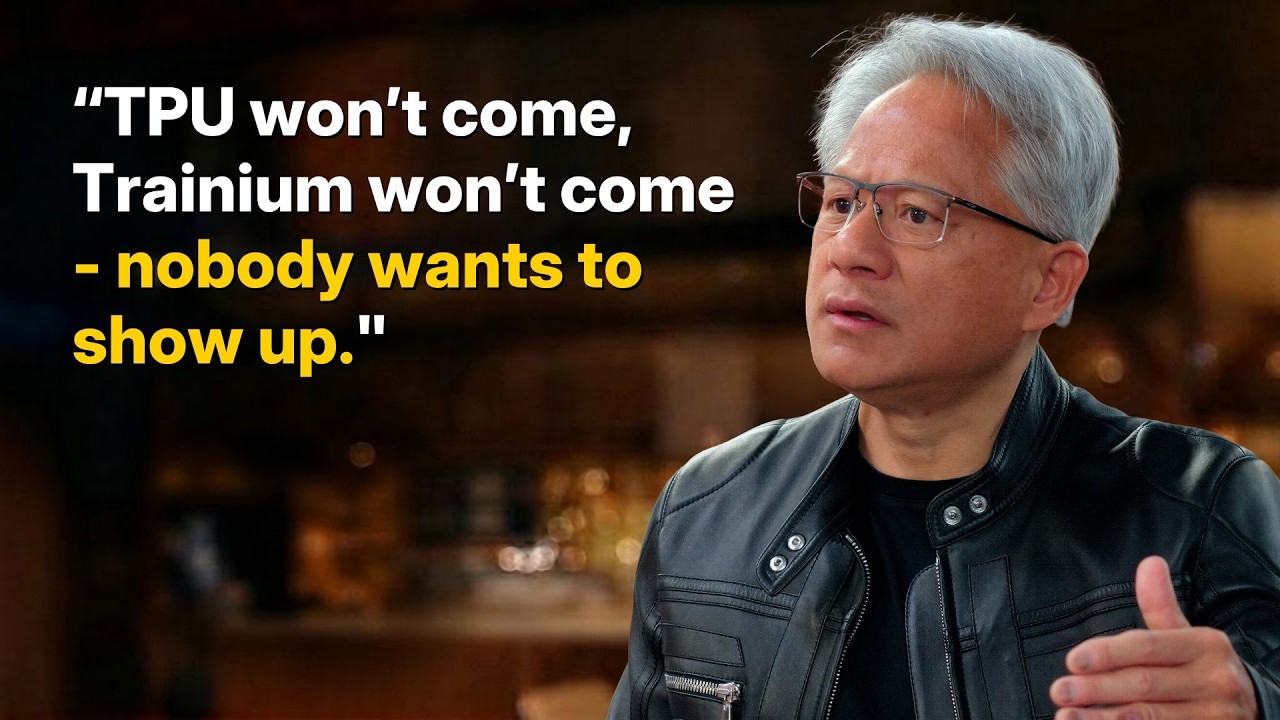
📺 Today’s recommended deep-dive video: https://www.youtube.com/watch?v=Hrbq66XqtCo
The Token Refinery: Jensen Huang on the New Industrial Revolution
NVIDIA CEO Jensen Huang reframes the company’s mission as a fundamental transformation of energy into value. He explains how NVIDIA’s “electron-to-token” factory is reshaping the global economy while addressing the looming bottlenecks in energy, supply chains, and geopolitics.
Core Question: How does NVIDIA maintain its dominance in a world where software is being commoditized and global superpowers are fighting for control over the AI stack?
Highlights
- The “Electron-to-Token” pipeline is the core mental model for the future of global industry.
- NVIDIA’s primary “moat” is a 360-degree ecosystem that spans from raw silicon manufacturing to developer-focused software libraries.
- General-purpose accelerated computing (CUDA) provides an “F1” level of performance that specialized ASICs cannot match in architectural flexibility.
- The ultimate constraint for AI expansion isn’t chip manufacturing capacity, but rather energy policy and physical infrastructure.
⏱️ Reading time: approx. 12 minutes · Saves you about 91 minutes vs. watching.
Want to take notes while watching? Click the image below and let AI Notebook capture the key points for you 👇

The Transformation of Electrons to Tokens
The NVIDIA Mental Model
Huang views the current technological shift as a new industrial revolution where the factory’s raw material is electricity. (Short)
NVIDIA functions as a refinery where the input is electrons and the output is tokens—the digital currency of intelligence. While many fear that AI will commoditize software, Jensen argues that the “artistry, engineering, and science” required to make one token more valuable than another is incredibly difficult to replicate. (Long)
NVIDIA follows a strict philosophy of doing “as much as needed, but as little as possible.” By focusing on the “insanely hard” parts of the stack, they enable a massive ecosystem of partners to build the actual applications. (Medium)
This “five-layer cake” approach ensures that NVIDIA remains the foundational layer of the industry without having to own every vertical. They act as the central hub connecting upstream suppliers like TSMC to downstream developers and model makers. (Medium)

💡 Digging Deeper
Q: Is NVIDIA worried about software commoditization?
A: No, because the transformation of tokens into something valuable requires deep engineering that is far from over.
Q: What is the “Five-Layer Cake”?
A: It is Jensen’s model of AI consisting of energy, chips, system architecture, models, and applications.
Q: Why does NVIDIA partner so extensively?
A: They want to be part of the largest possible ecosystem rather than a closed vertical, maximizing their reach across every cloud and industry.
Building the Global Supply Chain Moat
Churns, Fabs, and Purchase Commitments
NVIDIA’s scale allows them to “prefetch” supply chain bottlenecks years before they manifest in the market. (Short)
With over $100 billion in purchase commitments, NVIDIA has effectively locked up the most critical components of the AI era, from HBM memory to advanced packaging. This allows them to build for a trillion-dollar future that competitors simply cannot afford to bet on. (Medium)
Huang spends significant time “informing, inspiring, and aligning” with CEOs of upstream suppliers like TSMC and ASML. By sharing his vision of the industry’s growth, he convinces these giants to make the massive capital investments necessary to support NVIDIA’s roadmap. (Medium)
The true bottleneck for the industry isn’t necessarily the logic gates or memory, but the “plumbers and electricians.” Building AI factories requires energy and physical infrastructure that take far longer to scale than doubling fab capacity or ordering more EUV machines. (Long)

💡 Digging Deeper
Q: Is the EUV machine supply a permanent bottleneck?
A: No; Jensen believes that with a strong enough demand signal, any hardware bottleneck can be solved within two to three years.
Q: What is the role of “plumbers” in the AI revolution?
A: They represent the physical infrastructure and energy policies required to build data centers, which are currently the hardest things to scale.
Q: Why do suppliers prioritize NVIDIA?
A: Because NVIDIA has the largest downstream demand, giving suppliers the confidence that their capacity will be fully utilized.
The CUDA Advantage: Cadillac vs. Formula 1
Why ASICs Struggle to Compete
Standard CPUs are like Cadillacs—comfortable and reliable—but NVIDIA’s accelerated computing stack is built for the “F1” circuit of high-performance AI. (Short)
Critics often argue that specialized Tensor Processing Units (TPUs) or ASICs can do matrix multiplication more efficiently. However, Huang points out that AI is more than just matrix multiplies; it requires a generally programmable system that can handle the invention of new algorithms like Mixture of Experts (MoE). (Long)
CUDA’s flexibility allows developers to “offload” computation into the network fabric itself, such as NVLink or Spectrum-X. This co-design of hardware and software is what allowed NVIDIA to jump from 35x to 50x efficiency between the Hopper and Blackwell architectures. (Medium)
Furthermore, the “install base” of hundreds of millions of NVIDIA GPUs makes it the safest bet for any software developer. Writing for CUDA ensures your model runs everywhere—from a single laptop to the world’s largest supercomputers. (Medium)
💡 Digging Deeper
Q: Why doesn’t NVIDIA build a specialized chip for every workload?
A: Because general-purpose acceleration allows for faster innovation as algorithms change every single year.
Q: How does NVIDIA handle the “hyperscaler” threat?
A: By providing better TCO (Total Cost of Ownership) and a larger external ecosystem than any internal cloud chip can offer.
Q: What was the “InferenceMAX” challenge?
A: A benchmark challenge Jensen issued to competitors to prove their cost-efficiency, noting that few have actually shown up to compete.
The Geopolitical Stakes: The China Dilemma
National Security and the American Tech Stack
Jensen argues that conceding the Chinese market is a “disservice to the nation” that could lead to unintended consequences for American leadership. (Short)
While the US wants to remain ahead in AI, Huang believes that isolating the Chinese market forces their massive ecosystem of researchers to build on non-American hardware. This risks a future where the “Global South” adopts standards and architectures that the US no longer controls. (Medium)
China possesses an abundance of energy, which Jensen notes can often make up for a lack of the most advanced chips. If energy is cheap and abundant, researchers can “gang together” older 7nm chips to achieve the same throughput as more efficient US systems. (Medium)
He advocates for a “nuanced” approach that keeps the most advanced technology in the US while allowing American companies to compete globally. Without this global reach, the American chip layer loses the scale needed to win the long-term technology race. (Long)

💡 Digging Deeper
Q: Can China train models like Claude Mythos with 7nm chips?
A: Yes, because they have an abundance of energy and some of the world’s best AI researchers who can optimize algorithms to overcome hardware gaps.
Q: What is the danger of “scaring” the public about AI?
A: Huang believes treating AI like a “nuclear bomb” discourages the next generation of engineers and radiologists, creating artificial shortages.
Q: Why is “open source” relevant to the China debate?
A: Much of the global open-source ecosystem is built by Chinese developers; keeping them on the American tech stack benefits US interests.
Key Takeaways
NVIDIA’s dominance is not merely a product of superior silicon, but a systemic lock on the entire “electron-to-token” lifecycle. By viewing computing as an industrial process rather than a consumer good, Jensen Huang has positioned the company as the indispensable refinery of the AI age. The company’s philosophy of doing “as little as possible” elsewhere has ironically made them the center of the largest technology ecosystem in history.
The interview makes it clear that the future of AI will be decided by physical infrastructure as much as digital innovation. While the “moat” of CUDA and massive purchase commitments provide a short-term buffer, the long-term challenge lies in navigating a fragmented geopolitical landscape where energy is the ultimate currency.
Ultimately, Huang emphasizes that American leadership depends on the ability to set global standards. By remaining the “F1” of computing—faster, more programmable, and more widely available than any competitor—NVIDIA intends to remain the foundation upon which the rest of the world builds its intelligence.
Q&A
Q1: Why doesn’t NVIDIA become its own cloud provider?
A1: NVIDIA follows a “do as little as possible” philosophy. They would rather support “neoclouds” like CoreWeave and existing hyperscalers to expand the ecosystem than compete with their own customers.
Q2: Is Moore’s Law dead?
A2: For transistors alone, it is slowing significantly (approx. 25% per year). However, through architecture, networking, and software co-design, NVIDIA is achieving 10x to 50x leaps in efficiency.
Q3: How does NVIDIA handle GPU shortages and prioritization?
A3: There is no “highest bidder” system. It is largely “first in, first out” based on purchase orders, though they may prioritize customers whose data centers are physically ready to deploy.
Q4: What happens if the deep learning revolution stops?
A4: NVIDIA would still be a massive company. Their core mission is “accelerated computing” for physics, molecular dynamics, and data processing—all of which require more than general-purpose CPUs can offer.
Q5: What is the biggest threat to AI growth?
A5: Energy policy and the time it takes to build physical infrastructure. While chips can be manufactured in 2-3 years, energy grids and data center cooling take much longer to modernize.
Q6: Why is NVIDIA investing in OpenAI and Anthropic now?
A6: Huang realized that these “foundation labs” require investments that VCs cannot provide alone. He views supporting them as essential to the survival and scale of the entire AI industry.
Q7: Is there a “winner-take-all” dynamic in AI?
A7: Jensen believes in supporting the entire ecosystem. He avoids “picking winners” because NVIDIA’s history as a survivor among 60 graphics companies taught him that the underdog often prevails.