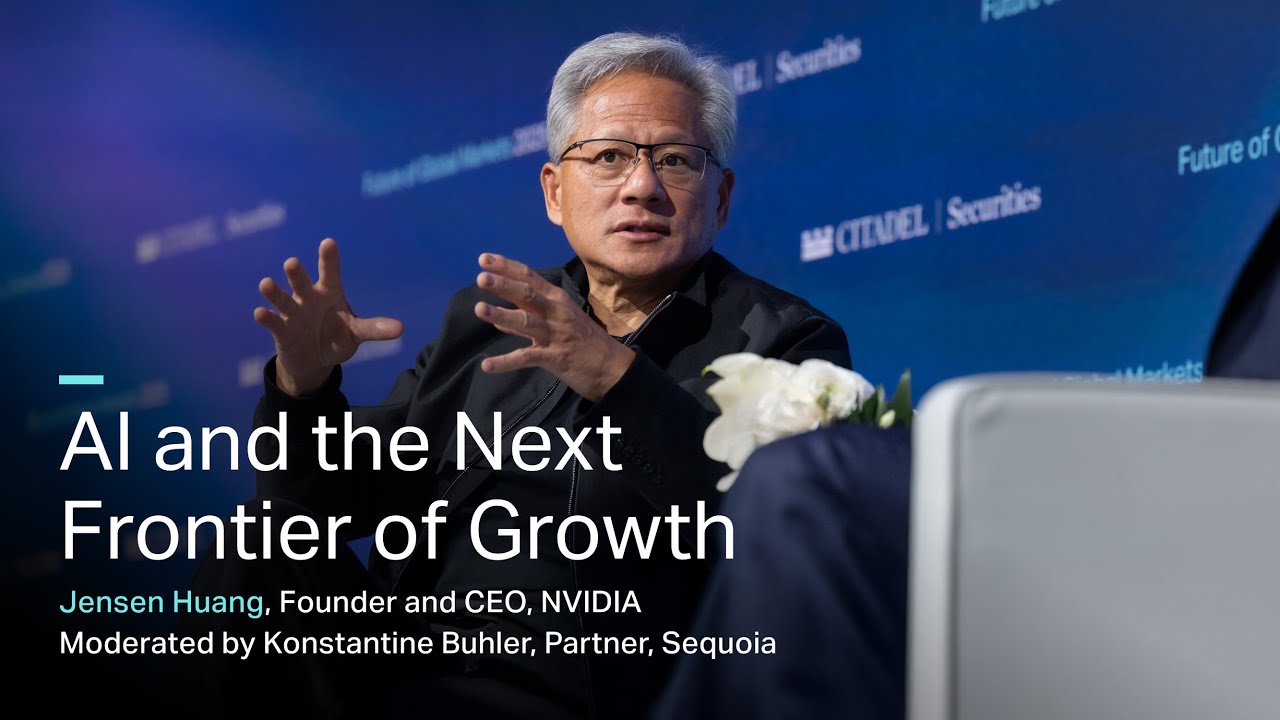
📺 Today’s recommended deep-dive video: https://www.youtube.com/watch?v=m1wfJOqDUv4
The Architecture of Intelligence: Jensen Huang on the Future of AI Factories
From a million-dollar gamble in 1993 to powering a multi-trillion-dollar industrial shift, Nvidia has redefined the limits of computation by betting against the general-purpose status quo. Jensen Huang explores why the era of retrieval-based computing is ending and why “AI factories” are the new foundation of the global economy.
Core Question: How is Nvidia transitioning from a chip designer to the architect of a world where every industry operates on generative, agentic intelligence?
Highlights
- The Death of Moore’s Law: Why the limits of Dennard scaling necessitated a shift from general-purpose CPUs to domain-specific acceleration.
- Agentic AI as Digital Labor: The transition from software as a tool used by humans to software as autonomous “digital employees” (coders, lawyers, and nurses).
- Physical AI and the Three-Computer Rule: Why the future of robotics requires a closed loop of training, simulation (Omniverse), and edge execution.
- The Generative Paradigm: Why 100% of future computing will be generated in real-time rather than retrieved from storage.
⏱️ Reading time: approx. 8 minutes · Saves you about 53 minutes vs. watching.
Want to take notes while watching? Click the image below and let AI Notebook capture the key points for you 👇

From Graphics to General Intelligence
The First Principles of Acceleration
Nvidia succeeded because they chose to invent the technology and the market simultaneously, a strategy with a statistical probability of success near zero percent. In 1993, the industry was obsessed with Moore’s Law and the scaling of general-purpose transistors, but Huang observed that these generalist architectures were fundamentally ill-equipped for the world’s hardest computational problems.
While Silicon Valley poured billions into traditional CPUs, Huang reasoned from first principles that specialized accelerators would be required once Dennard scaling hit its physical limits. This led to a focus on 3D graphics—not just for entertainment, but because simulating reality is essentially a massive exercise in linear algebra and physics. By solving the “chicken and egg” problem of creating a market for a hardware architecture that didn’t yet exist, Nvidia built a flywheel that eventually outpaced the entire semiconductor industry.
The introduction of CUDA was less about a single software release and more about the decade-long process of “schlepping” the architecture to researchers across the globe. By democratizing high-performance computing for seismic processing and molecular dynamics, Nvidia unknowingly laid the infrastructure for the deep learning researchers who would eventually use that same stack to ignite the modern AI revolution.

💡 Digging Deeper
Q: Why was the DGX-1 so significant?
A: It was the world’s first “AI factory” in a box, a specialized computer that didn’t work or look like anything before it, designed specifically for non-linear deep learning.
Q: What was the “serendipity” of 2012?
A: While Nvidia was trying to solve computer vision using “tricks,” researchers like Alex Krizhevsky and Jeff Hinton used Nvidia GPUs to prove that neural networks could learn functions automatically at scale.
Q: How does Nvidia view the universal function approximator?
A: As a tool that can learn almost any function, meaning every layer of the computing stack—from chips to software—must be reinvented to support it.
The Rise of the AI Factory
Beyond the Chip: Infrastructure as a Product
Nvidia is no longer a component company; it is a full-stack infrastructure provider that designs everything from the switch to the rack. Huang explains that the modern GPU is no longer a small card that plugs into a PC, but a rack-scale system weighing two tons and consuming 120,000 watts.
The reason for this vertical integration is velocity. By co-designing the networking, the CPUs, and the software libraries, Nvidia can break out of the slowing limits of Moore’s Law to deliver 10x performance gains every year. This allows them to build “AI factories”—data centers where the raw input is electricity and data, and the high-value output is intelligence (tokens).

The New ROI: Throughput-per-Watt
In the factory model, the primary KPI is the token generation rate per unit of energy. For a cloud provider with a fixed one-gigawatt power limit, a 3x increase in performance-per-watt translates directly into 3x more revenue from the same facility. This economic reality is what drives the massive capital expenditure we see today; it isn’t just about spending more, but about maximizing the yield of the world’s most valuable real estate.
The Next Frontier: Agentic and Physical AI
The Era of Digital Labor
We are moving from a world where software is a tool used by accountants to a world where software is the accountant. This concept, known as “agentic AI,” represents a multi-trillion-dollar shift into the labor market, where enterprises will “hire” and “onboard” digital employees for coding, marketing, and legal work.
Nvidia itself already uses “agentic” AIs to augment 100% of its chip designers and software engineers through tools like Cursor.
Robotics and the Three-Computer Loop
Physical AI is the second great wave, characterized by “embodied” intelligence like robo-taxis and humanoid robots. Huang posits that if an AI can generate a video of a person picking up a bottle, it can generate the motor commands for a robot to do the same. To make this a reality, developers need three distinct computers working in tandem.
First, an AI computer is required for training the foundation models. Second, a simulation computer (the Omniverse) is needed as a “digital twin” where robots can play through trillions of iterations in a physics-compliant virtual world before entering the real one. Finally, the robot itself needs an onboard computer to serve as its brain. Nvidia provides all three, positioning itself as the operating system for anything that moves.

Key Takeaways
The shift from “retrieval-based” to “generative” computing is the most profound change in technology since the invention of the microprocessor. In the old paradigm, computers retrieved pre-written files from storage; in the new paradigm, 100% of the content—from search results to video pixels—is generated in real-time based on context. This is fundamentally closer to how the human mind functions, moving from a library model to a thinking model.
As the marginal cost of intelligence approaches zero, the global economy will reorganize around AI factories. Whether through sovereign AI initiatives where nations protect their own data or through agentic workforces in the enterprise, the infrastructure being built today is the foundation for a $100 trillion opportunity in digital and physical labor.
Q&A
Q1: What is the most underrated part of Nvidia’s platform?
A: The suite of 350+ specialized libraries like cuDNN and cuLitho. While CUDA gets the headlines, these libraries are the “treasure trove” that allows Nvidia to accelerate specific industries like semiconductor manufacturing and weather forecasting.
Q2: How should we think about AI security?
A: It will mirror cybersecurity. As the cost of AI drops to zero, we will surround every primary AI with millions of “protector AIs” designed to watch for intrusions, vulnerabilities, and malfunctions.
Q3: What is “Sovereign AI”?
A: It is the principle that a nation should not outsource its data to import intelligence. Countries like the UK, France, and Japan are increasingly building their own national AI factories to ensure their “national intelligence” remains a domestic asset.
Q4: Is there a bubble similar to the year 2000?
A: No. In 2000, many internet companies were not profitable and the industry was small ($20-$30B). Today, AI is powering hundreds of billions in revenue for hyperscalers through recommender systems and ads, even before considering the new generative AI market.
Q5: What is the “Three-Computer Rule” for robotics?
A: To build a robot, you need a computer to train the model, a computer to simulate the world (Omniverse), and a computer to act as the robot’s brain.
Q6: What should a CIO do with a $10 billion AI budget?
A: Start “onboarding” digital employees immediately. Just as companies have a culture for hiring humans, they must develop the methodology for fine-tuning and evaluating agentic AI to protect proprietary knowledge.
Q7: How does Huang view the China export situation?
A: He advocates for nuance. While the US wants to win the AI race, having 50% of the world’s researchers build on a non-American tech stack is a strategic risk. The goal should be to stay ahead while ensuring the world remains built on American technology.