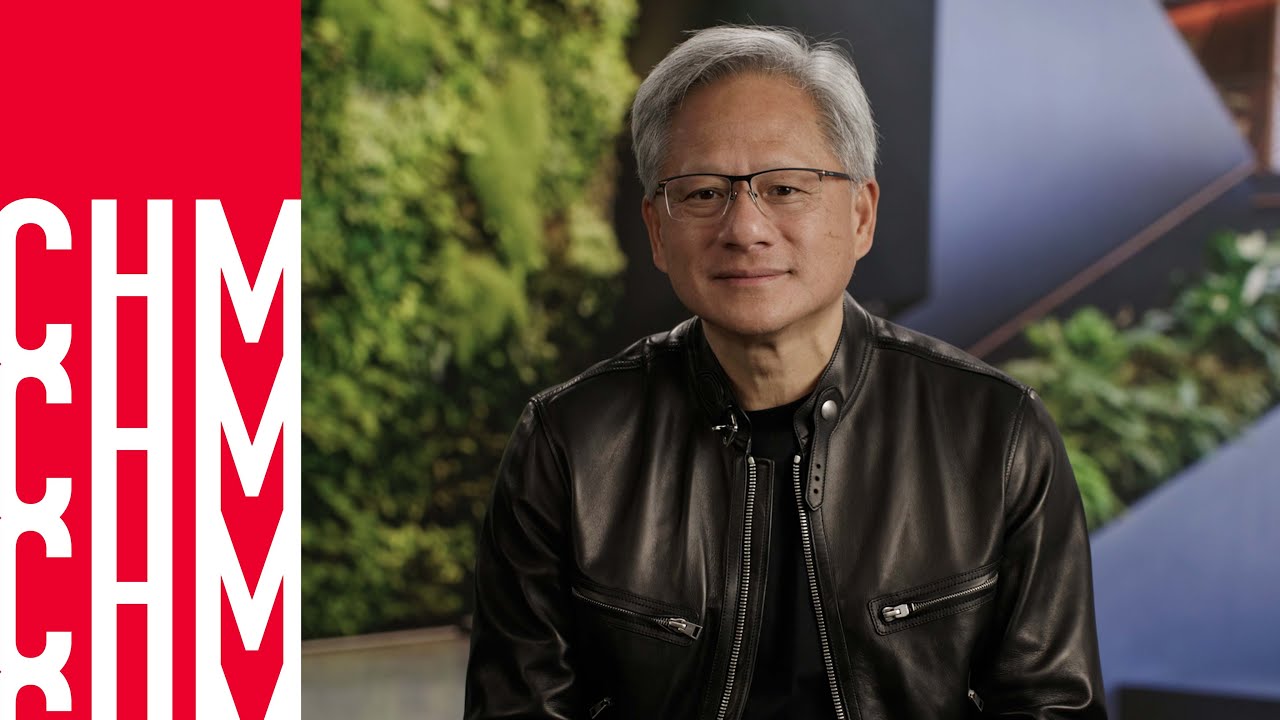
📺 Today’s recommended deep-dive video: https://www.youtube.com/watch?v=0c8i4T9BSqY
The Gardener of Silicon: Jensen Huang’s Journey from Denny’s to the AI Frontier
From washing dishes at a Portland Denny’s to leading the world’s most influential AI powerhouse, Jensen Huang’s life is a masterclass in resilience and architectural foresight. This interview reveals the personal philosophy and “near-death” pivots that transformed NVIDIA from a struggling startup into the essential engine of the global computing revolution.
Core Question: How did a philosophy of “having plenty of time” and a willingness to be technically wrong allow Jensen Huang to redefine the fundamental nature of modern computing?
Highlights
- The pivotal transition from curved surfaces to triangles that saved NVIDIA from early obsolescence.
- Why the “Unified Driver Architecture” of 1993 remains the technical foundation for modern AI.
- Huang’s “plenty of time” philosophy, learned from a Kyoto gardener, which drives his long-term focus.
- The intentional fusion of the semiconductor and systems industries into a single, accelerated stack.
⏱️ Reading time: approx. 7 minutes · Saves you about 65 minutes vs. watching.
Want to take notes while watching? Click the image below and let AI Notebook capture the key points for you 👇

The Formative Years: From Tacoma to the Tech Lab
Roots of a Nomadic Engineer
Born in Taipei the same year the IBM System/360 was announced, Jensen Huang’s childhood was a nomadic journey through Thailand and rural Kentucky before settling in Oregon. This early exposure to different cultures and high-pressure environments—including a boarding school where he cleaned bathrooms—instilled a rugged work ethic and a lack of shyness that would later define his leadership.
His father, an instrumentation engineer, instilled a deep love for science and math, though Jensen initially excelled at competitive table tennis. Spending seven days a week at the table, he reached the US Open level, proving early on that he possessed the focused grit required for high-stakes competition.
While his parents envisioned a career in petroleum engineering, the arrival of a teletype terminal in his high school computer club changed everything forever. Along with his best friend, he enrolled at Oregon State University to study electrical engineering because it felt like the frontier. It was there that he met his future wife, Lori, in an “E-Fundies” lab, famously using his prowess at homework as a “superpower” to ask her out for their first study date.

💡 Digging Deeper
Q: What did you learn from the Kyoto gardener?
A: I learned the value of dedication to craft and perspective. He told me, “I have plenty of time” to pick dead moss in an enormous garden because he had prioritized his life’s work one tiny piece at a time.
Q: How did your first job at Denny’s impact you?
A: It made me less shy and taught me the value of service. I learned how to handle complaints and how to work every second of an eight-hour shift to leave the station immaculate for the next person.
Q: Why did you choose AMD over other semiconductor giants after college?
A: I was fascinated by the bipolar microprocessors they were building. It gave me my first exposure to designing large chips and understanding the fundamental trade-offs between performance, power, and density.
The Founding and the First “Near-Death” Experience
The Architecture of Survival
NVIDIA was born in a Denny’s booth, driven by a vision to accelerate computer graphics for a PC gaming market that effectively didn’t exist in 1993. Co-founders Chris Malachowsky and Curtis Priem brought the technical depth, but Huang provided the strategic glue, focusing on a “full stack” approach before the term was popular.
They realized early on that software was the true limiter of hardware companies. To solve this, they invented a virtualized driver architecture that allowed their software investment to span multiple generations of hardware, a concept that still governs NVIDIA’s operations today.
Disaster struck early when their first architecture choice—curved surfaces—proved to be exactly what software developers did not want. Realizing they were on a collision course with bankruptcy, Huang had to plead with Sega’s CEO for a contract release and a survival payment. This “diving catch” forced the company to pivot to triangles and Z-buffering, eventually leading to the industry-defining RIVA 128 chip designed in a record-breaking nine months using new emulation tools.

💡 Digging Deeper
Q: Why was the decision to pivot so difficult?
A: We were under contract with Sega to build a console using the “wrong” technology. Admitting we were wrong meant risking the contract and the company’s funding simultaneously.
Q: How did you design the RIVA 128 so quickly?
A: We inverted the equation. Instead of asking how long the chip would take, we asked what we could build in the nine months of cash we had left, which led us to adopt hardware emulation for the first time.
Q: Why do you focus so much on developers?
A: I learned that a platform is nothing without them. If you don’t make your architecture easy for developers to realize their imagination, it won’t be adopted, regardless of how cost-effective it is.
The Leap to Accelerated Computing and AI
Simulating the Physical World
Moving beyond pixels, Huang envisioned a world where GPUs could simulate the laws of atomic physics and fluid dynamics. This journey from computer graphics to “physics simulation” was the first step toward the modern GPU’s role as a scientific instrument rather than just a toy for gamers.
The birth of CUDA was a massive gamble on programmability, allowing researchers to treat GPUs like general-purpose processors for scientific research. This gamble paid off when Oak Ridge National Laboratory selected NVIDIA for their supercomputing needs, proving that accelerated computing was the only way to overcome the slowdown of Dennard scaling.
Today, that foundation supports the AI revolution, where the methodology of software development has shifted from manual coding to neural network training. Huang views AI safety not just as a policy issue, but as a technical challenge requiring “AI to guardrail AI.” By using synthetic data and curriculum curation, the industry is building physical AIs capable of operating safely in the messy, unstructured reality of the human world.

💡 Digging Deeper
Q: How has AI changed the mental image of a chip designer?
A: It has shifted from transistors and gates to language. When we use design tools, our representation of the work becomes the code itself, not the physical wires.
Q: What is the “chicken and egg” problem NVIDIA solved?
A: Accelerated computing requires both a new technology and a new market to exist simultaneously. We had to evangelize gaming, then supercomputing, and finally AI to create the demand for our hardware.
Q: How does NVIDIA approach AI safety?
A: We innovate in “guardrailing” technology. Just as air traffic controllers manage planes, we use specialized AIs to monitor and safety-check the outputs of other AIs in real-time.
Unorthodox Leadership and the “How Hard Can It Be?” Mindset
Shaping the Future in Real-Time
As a leader, Huang avoids the trap of static five-year plans, preferring to manage his company as a shape-shifting machine that adapts to market feedback. He describes his style as “floating,” moving between deep-level research and high-level strategy while leaving day-to-day operations to expert teams.
He believes that a healthy dose of “ignorance and irreverence” for how hard a task is remains an essential quality for any founder. If he had known the sheer volume of setbacks and pain the founding of NVIDIA would entail, he admits he might never have started.

💡 Digging Deeper
Q: Why are you reluctant to give advice to new entrepreneurs?
A: Because their environment is different. The machinery you build to go 100 miles an hour is different from what you build to go one mile an hour; the culture must match the context.
Q: Do you use annual plans?
A: No, we don’t have annual or five-year plans. Our plans are evolving all the time to accommodate our long-term vision as the world changes.
Q: What is the “superpower” of a startup founder?
A: The belief that “it can’t be that hard.” You need a superhuman mindset to tackle world-changing problems even before you have the superhuman capabilities to solve them.
Key Takeaways
Jensen Huang’s story highlights the necessity of architectural foresight over short-term gains. By investing in the Unified Driver Architecture and CUDA long before they were profitable, NVIDIA created a massive “installed base” that competitors could not easily replicate. This fusion of hardware and software was the fundamental prerequisite for their current dominance in the generative AI space.
Success in deep tech requires the courage to make the “right” decision regardless of the immediate financial consequences. Whether it was pivoting from curved surfaces or asking a partner for survival money, Huang focused on technical truth and developer needs first. By prioritizing a life’s work one “moss spore” at a time and embracing a mindset of perpetual adaptation, he transformed a niche graphics company into the cornerstone of modern industrial and scientific computing.
Q&A
Q1: When was Jensen Huang born and what was the significant tech event of that year?
A1: He was born on February 17, 1963, the same year the IBM System/360 was announced.
Q2: What did Jensen’s father do for a living?
A2: He was an instrumentation engineer who worked on oil refineries and paper mills.
Q3: How did Jensen meet his wife, Lori?
A3: They met in an Electrical Engineering Fundamentals (E-Fundies) lab at Oregon State University.
Q4: What was the primary reason NVIDIA nearly went out of business early on?
A4: They chose a graphics architecture (curved surfaces) that was incompatible with the industry standard (triangles/DirectX).
Q5: Why does Jensen not wear a watch?
A5: He believes that whatever he is doing at the moment is the most important thing, adhering to the philosophy that he has “plenty of time” for his priorities.
Q6: What specific tool did NVIDIA use to design the RIVA 128 in nine months?
A6: They used a hardware emulator from a company called IKOS, becoming one of the first chip companies to emulate software before tape-out.
Q7: How does Jensen describe the current transition in software development?
A7: He describes it as a shift from humans writing principled algorithms to using AI to train neural networks that can handle the “long tail” of unstructured data.