📺 Today’s recommended deep-dive video: https://www.youtube.com/watch?v=UyyjU8fzEYU
A Stroke of Enlightenment: A Neuroanatomist’s Journey Into Nirvana
What happens when a brain scientist watches their own mind shut down from the inside? Dr. Jill Bolte Taylor experienced a massive stroke that silenced her left hemisphere, stripping away her identity but revealing a profound, euphoric state of universal connection. This is the story of how a biological catastrophe became a spiritual awakening.
Core Question: Can we consciously choose to step away from our analytical egos to embrace a state of universal peace?
Highlights
- The biological distinction between the right hemisphere’s “parallel processing” and the left hemisphere’s “serial processing.”
- A firsthand account of losing language, boundaries, and self-identity during a brain hemorrhage.
- The sensation of “Nirvana” that occurs when the left brain’s analytical chatter is silenced.
- The realization that peace is a biological choice available to every human being at any moment.
⏱️ Reading time: approx. 5 minutes · Saves you about 13 minutes vs. watching.
Want to take notes while watching? Click the image below and let AI Notebook capture the key points for you 👇

The Biological Split: Parallel vs. Serial Processing
Two Minds in One Skull
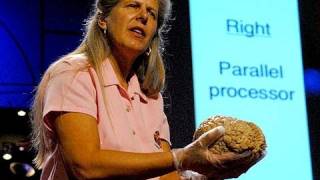
The human brain is divided into two distinct cortices that communicate via the corpus callosum. While they appear symmetrical, they function as two entirely different personalities with unique priorities. The right hemisphere functions like a parallel processor, absorbing the “collage” of the present moment through sensory energy, movement, and images. It sees no boundaries, connecting us to the energy of everything around us as a single, collective human family.
In contrast, the left hemisphere operates as a serial processor. It takes the massive data stream from the right and breaks it down into linear details, categorizing them into past, present, and future.
This is the home of language and the “ego.” It is the voice that reminds you to buy bananas or do the laundry, but more importantly, it is the voice that says “I am,” creating the perception that you are an individual separate from the rest of the world.

💡 Digging Deeper
Q: How do the hemispheres view time differently?
A: The right brain only cares about the “here and now,” while the left brain is designed to link the present to the past and project it into the future.
Q: Is the sense of “self” a whole-brain function?
A: No, the specific feeling of being a separate, individual entity—the “I am”—is primarily a construction of the left hemisphere’s language and analytical centers.
Q: What happens when the connection between them is disrupted?
A: You lose the ability to bridge the gap between internal feelings and external definitions, often leading to a loss of physical boundaries.
The Morning of the Stroke
When the Left Brain Goes Silent
On December 10, 1996, a blood vessel exploded in the left side of Dr. Taylor’s brain. The experience began not as a medical emergency, but as a surreal shift in perception. As the hemorrhage grew, she watched her cognitive functions deteriorate in real-time. She describes the sensation of her hands looking like “primitive claws” and the atoms of her body blending into the molecules of the wall. Because her left brain was failing, she could no longer define where her physical self ended and the environment began.
The most shocking transition was the silence. The constant internal dialogue—the voice that connects us to the external world—simply stopped.
Initially, this was terrifying, but it was quickly replaced by a sense of massive expansion. Without the left brain to categorize her as a “separate individual,” she felt like a fluid being made of energy, drifting in a sea of euphoria she calls “La La Land.” Even the stress of her career and her 37 years of emotional baggage vanished instantly.

💡 Digging Deeper
Q: Why did she compare her colleague to a Golden Retriever?
A: Because her left hemisphere’s language centers were offline, she could hear the sound of his voice but could not translate the phonemes into words; it sounded like rhythmic barking.
Q: How did she manage to call for help?
A: It took 45 minutes of intense effort to match the “squiggles” on a business card to the buttons on a phone, waiting for brief “moments of clarity” before the hemorrhage pulled her back into euphoria.
Q: Was the experience painful?
A: While the initial hemorrhage caused a sharp “ice cream” headache, the cognitive dissolution itself was described as beautiful, expansive, and peaceful.
Choosing Nirvana
A Second Chance at Life
It took eight years for Dr. Taylor to fully recover her ability to speak, walk, and think linearly. During this time, she realized that she was no longer the same person she had been before the stroke. She had discovered that the “Nirvana” spiritualists speak of is actually a biological reality residing in the right hemisphere. By losing the dominance of her left brain, she gained a permanent understanding of how to access a state of profound compassion and peace.
We are not just individuals; we are the life-force power of the universe.
We have the power to choose, moment by moment, which hemisphere we inhabit. We can live in the left brain as Dr. Jill Bolte Taylor—the intellectual, separate, and busy neuroanatomist—or we can step to the right and exist as the energy that connects all things. This choice is the key to global peace. If more people knew they could deliberately silence their judgmental left brain, the world would naturally become more compassionate.

Key Takeaways
The stroke revealed that the “ego” is a fragile biological construct. When the left hemisphere’s chatter is silenced, the human spirit doesn’t die; instead, it expands into a state of blissful connection with the universe. This suggests that much of our daily stress and sense of isolation is a byproduct of specific neural circuitry rather than an objective reality.
Recovery is a choice to reintegrate the analytical self while retaining the wisdom of the connected self. Dr. Taylor’s eight-year journey emphasizes that we are “genies” trapped in small bodies, but we have the manual dexterity and cognitive tools to navigate both the physical world and the spiritual one simultaneously.
Ultimately, peace is an internal projection. The more time we spend in the deep, peaceful circuits of our right hemispheres, the more peace we project into the world. It is not just a scientific observation; it is a roadmap for a more harmonious planet.
Q&A
Q1: What is the main difference between how the two hemispheres process information?
A1: The right hemisphere processes information as a “parallel processor” focused on the energy and images of the present moment, while the left hemisphere is a “serial processor” focused on linear time, details, and language.
Q2: Why did Dr. Taylor lose her sense of physical boundaries during the stroke?
A2: The left hemisphere is responsible for defining the “I am” and the boundaries of the self; when it was damaged by the hemorrhage, she could no longer distinguish her own atoms from the atoms of the objects around her.
Q3: What did Dr. Taylor mean by “La La Land”?
A3: This was her affectionate term for the state of euphoria and energetic expansion she experienced when her left brain’s analytical functions and internal monologue went silent.
Q4: How did the stroke affect her ability to communicate?
A4: She could no longer understand or produce language. To her, spoken words sounded like the barking of a dog, and written numbers appeared as meaningless pixels that blended into the background.
Q5: How long did the recovery process take?
A5: It took eight years for Dr. Taylor to fully recover her speech, motor skills, and memory.
Q6: What is the “Stroke of Insight” mentioned in the title?
A6: It is the realization that we can consciously choose to step away from our separate, analytical left-brain ego and enter the peaceful, connected consciousness of the right brain at any time.
Q7: Does Dr. Taylor believe we should get rid of the left hemisphere’s functions?
A7: No, she views us as “two minds in one skull” and argues that we should use the left brain as a tool for navigation, but prioritize the right brain’s peace to improve the world.