📺 Today’s recommended deep-dive video: https://www.youtube.com/watch?v=Kpd7XKjODbQ
The Billionaire’s Side Quest: Why Your 12-Year-Old Self Holds the Key to Success
Most people work for a paycheck, but the world’s most successful entrepreneurs often operate on “FU energy” and childhood obsessions. This article explores why the richest man in Britain spent $2 billion on a car company just because a legacy brand said “no,” and why your pre-teen interests are the most reliable predictor of your ultimate career success.
Core Question: How do the patterns of childhood obsession and the “just because” mindset of billionaires provide a blueprint for high-performance entrepreneurship?
Highlights
- The rise of Sir Jim Ratcliffe: From chemical engineering to owning Manchester United and building a car company out of spite.
- The “Golden Window” Framework: Why specialization between the ages of 8 and 18 defines extreme performers like Bill Gates and Warren Buffett.
- Social Commerce Secrets: How brands like Goalie and Comfort use thousands of creators to generate millions in revenue without upfront ad spend.
- Reverting to Nature: Using Robert Greene’s advice to find your “life’s work” by examining what you were weirdly obsessed with at age twelve.
⏱️ Reading time: approx. 6 minutes · Saves you about 42 minutes vs. watching.
Want to take notes while watching? Click the image below and let AI Notebook capture the key points for you 👇

Sir Jim Ratcliffe and the $2 Billion Spite Car
The Ineos Empire and “Just Because” Energy
Jim Ratcliffe was born in Manchester, England—a blue-collar city often compared to Boston for its grit and hardworking ethos. After studying chemical engineering and accounting, he entered private equity at 35, only to realize he was tired of making other people rich. At age 40, he mortgaged his home, pooled $150,000 of his own money, and convinced LPs to help him buy an $80 million spin-off from BP. That company, Ineos, is now a $40 billion chemical giant.
It was a total career-or-nothing gamble.
Ratcliffe didn’t stop at chemicals; he became a sports and adventure fanatic, running 50 marathons and underwriting the first sub-two-hour marathon by Eliud Kipchoge. He owns parts of Mercedes F1, a world-class sailing team, and Manchester United. But his most audacious move was the Grenadier. When Jaguar Land Rover refused to sell him the tooling to keep making the classic, boxy Defender, Ratcliffe didn’t complain—he simply built his own car company within his chemical business.
He has lost roughly $2 billion on the Grenadier since 2018, but he doesn’t seem to care because he loves the car.
💡 Digging Deeper
Q: Why did Ratcliffe start a car company if it’s losing so much money?
A: It’s the ultimate “side quest.” He loved the old Land Rover Defenders and wanted a modern version that felt mechanical rather than overly luxurious. When the original manufacturer refused to collaborate, he used his wealth to build exactly what he wanted.
Q: Is Ineos actually a PE firm or a chemical company?
A: It is a hybrid. Ratcliffe used his engineering background to understand the assets and his PE background to structure deals for “distraction” spin-offs from conglomerates, doubling their EBITDA within five years.
Q: What is “FU Energy” in this context?
A: It is the confidence to pursue a project that makes zero financial sense on paper simply because you have the resources and the passion to see it exist in the world.

The 12-Year-Old Framework: Finding Your Nature
The Golden Window of Specialization
There is a theory that your personality is mostly hardwired by the age of five, but your “Golden Window” for specialization happens between ages 8 and 18. This ten-year span is when the brain can develop incredible expertise if it is allowed to focus. While modern schools encourage students to be generalists—spending 30 minutes on eight different subjects—extreme performers like MrBeast, Bill Gates, and Warren Buffett were all hyper-specializing in their respective crafts during this exact window.
Buffett, for example, spent his childhood at racetracks.
He wouldn’t bet on the horses; instead, he would collect thousands of discarded betting slips to find the few “losing” tickets that actually qualified for third-place payouts. This was value investing in its purest, most primitive form. He was training his brain to look through rubbish to find hidden value, a skill he later applied to the stock market to become one of the wealthiest people in history.
Reverting to Your Pre-Jaded Self
Robert Greene, the author of The 48 Laws of Power, suggests that to find your life’s work, you must look at what you were doing at age twelve. This is the age before you felt the pressure of “coolness,” before you were jaded by the workforce, and before you were told your hobbies were stupid. If you were taking apart remote-control cars to avoid chores, you might be a natural systems builder or engineer; if you were selling burned CDs, you might be a media mogul in training.
Nature eventually wins, so you might as well stop fighting it.
The Social Commerce Gold Rush
The TikTok Shop Playbook
Traditional e-commerce revolved around running Facebook and Google ads with in-house creative teams, but a new model has emerged: crowdsourced creative. Brands like Goalie and Comfort are bypassing traditional agencies and instead “seeding” their products to thousands of everyday TikTok creators. These aren’t necessarily famous influencers; they are people with time and an understanding of the platform’s “authentic” aesthetic.
The brand doesn’t pay for the content; they only pay when a sale is made.
This commission-based model (UGC or User Generated Content) allows a brand to test 5,000 pieces of content a month instead of fifty. When one video “pops,” the brand puts ad spend behind it, and other creators immediately remix the successful hook. It is a hive-mind approach to marketing that has allowed companies to go from zero to $30 million in monthly revenue in less than a year.
From Janky to Legit
Many billion-dollar brands started with “janky” marketing. Moiz Ali, the founder of Native Deodorant, originally found his product by looking at the top-selling items on Etsy. He licensed a homemade formula from a woman working out of her kitchen, put a logo on it that looked suspiciously like a local restaurant, and ran clinical trials by having his brother smell his armpits after he ran around the block.
You don’t need to be professional to start; you just need to be fast.
Once the “hacky” sales tactics work, the brand can eventually “legitimize.” Native eventually sold to Procter & Gamble for $100 million. Similarly, Athletic Greens (AG1) evolved from a 2010s-style “internet marketing” landing page with giant orange arrows into a high-end wellness brand endorsed by Hugh Jackman. The key is to survive long enough with “hustle” marketing to afford the “brand” marketing.

Key Takeaways
Success is often a byproduct of alignment rather than raw effort. When you align your adult career with your natural childhood inclinations, the “friction” of work disappears. Much like driving a screw into a wall, if the angle is wrong, you’ll break your wrist trying to force it; if the angle is right, it glides in effortlessly.
The modern landscape of business rewards those who can leverage “high-volume” tactics—whether that’s Jim Ratcliffe buying up dozens of chemical spin-offs or a TikTok brand testing thousands of video hooks. The goal is to use these aggressive, often “janky” methods to build a foundation of cash flow that eventually allows you to pursue your own “side quests” and “just because” projects.
Q&A
Q1: What is “seeding” in social commerce?
A1: Seeding is the process of sending free products to hundreds or thousands of creators without a guaranteed contract, hoping they will create content and tag the brand’s shop for a commission.
Q2: Who is Palmer Luckey and what is his “side quest”?
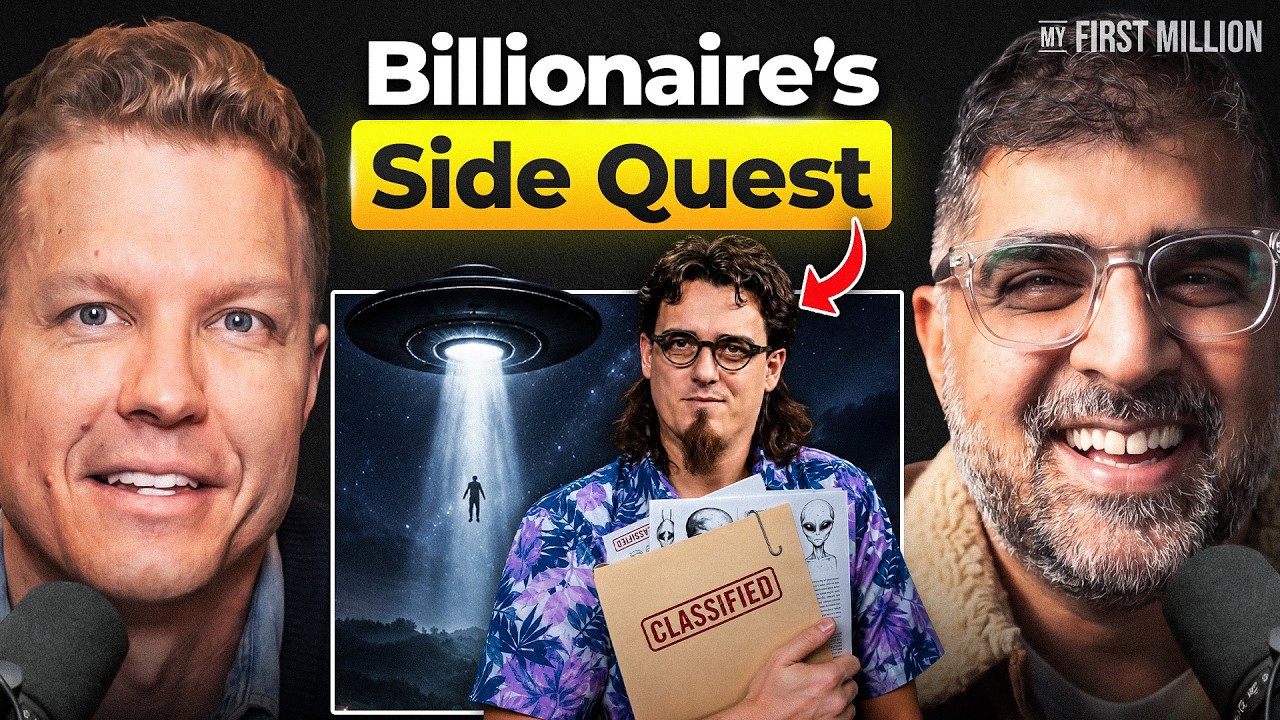
A2: Palmer Luckey founded Oculus and Anduril. His side quest is a privately funded version of the “X-Files” where he intends to hunt for aliens and uncover government secrets.
Q3: Is the “Golden Window” scientifically proven?
A3: The transcript refers to it as a theory used by high performers to describe the 10-year period (8-18) where the brain is most plastic and capable of hyper-specialization.
Q4: How did Moiz Ali validate the market for Native Deodorant?
A4: He looked at Etsy to see what the number one selling product was. Seeing it was natural deodorant, he realized there was massive demand but no dominant commercial brand.
Q5: Why does the transcript mention “white housekeepers” in Austin?
A5: It was a humorous observation by the speakers about the demographic differences in service workers between Austin and other cities, used to illustrate the unique “vibe” of the city.
Q6: What is the main downside of the social commerce model?
A6: These companies are often seen as less “valuable” because they lack defensibility. A buyer doesn’t know how long a specific TikTok tactic will last, leading to lower acquisition multiples.
Q7: Can B2B companies use B2C tactics?
A7: Yes. The speakers argue that B2B is a “blue ocean” for B2C tactics like social selling and high-volume content, as most B2B marketers are too “scarred” or conservative to try them.