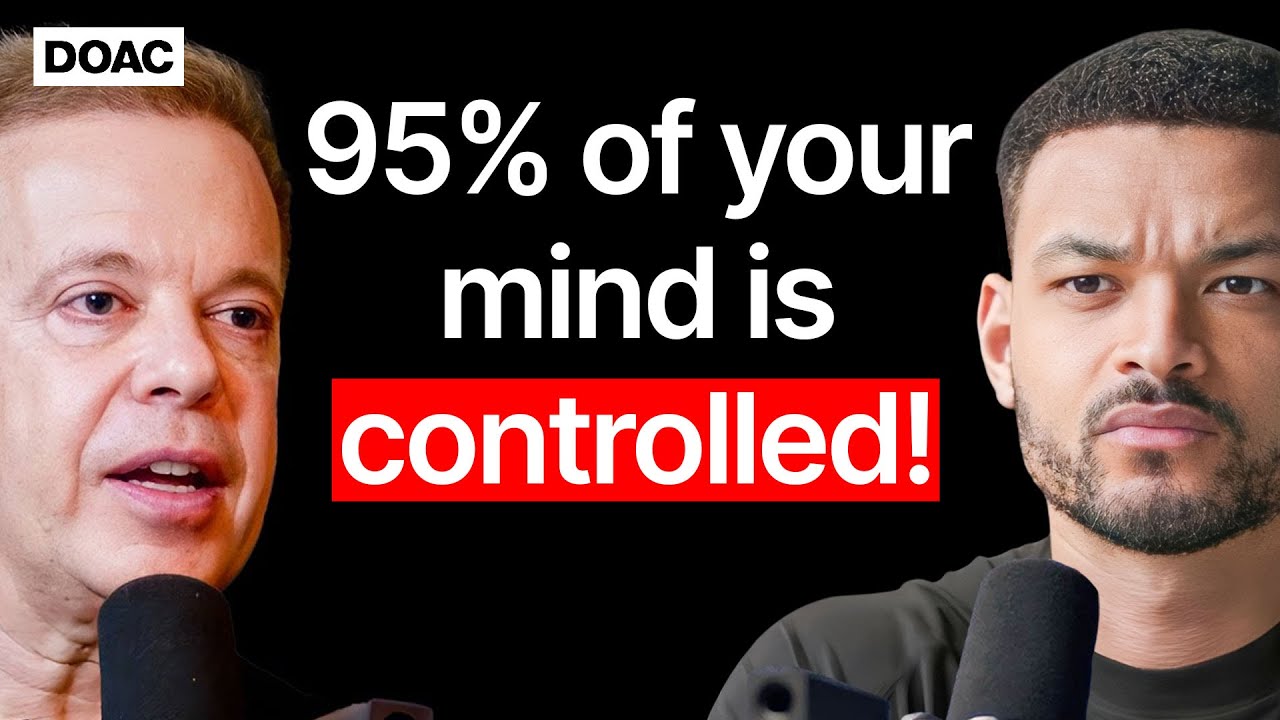
📺 Today’s recommended deep-dive video: https://www.youtube.com/watch?v=rOYlOdDgYUU
Rewiring the Brain: Dr. Joe Dispenza on How Your Thoughts Can Heal Your Body
Most of who we are by the age of 35 is a set of memorized behaviors and emotional reactions that function like a computer program. Dr. Joe Dispenza argues that by becoming conscious of these patterns, we can break the cycle of stress and literally signal new genes to heal our bodies.
Core Question: Can we intentionally use mental rehearsal and meditation to move from a state of survival into a state of creation and physical healing?
Highlights
- By age 35, 95% of our personality is a subconscious program of past habits.
- Stress is highly addictive; people often use their problems to reaffirm their identity.
- Mental rehearsal physically changes the brain’s circuitry as effectively as physical practice.
- Collective coherence, through heart-centered meditation, can influence physical reality and local crime rates.
⏱️ Reading time: approx. 12 minutes · Saves you about 108 minutes vs. watching.
Want to take notes while watching? Click the image below and let AI Notebook capture the key points for you 👇

The Subconscious Puppet Master
Breaking the 95% Program
Dr. Dispenza explains that a habit is a redundant set of automatic, unconscious thoughts and behaviors acquired through repetition. By the time we reach our mid-thirties, 95% of who we are is a series of these programs, leaving only 5% for our conscious mind to operate. When the body knows how to do something better than the conscious mind, we are effectively living in the past.
We are often puppets to a master we didn’t even know we hired.
To change, we must develop metacognition—the ability to observe our own thoughts without being swept away by them. This process involves becoming so conscious of our unconscious behaviors that they no longer slip by our awareness unchecked. Neuroplasticity proves that nerve cells that fire together, wire together; therefore, to reach a new future, we must deliberately unfire and unwire the old neurological circuits of our identity.

💡 Digging Deeper
Q: Why do habits feel so hard to break?
A: Because the body has been conditioned to be the mind, and stepping into the unknown feels like a threat to survival.
Q: What is the first step toward change?
A: Metacognition—becoming the observer of your program rather than the program itself.
Q: Is there a specific age where change becomes impossible?
A: No; while 95% is programmed by 35, the brain remains plastic throughout life if we provide the right stimulus.
The Inner Pharmacy: Thoughts as Medicine
The Science of Mental Rehearsal
One of the most profound tools for transformation is mental rehearsal, a technique where the brain is primed for a new behavior through focused imagination. Dispenza cites a study where people mentally rehearsed piano scales without ever touching a keyboard. Remarkably, after five days, they grew the same amount of neurological circuits as the group that physically practiced the scales.
The brain does not know the difference between a real-world experience and a vividly imagined one.
When you combine a clear intention with an elevated emotion, you begin to signal genes ahead of the actual environment. This epigenetics approach allows the body to begin producing the “pharmacy of chemicals” necessary for healing before the physical recovery has even begun. Our research shows that in just seven days, novice meditators can significantly shift their microbiome and gene expression simply by changing their internal state.

💡 Digging Deeper
Q: What role does emotion play in healing?
A: Emotions are the chemical residue of past experiences; by feeling “elevated” emotions like gratitude before a healing occurs, you signal the body that the event has already happened.
Q: Can meditation really affect my genes?
A: Yes; research indicates that intensive meditation can up-regulate genes for health and down-regulate those for disease within one week.
Q: What is the “analytical mind”?
A: It is the barrier between the conscious and subconscious; meditation helps slow brain waves to bypass this barrier and access the operating system.
Moving from Survival to Creation
The Addiction to Stress
Living in stress is living in survival, where the brain and body are constantly knocked out of homeostasis by perceived threats. This state causes the brain to become “compartmentalized” or incoherent, where different regions stop communicating with one another. Because the rush of adrenal hormones is so powerful, many people become subconsciously addicted to the very emotions that make them sick.
Wholeness is the ultimate antidote to the state of lack that drives our various addictions.
People often use their enemies or their bad jobs to reaffirm their addiction to hatred or frustration. They would rather tell the story of their miserable past than take the risk of romancing a new, unknown future. Breaking this cycle requires a “moment of reckoning” where the individual decides that the emotional cost of their past is no longer worth the price of their health.
💡 Digging Deeper
Q: How does stress lead to disease?
A: Chronic activation of the fight-or-flight system exhausts the body and pushes the genetic buttons that trigger illness.
Q: What is heart coherence?
A: It is when the heart beats in an orderly, rhythmic fashion, which happens when we feel gratitude, kindness, or love.
Q: Why do I fall back into old patterns so easily?
A: You likely went “unconscious” to a trigger in your environment that signaled your body to return to a familiar emotional state.
Key Takeaways
We often wait for a crisis—a diagnosis, a betrayal, or a loss—to finally decide to change our lives. However, Dispenza argues that we can learn to change in a state of joy and inspiration rather than a state of pain and suffering. By dedicating time each morning to “tame the animal” of the body and rehearse a new way of being, we can effectively steer our own biological evolution.
True power lies in the transition from being a victim of your environment to being the creator of your personal reality. This requires a radical shift in perspective where you no longer look for something outside of you to take away your internal lack. Instead, by cultivating wholeness through coherence, the “magic” of synchronicity and serendipity begins to manifest as a natural byproduct of your internal state.
Ultimately, the goal is to become the example of the truth you wish to see in the world. Whether it is through individual meditation or collective initiatives like the “Walk for the World,” the aim is to shorten the distance between a thought and its physical manifestation. When enough individuals achieve heart and brain coherence, they don’t just change themselves—they begin to influence the collective consciousness of the species.
Q&A
Q1: What did Joe Dispenza’s own injury teach him?
A1: After breaking six vertebrae in a truck accident, he refused surgery and spent weeks mentally reconstructing his spine, proving to himself that the mind could heal the body.
Q2: What are the two best times to access the subconscious?
A2: Right after waking up and right before going to sleep, as the brain naturally cycles through the alpha and theta brainwave states during these windows.
Q3: How does the “pineal gland” function in this model?
A3: It acts as a radio receiver for electromagnetic frequencies, transducing quantum information into profound sensory imagery that feels more real than 3D reality.
Q4: What is the impact of collective meditation?
A4: Research suggests that when a coherent group focuses on peace, local crime rates and violence can decrease, implying that human consciousness is an interconnected field.
Q5: Why is “metacognition” so vital?
A5: It is the act of observing your programs; the moment you observe the program, you are no longer the program itself, but the consciousness behind it.
Q6: What does the research show about novice meditators?
A6: After only seven days of immersive practice, significant biological changes occur, including shifts in thousands of metabolites and improved immune function.
Q7: How should someone handle “sad days” or overwhelm?
A7: Dispenza suggests being introspective, recentering your attention, and remembering the “work” of returning to the present moment rather than being dragged by external obligations.