📺 Today’s recommended deep-dive video: https://www.youtube.com/watch?v=5aly0iKUbOg
Beyond the Lone Genius: Reverse Engineering Human-Like Social Intelligence
To build true Artificial General Intelligence, we must stop treating AI as a solitary problem-solver and start viewing intelligence as a cooperative, collective achievement. DeepMind research scientist Joe Leibo argues that the secret to human dominance lies not in our individual IQ, but in our unique social cognitive capacities that facilitate cumulative culture.
Core Question: How can we design multi-agent reinforcement learning environments that drive the emergence of human-like cooperation, reputation, and social norms?
Highlights
- The “Cultural Intelligence Hypothesis” suggests that human superiority stems from social learning, not raw physical reasoning.
- DeepMind’s Melting Pot framework provides a diverse suite of 85+ environments to test multi-agent generalization.
- Common pool resources and public goods represent distinct economic challenges that require different cognitive solutions.
- Reputation and identifiability are proven catalysts for cooperation in both human participants and AI agents.
⏱️ Reading time: approx. 8 minutes · Saves you about 43 minutes vs. watching.
Want to take notes while watching? Click the image below and let AI Notebook capture the key points for you 👇

The Social Architecture of Human Intelligence
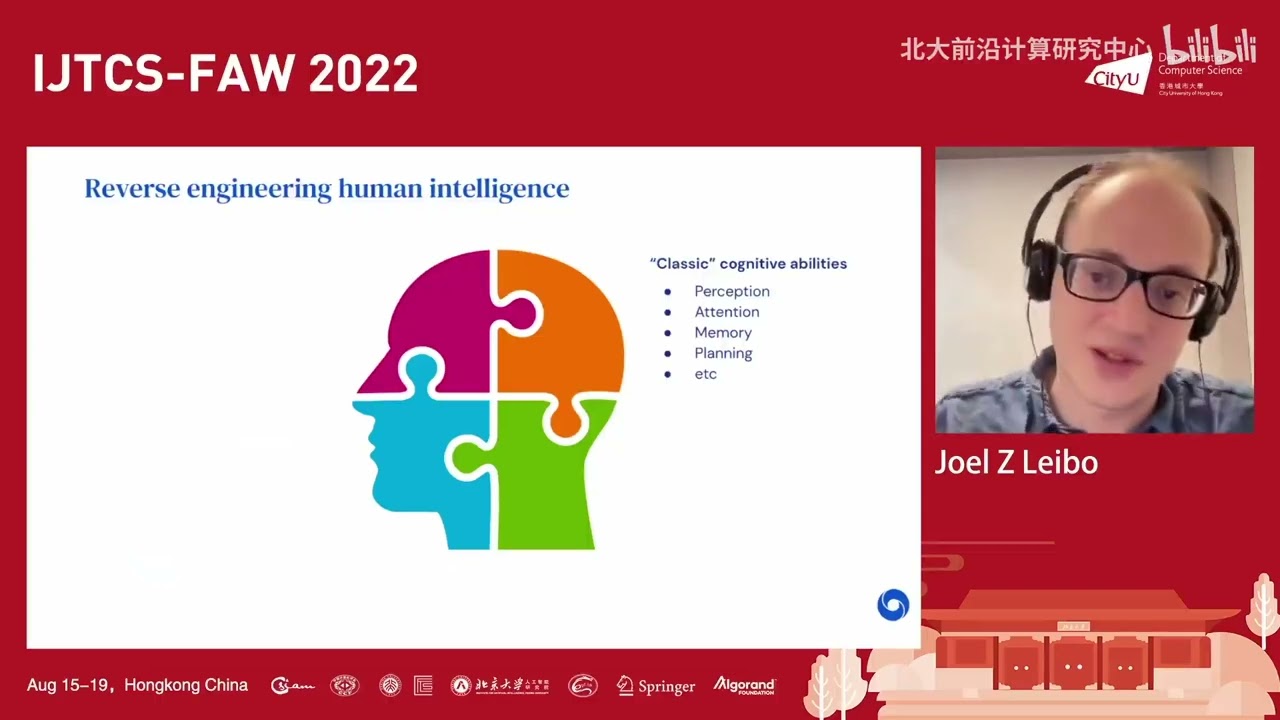
Artificial Intelligence is often divided between narrow applications and the pursuit of Artificial General Intelligence (AGI). Joe Leibo’s research focuses on the latter, specifically through a “human-like” lens that prioritizes the principles of how our intelligence evolved.
He argues that the most impressive feats of intelligence are not the products of individuals, but the achievements of groups working in concert.
A landmark 2007 study compared two-year-old humans with chimpanzees and orangutans on physical and social IQ tests. While all three species performed similarly on physical tasks like spatial rotation and quantity discrimination, the human children vastly outperformed the apes in social domains. This “Cultural Intelligence Hypothesis” posits that social skills are the “initial difference” that allows humans to learn from one another and eventually dominate the planet.

💡 Digging Deeper
Q: What exactly are SCCRMs?
A: They are Social Cognitive Capacities, Representations, and Motivations—the underlying toolkit (like theory of mind, social graphs, and emotions like shame) that enables cooperation.
Q: Why focus on groups rather than individual AI agents?
A: Because human-level intelligence is cumulative; it relies on language, norms, and institutions that no single individual could invent from scratch.
Solving the Tragedy of the Commons
In economics, goods are categorized by excludability (how easily others are kept away) and subtractability (whether using it depletes it). Common pool resources, like fisheries or pastures, are subtractable but non-excludable, making them prone to the “Tragedy of the Commons.”
In Leibo’s Commons Harvest environment, reinforcement learning (RL) agents race to eat apples. Because apples regrow faster when they are dense, a sustainable agent would show restraint.
However, in a multi-agent setting, “vanilla” RL agents fail miserably. They eat everything instantly because any apple they leave behind is simply consumed by a rival, providing no reinforcement for restraint. This creates a race to the bottom where the resource is permanently depleted within seconds.
The dilemma changes when agents are given the ability to “zap” or sanction each other. In maps with choke points, agents learn to exclude others, turning a social dilemma back into a single-agent problem. While this leads to inequality, it achieves sustainability by effectively creating “private property” through force.

The Public Goods Problem and the Power of Reputation
Public goods, such as clean air or national defense, are non-excludable and non-subtractable, presenting a different challenge: free-riding. In the Cleanup environment, agents must clean a river to make apples grow, but the cleaners often get no apples because others stay in the grove and eat the fruits of their labor.
Traditional RL struggles here because the “credit assignment” cycle is too long; an agent cleaning the river doesn’t see an immediate reward, and by the time apples appear, they are gone.
To solve this, Leibo’s team introduced “imitator” agents. These agents are intrinsically motivated to match the “niceness” or prosociality of others. When an innovator cleans, the imitators follow suit, creating a self-sustaining cycle of cooperation that benefits the entire group.
When humans play this game, they cooperate far more effectively when they are identifiable rather than anonymous. In identifiable modes, humans engage in “competitive altruism,” cleaning the river to maintain a high reputation. This suggests that for AI to be truly human-like, it must value its standing within a social group.

Key Takeaways
We must move beyond the idea that all social problems are just “Prisoner’s Dilemmas.” Different environmental pressures—whether they involve depletable resources or the maintenance of public infrastructure—demand distinct social cognitive capacities. Over-abstracting these challenges is the enemy of progress in AGI research.
General intelligence is not a single algorithm but a suite of adaptive social strategies. DeepMind’s Melting Pot is an effort to formalize this by testing agents across dozens of scenarios to see which behaviors generalize. By reverse-engineering the pressures of our evolutionary past, we can train agents that don’t just solve tasks, but actually understand how to coexist and thrive within a group.
Finally, the transition from anonymity to identifiability is a powerful lever for cooperation. Whether in humans or AI, the presence of a social “shadow of the future”—the knowledge that your current actions will affect your future treatment—is what keeps the tragedy of the commons at bay.
Q&A
Q1: How does Leibo define “Human-like AI”?
A1: It is AI built on the principles of human intelligence, specifically focusing on the social cognitive abilities that allow for cumulative culture rather than just raw processing power.
Q2: What is the “Melting Pot” project?
A2: It is an open-source suite of over 85 multi-agent reinforcement learning environments designed to test how well AI agents can generalize their cooperative behaviors to new social situations.
Q3: Why do standard RL agents fail in the “Cleanup” game?
A3: They fail because of a “chicken and egg” problem; agents won’t clean without a reward, but they won’t get a reward unless they clean consistently enough for others to notice and react.
Q4: What is the difference between territorial and turn-taking strategies?
A4: Territorial strategies involve agents claiming specific areas to manage themselves, while turn-taking involves agents alternating between cleaning and harvesting for the whole group.
Q5: How did anonymity affect human players in the DeepMind study?
A5: Anonymity significantly reduced cooperation; when players didn’t know who was who, they cleaned the river much less and focused on selfish harvesting, leading to lower total rewards.
Q6: Can “zapping” or punishment actually lead to cooperation?
A6: Yes. When paired with inequity aversion (a dislike of others having more), agents use zapping beams to “police” free-riders, which eventually teaches the group to follow social norms.
Q7: What is the ultimate goal of this research program?
A7: To build a cooperative AI that understands how to work with both humans and other AIs by mastering the social cognitive capacities that underpin human society.