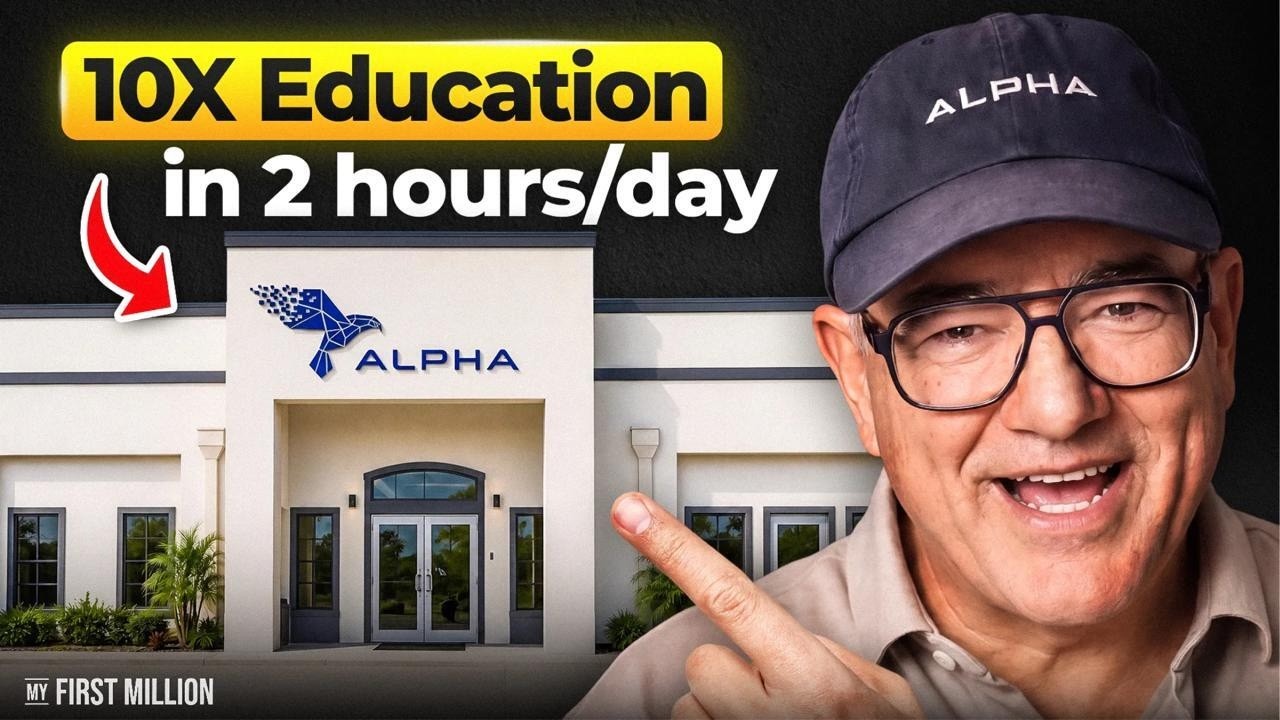
📺 Today’s recommended deep-dive video: https://www.youtube.com/watch?v=GaXsABG1_GM
The Billionaire Reimagining Education: Joe Liemandt’s Quest for 10x Learning
After building a billion-dollar empire and out-recruiting Bill Gates at the height of Microsoft’s power, Joe Liemandt disappeared for twenty years. Now, he has returned with a billion-dollar personal investment and a radical blueprint to prove that the current education system is wasting 80% of our children’s potential.
Core Question: Can the high-intensity principles of Silicon Valley engineering and Navy SEAL training be applied to fix a broken global education system?
Highlights
- Joe Liemandt explains how Trilogy became the first AI company to generate $1 billion in revenue through “configurator” software.
- The secret to beating Microsoft in recruiting was offering the hardest possible challenges rather than the easiest perks.
- Alpha School uses a “Time Back” model where students learn twice as much in 120 minutes as they do in a traditional six-hour day.
- The strategy for scaling to one billion students involves a multi-billion dollar investment and a focus on “high standards, high support.”
⏱️ Reading time: approx. 8 minutes · Saves you about 54 minutes vs. watching.
Want to take notes while watching? Click the image below and let AI Notebook capture the key points for you 👇

The Trilogy Playbook: Recruiting for Intensity
Hard Challenges Over Easy Perks
Joe Liemandt didn’t just build a software company; he built an elite talent magnet that famously forced Bill Gates to personally call every recruit who turned down Microsoft.
In the early 90s, Trilogy solved the “configurator” problem—an incredibly complex AI challenge that allowed Fortune 500 companies to accurately build massive products like Boeing airplanes or mainframe computers. By tackling technically impossible problems, Liemandt was able to attract the top 1% of computer scientists from MIT and Stanford, effectively convincing them that their work had higher stakes than anything happening in Redmond. He realized early on that young, ambitious people are not attracted to laundry services or free snacks; they are attracted to significance and the opportunity to do things that have never been done before.
The company’s culture was defined by a ruthless commitment to intensity, which included a swap program with the Navy SEALs and a requirement for new hires to bet a month’s salary on a single roulette spin. It wasn’t about the money, but about proving a willingness to take calculated risks in pursuit of greatness.

💡 Digging Deeper
Q: Why did Bill Gates fly to Austin to meet you?
A: He wanted to reverse-engineer why we were winning 70% of the candidates we both made offers to. It was a fight for talent, and he realized we were offering something more intense than Microsoft was at the time.
Q: What was the goal of the “Vegas bet”?
A: It was a test of risk-taking. If you want a venture capitalist to give you millions of dollars, you have to be willing to put something on the line. It filtered for people who truly had an entrepreneurial “gear.”
Q: How did you handle Fortune 500 sales as a college dropout?
A: We focused on ROI. We were the most expensive software on the market because we knew our product saved companies hundreds of millions of dollars. We were the “last choice” because we were kids, but we were the only ones who could actually solve the problem.
The Alpha School Revolution
High Standards, High Support
Liemandt’s new venture, Alpha, seeks to apply these high-intensity principles to K-12 education by leveraging generative AI to personalize the learning path for every student.
The school’s primary metric is “Love of School,” measured by asking kids if they would rather be in class or on a family vacation. Currently, nearly half of Alpha students prefer school, a feat Liemandt claims is only possible by setting incredibly high bars. If you have low standards, you can’t build a school that kids love, because excitement comes from doing hard things with friends and winning.
To achieve this, Alpha uses a “two-hour power hour” where students use AI-driven software to master academic content at 10 times the speed of traditional methods. Once the core academics are finished by mid-morning, the rest of the day is dedicated to “Life Skills”—including public speaking, financial literacy, and physical challenges like second graders running a 5K or kindergartners conquering 40-foot rock walls.

💡 Digging Deeper
Q: Why do kids need to learn twice as fast?
A: Because we currently suck up 12 years of a child’s life sitting in class. If technology can give them that time back, they can spend it learning leadership, grit, and entrepreneurship.
Q: How do you get a 7th grader to care about a test?
A: We use “scaffolding” and motivation. We might offer a $100 bill for a perfect score, but allow them to start with a 3rd-grade test. Once they see that 100% is possible through work, their mindset shifts.
Q: What is “High Support”?
A: It’s the mentor mindset. You give hard feedback, but you preface it by saying, “I’m giving you this because I know you can crush this.” It’s about providing the tools to meet the high standard.
Scaling to a Billion Students
The Business of Transformation
Moving from a single high-end private school in Austin to a billion students worldwide requires a shift from philanthropy to a scalable, capitalistic business model.
Liemandt argues that non-profits are inherently non-scalable because their growth depends on donations rather than profit-driven reinvestment; therefore, Alpha is designed as a profitable entity capable of attracting the tens of billions of dollars needed for global expansion. He views Alpha as the “Tesla Roadster” of education—a high-end product that builds the brand and funds the technology for eventual mass-market deployment in public sectors. This approach ensures that the “Time Back” software is refined in a high-stakes environment before it is ever offered to the broader public.
By 2045, Liemandt envisions a world where AI has fundamentally replaced the “teacher at a whiteboard” model with a “mentor and AI-tutor” relationship. The goal is to unlock the “human knowledge graph” by allowing 17-year-olds to reach the research capabilities currently reserved for Stanford PhDs.

💡 Digging Deeper
Q: Why did other billionaires tell you not to do this?
A: They saw it as the lowest ROI philanthropic endeavor possible because the system is so resistant to change. I decided to approach it as a business problem instead of a charity problem.
Q: How do you scale physical buildings?
A: By proving the model is profitable. Capitalism will provide the capital once you show a business that works. We are also building “specialized academies” for sports and gifted students to capture different market segments.
Q: Is AI going to make kids “dumb”?
A: Only if it’s used as a “cheat bot.” We use it to help students reach Depth of Knowledge (DOK) level 4—creating new knowledge—while the AI handles the lower-level summarization and fact-finding.
Key Takeaways
The fundamental shift Liemandt proposes is moving from a “factory model” of education to an “intensity model.” By utilizing AI to compress academic learning into two hours, schools can finally address the “missing curriculum” of life skills that the industrial age ignored. This isn’t just about faster math; it’s about giving children the agency to fail, recover, and eventually master their environment.
Raising the standards for what a child can achieve is the most powerful lever for societal change. When a second grader runs a 5K or an eighth grader completes a Tough Mudder, they are not just exercising; they are rewriting their internal narrative about what is “impossible.” This self-confidence, combined with 10x academic efficiency, creates a generation capable of solving problems that our current systems cannot even define.
Q&A
Q1: What is the “Time Back” software?
A1: It is a generative AI engine designed to teach kids academic concepts 10 times faster than a traditional teacher, allowing them to finish a day’s work in two hours.
Q2: How does Alpha measure success?
A2: Success is measured by academic mastery (100% scores), the “Love of School” index, and the achievement of “impossible” physical or entrepreneurial goals every 10 weeks.
Q3: Why focus on the private school market first?
A3: It serves as a $100 billion “beachhead” where parents are willing to pay for innovation, providing the R&D funds to eventually move the technology into the public sector.
Q4: What are the “Three Lines” of Alpha’s strategy?
A4: 1. You will love school. 2. You will learn twice as much in two hours. 3. You will learn valuable life skills to thrive in the new world.
Q5: What is Depth of Knowledge (DOK) level 4?
A5: It is the highest level of learning where a student creates new knowledge or insights that didn’t exist before, rather than just summarizing existing facts.
Q6: Why is Liemandt back in the limelight after 20 years?
A6: He believes the biggest impediment to educational change is parent disbelief, and he needs to be public to “educate the parents” on what is actually possible for their children.
Q7: What is the “Science of Motivating” (10 to 25)?
A7: It is a framework by Dr. Yeager used at Alpha to move kids toward independence and growth mindsets through “mentor” coaching rather than traditional “boss” teaching.