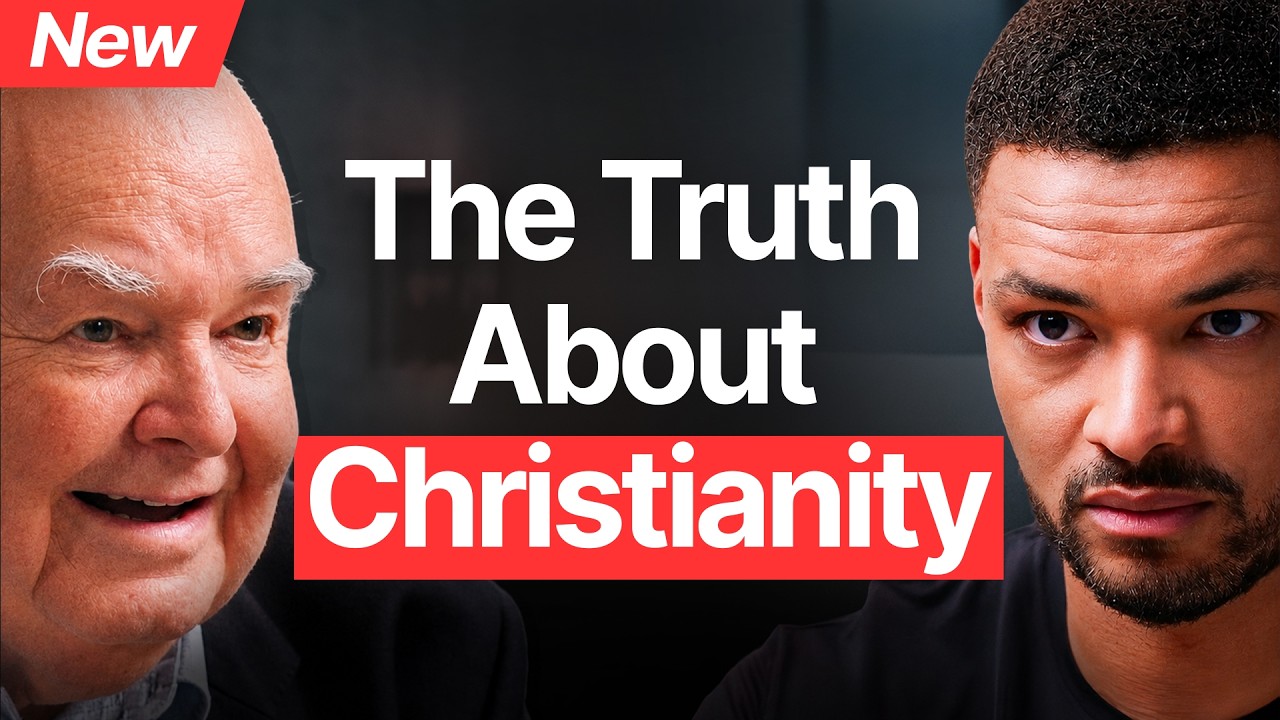
📺 Today’s recommended deep-dive video: https://www.youtube.com/watch?v=dLrvJeSugkM
Beyond the Algorithm: Why AI Can’t Capture the Human Soul
As Silicon Valley races toward Artificial General Intelligence, Oxford mathematician John Lennox argues we are sleepwalking into a “power grab” that threatens the very definition of human identity. This conversation explores the intersection of high-level logic and ancient faith, suggesting that while machines can simulate intelligence, they will never grasp the “redness of red.”
Core Question: Can a universe grounded in mathematical logic coexist with a personal God, or is humanity destined to engineer its own digital replacement?
Highlights
- The distinction between “narrow AI” solving specific tasks and the “transhumanist” drive to solve physical death.
- Why the “word-based” nature of both mathematics and biology points toward a rational creator rather than a random process.
- The psychological and philosophical dangers of treating unconscious machines as if they were sentient beings.
- A redefinition of faith as an evidence-based trust rather than a blind leap into the dark.
⏱️ Reading time: approx. 9 minutes · Saves you about 77 minutes vs. watching.
Want to take notes while watching? Click the image below and let AI Notebook capture the key points for you 👇

The Machine God and the Transhumanist Agenda
The Drive for Self-Deification
We are witnessing a modern drive for self-deification, where human beings attempt to solve physical death as if it were merely a technical glitch in the biological software. This ambition, championed by thinkers like Yuval Noah Harari, suggests that the 21st century’s primary agenda is to upgrade humans into “gods” through bioengineering and mechanical implants.
Harari argues that because evolution brought us to this point through unguided processes, we must now take the reins to engineer a superhuman future. This vision of “Homodeus” moves beyond organic brains toward machine-based superintelligence, promising a merger that supposedly transcends our biological limitations.
This transition represents a colossal power grab by those who control the algorithms, often bypassed by the ethics needed to govern them. Lennox suggests that while technology advances at breakneck speeds, our moral framework remains static, leaving us vulnerable to totalitarian structures that utilize social credit systems to suppress dissent under the guise of progress.

💡 Digging Deeper
Q: What is the difference between Narrow AI and AGI?
A: Narrow AI is a system designed to perform one specific task that requires intelligence, like diagnosing cancer. AGI (Artificial General Intelligence) is the theoretical goal of a machine that can do any intellectual task a human can, but faster and better.
Q: Why does Lennox call the pursuit of AI a “religion”?
A: Because it mimics divine qualities: it appears omniscient (accessible knowledge), omnipresent (via the internet), and offers a version of eternal life through “uploading” consciousness.
Q: How does the trial of Jesus relate to modern AI?
A: It represents the ultimate clash between power and truth. While AI represents a massive accumulation of power, it lacks the “word-based” truth that Jesus claimed to embody.
The Logic of a Word-Based Universe
Why Mathematicians Believe in the Logos
If the computer you use daily were the result of a purely random, unguided process, you would never trust its output for a single calculation. Yet, many high-powered scientists paradoxically believe their own minds—the very instruments they use to decode the laws of physics—are the end products of mindless evolution. This fundamental contradiction undermines the very rationality required to conduct scientific inquiry in the first place.
Mathematics works because the universe is constructed on a rational, word-based foundation that resonates with the biological language found within the human genome.
Thinking God’s thoughts after Him, as Kepler famously put it, describes the experience of a scientist discovering that the cosmos is intelligible. This intelligibility is not a given; it is a profound clue that points toward an underlying intelligence that precedes the material world we observe.

💡 Digging Deeper
Q: Why does Lennox reject atheism as irrational?
A: He argues that atheism suggests the human mind is the product of unguided, random processes, which should logically make us doubt the reliability of our own thoughts.
Q: What is the “Red Ferrari” analogy?
A: It illustrates that you cannot know if a claim is true (like a car parked outside) unless you step out and look. Skepticism should lead to investigation, not just distance.
Q: How do the two hemispheres of the brain affect our view of God?
A: Following Iain McGilchrist, Lennox notes the West focuses on the “narrow-focus” left brain, understanding how things work while losing the “big-picture” right brain, which provides meaning and context.
Consciousness and the Problem of Suffering
The Limits of Machine Simulation
Machines do not experience “qualia,” meaning they have no internal awareness of the color red or the weight of a heavy heart. They simulate intelligence through complex pattern recognition but remain devoid of the actual consciousness that gives human life its supreme dignity and value.
Treating robots as conscious beings is a dangerous form of anthropomorphism that demeans our own value as moral agents.
When confronted with the reality of natural disasters or parasites, Lennox points to the cross as the ultimate evidence of a God who does not remain distant from suffering. By becoming part of the human experience and facing death directly, this perspective offers a hope that transcends material compensation, suggesting a world where every tear is eventually answered by a restorative justice.
True peace is not found in the optimization of an algorithm, but in the certainty of being forgiven by a person who understands the depths of human failure.

💡 Digging Deeper
Q: Can AI be creative?
A: It can generate “new” combinations of data, but it has no awareness of what it is creating. It doesn’t know what a “child” is; it only knows the data patterns associated with the word.
Q: Why is the Resurrection central to Lennox’s view of the future?
A: Because it suggests that the “technical problem” of death has already been solved by God, offering a “paradise” that isn’t dependent on human engineering.
Q: How does Lennox define “Grace”?
A: Unlike merit-based religions where you hope your good deeds outweigh the bad, Christianity is based on an acceptance that comes at the start of the journey, not the end.
Key Takeaways
John Lennox presents a compelling argument that the rise of AI does not render faith obsolete but rather highlights the unique, non-computable nature of the human spirit. While transhumanism seeks to “upload” humanity into a digital eternity, Lennox argues that a more profound “uploading” was promised centuries ago—one based on a relationship with a creator rather than a merger with a machine.
The most powerful evidence for this worldview, as noted by the interviewer, is the “peace and contentment” that often accompanies those who find an anchor in these beliefs. In a world increasingly fragmented by deepfakes and digital isolation, the call is to return to a “touch and feel” reality, reclaiming the five senses and the moral consciousness that no machine, however “superintelligent,” can ever truly replicate.
Q&A
Q1: Is it fair that the “birth lottery” determines most people’s religion?
A: Everyone has a responsibility to respond to the evidence they have. Just as an atheist may stay in the “faith” of their parents, we must all interrogate whether our worldview is based on truth or just tradition.
Q2: If God is all-knowing, why create people He knows will fail or suffer?
A: This is the hardest question of all. However, if God is a god of love, He allows for the possibility of rejection because love requires free will. The cross shows that God is willing to suffer alongside us in that mess.
Q3: Can a serial killer really be forgiven and go to heaven?
A: Christianity teaches that no one is “good” enough on their own. Forgiveness is a gift available to anyone who truly repents, including those who have made a total mess of their lives, as seen in the story of the thief on the cross.
Q4: Is AI a threat to human meaning?
A: Yes, if we allow it to replace the things only humans can do—like forming real relationships and exercising moral judgment. It may actually force us to “regress” back to a more human way of living centered on physical connection.
Q5: Why do mathematicians often lean toward atheism?
A: Lennox disputes this, noting that the pioneers of modern science were almost all believers. He argues that mathematics itself is one of the strongest evidences for a “word-based” universe.
Q6: What should we do to restore hope in a challenging world?
A: Give people a basis for hope that transcends this material world. For Lennox, that basis is found exclusively in the life and resurrection of Christ.
Q7: Will AI ever be conscious?
A: Science cannot even define what consciousness is, let alone replicate it. While AI can “imitate” consciousness (the imitation game), it lacks the “hard problem” of subjective experience.