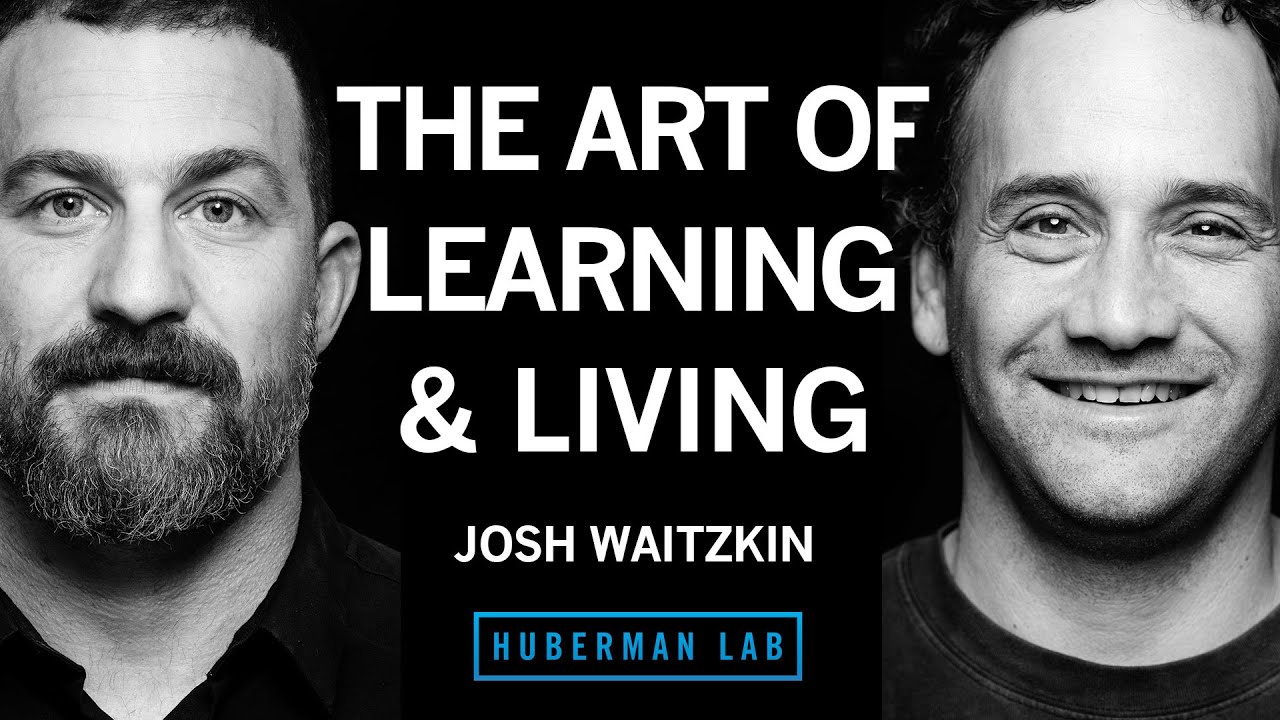
📺 Today’s recommended deep-dive video: https://www.youtube.com/watch?v=wAnDWfEIwoE
The Architecture of Virtuosity: Mastering Transitions and Thematic Interconnectedness
Josh Waitzkin, a former chess prodigy and martial arts world champion, shares his evolved philosophy on the science of learning and high performance. He deconstructs the cognitive and physiological tools used to coach elite investors, athletes, and scientists toward post-conscious mastery.
Core Question: How can we bridge the gap between technical skill and creative virtuosity by leveraging transitions and thematic patterns across different disciplines?
Highlights
- The “Tunnel” transition from pre-conscious to post-conscious performance.
- Harnessing the “in-between” spaces and high frame-rate perception.
- The “Most Important Question” (MIQ) process for unconscious problem-solving.
- Why elite performance requires the rhythmic oscillation of stress and recovery.
⏱️ Reading time: approx. 12 minutes · Saves you about 185 minutes vs. watching.
Want to take notes while watching? Click the image below and let AI Notebook capture the key points for you 👇

The Psychology of the Arena
Navigating the Pressure Cooker of Excellence
Waitzkin’s early development was forged in the high-pressure environment of New York City’s Washington Square Park, where he learned chess from hustlers who used psychological warfare as much as strategy. He describes a unique sensation of “rediscovering” the game rather than learning it, an experience that quickly evolved into a competitive lifestyle where every mistake was publicly analyzed by masters. This constant exposure to scrutiny forced an early adoption of truth-seeking; if a weakness wasn’t addressed, his rivals would inevitably exploit it until he felt the visceral sting of a devastating loss.
This created a “pressure cooker” of development where survival depended on analyzing the opponent’s misdirection and strategic traps.
As he reached the highest levels of the game, Waitzkin experienced the “tunnel” of self-consciousness that many performers face when they transition from gifted amateur to scrutinized professional. Transitioning from a pre-conscious, playful child to a post-conscious, scrutinized adult meant navigating a period of internal turmoil where external expectations threatened to choke his natural creativity and flow on the board. He argues that most performers break in this tunnel because they try to return to their naive past rather than integrating their new, complex reality into a deeper level of liberated mastery.

💡 Digging Deeper
Q: Why do many child prodigies fail to succeed as adults?
A: They often develop a “brittleness” by associating mastery with innate talent rather than the hard-work process, leading to a fear of failure that prevents them from taking the risks necessary for adult growth.
Q: How can you take on a weakness effectively?
A: By learning your weaknesses through the lens of your strengths—for example, an aggressive chess player learning defensive strategy by studying how elite attackers defend against counter-attacks.
Q: What is the benefit of a devastating loss?
A: It serves as a “relentless truth-teller” that exposes psychological and technical gaps, providing a neurochemical wavefront for rapid plasticity and growth.
The Art of the In-Between
Frame Rate and the Scramble
High-level performance is rarely about static positions but rather the fluid spaces in between them, a concept Waitzkin applies to both Jiu-Jitsu and high-stakes finance. He cites Marcelo Garcia, the legendary grappler, who dominated by never holding a position but instead living entirely in the “scramble,” providing him with significantly more “frames” of perception than his static opponents. Most people train for positions; the virtuoso trains for the transition, finding opportunities in the pockets of time that others ignore or simply cannot see.
This concept of “frame rate” is deeply tied to autonomic arousal and the visual system’s aperture.
When adrenaline spikes, the brain slices time more finely, creating the subjective experience of the world slowing down, which can be harnessed through deliberate training. By practicing in these high-stress transitions—whether on the mats, in big-wave foiling, or in cold water—a performer can learn to maintain cognitive clarity while their opponent remains trapped in a lower-resolution perception of the exchange. Waitzkin emphasizes that the ability to “turn it on” with intensity is directly proportional to the ability to “turn it off” and achieve deep physiological relaxation during lulls.

💡 Digging Deeper
Q: How does Marcelo Garcia’s “King of the Scramble” title relate to learning?
A: He avoided static dominance in training to maximize exposure to transitions, effectively training his brain to process the “in-between” moments that others treat as noise.
Q: Can you control your frame rate at will?
A: Yes, through biofeedback and visual aperture control. Shrinking your focus increases arousal and frame rate, while viewing the horizon (panoramic vision) triggers relaxation and a broader temporal slice.
Q: What is “Firewalking” in a learning context?
A: The cultivation of the ability to learn from others’ mistakes with the same somatic intensity as if you had experienced the failure yourself.
Practical Tools for the Mind
The MIQ Process and Stress/Recovery
The “Most Important Question” (MIQ) process is Waitzkin’s cornerstone for cognitive training and shared team consciousness. It involves identifying the specific “stuck point” or critical bottleneck in a project at the very end of the workday, then releasing it entirely to allow the unconscious mind to process it during sleep. By returning to this specific question first thing in the morning—pre-input, before checking phones or emails—the performer can harvest the deep, non-linear insights generated by the unconscious overnight.
This rhythmic oscillation between intense, 10-out-of-10 focus and total release mimics physical interval training.
Without a deliberate “off” switch, the mind falls into a “simmering six”—a state of mediocre, constant effort that lacks the intensity required for true breakthroughs. Waitzkin uses cold plunging not just for recovery, but as a laboratory to practice “living on the other side of pain,” training the mind to remain calm and analytical while the body is in a state of high-adrenaline alarm. This thematic training ensures that when a crisis hits in a professional arena, the physiological response is already familiar and managed.

💡 Digging Deeper
Q: Why is “pre-input” time so critical in the morning?
A: External inputs like email force the brain into a reactive, stimulus-response mode, which immediately shuts down the creative geysering from the unconscious mind’s overnight work.
Q: How long is an ideal deep-work session?
A: Waitzkin found that 4.5 hours of 10-out-of-10 intensity is his sweet spot, with the rest of the day dedicated to activities that cultivate and feed those prime hours.
Q: How does cold plunging translate to business?
A: It is a controlled environment to practice managing the “walls of adrenaline,” teaching you to breathe through stress rather than reacting impulsively to it.
Key Takeaways
Virtuosity is not a static destination but a way of living that prioritizes “Dynamic Quality” over stale mental models. Waitzkin’s journey through chess, Tai Chi, and foiling demonstrates that the most profound lessons are thematic; a breakthrough in understanding “empty space” in a chess game can directly lead to a world championship in martial arts years later. This interconnectedness suggests that we should not silo our lives, but rather look for the underlying principles—like receptivity, tension, and release—that govern every arena we enter.
We must become comfortable with the “relentless truth-telling” of the arena, whether that is a chessboard, a trading floor, or a cold plunge.
True growth occurs at the point of resistance, where we are forced to confront the “stains” on our lighthouse—those points of shame or weakness we usually avoid. By hunting for these areas of stuckness and bringing them into our MIQ process, we turn our greatest vulnerabilities into our primary power zones. Ultimately, high performance is a work of art that requires us to be as disciplined about our recovery as we are about our effort.
Q&A
Q1: How do you define “Thematic Interconnectedness”?
A: It is the idea that technical mistakes in one field are usually manifestations of a psychological or thematic pattern that exists across all areas of your life, including your relationships and health.
Q2: What is the “simmering six”?
A: It is a state of moderate, constant stress where you are never fully “on” (performing at a 10) and never fully “off” (recovering at a 0), leading to burnout and lack of creative breakthroughs.
Q3: How does Waitzkin view the role of AI in learning?
A: He sees AI like AlphaZero as a tool that can replicate the entire scientific process at a massive scale (3800 ELO equivalent), but emphasizes that human safety and light-side motivations must drive its development.
Q4: What is the benefit of writing down a chess move before making it?
A: It forces a “resurfacing” from deep calculation back to common sense, allowing the player to catch obvious blunders that the hyper-focused mind might miss while lost in the labyrinth.
Q5: Why is the shower a common place for insights?
A: The combination of white noise and somatic immersion moves the mind out of conscious, linear thinking, allowing the signal of a creative thought to rise above the noise.
Q6: What is the “Post-Conscious” performer?
A: A performer who has moved through the crisis of self-consciousness and integrated their awareness of mortality and absurdity into a deeper, more resilient state of flow.