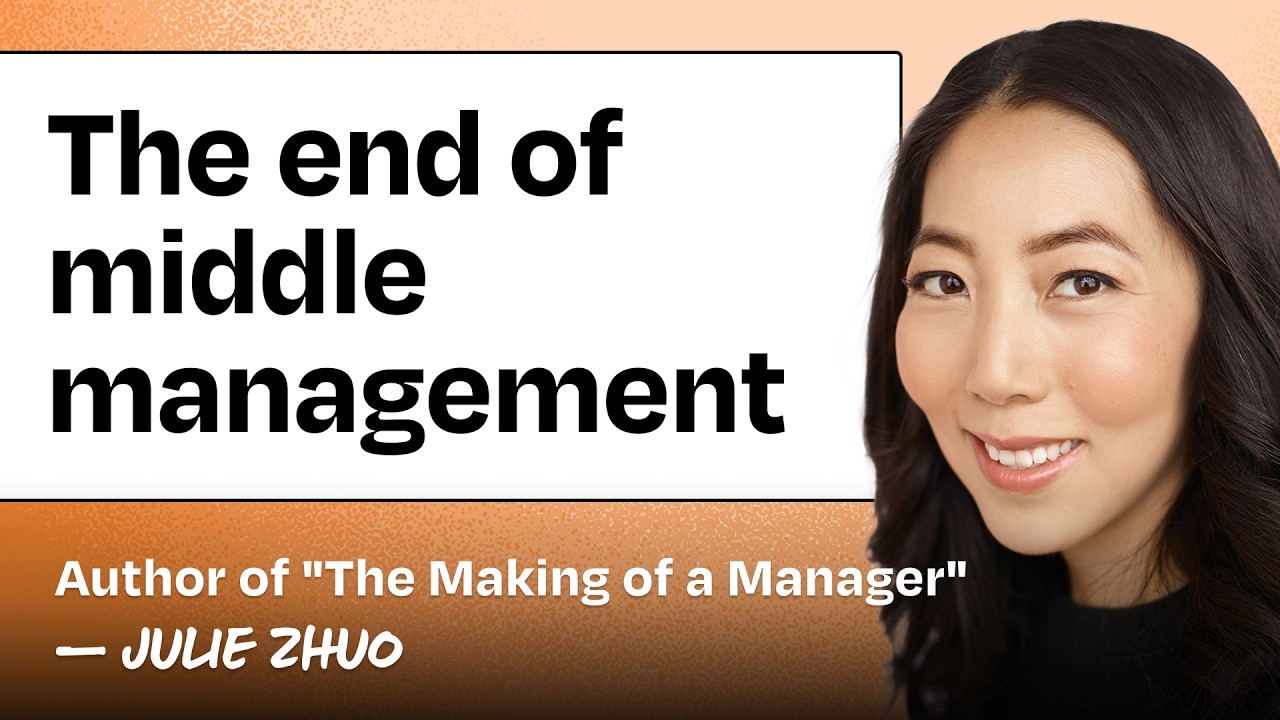
📺 Today’s recommended deep-dive video: https://www.youtube.com/watch?v=c_w0LaFahxk
The “Builder” Era: Why Every Individual is Now a Manager
In a world where AI agents are becoming integrated into every workflow, the traditional boundaries between product roles are rapidly dissolving. Former Meta VP of Design Julie Zhuo explains why the skills of great managers—defining outcomes, managing change, and providing feedback—are now the essential toolkit for every individual builder.
Core Question: How does the rise of AI transform organizational structures and the fundamental craft of product leadership?
Highlights
- Why the “Builder” title is replacing traditional PM, design, and engineering silos.
- The “Willow Tree” philosophy for leading teams through rapid technological change.
- Why you should “diagnose with data and treat with design” to build better products.
- The “Magic Loop” of feedback and how to turn every critique into a gift.
⏱️ Reading time: approx. 8 minutes · Saves you about 88 minutes vs. watching.
Want to take notes while watching? Click the image below and let AI Notebook capture the key points for you 👇

The Dissolution of Traditional Roles
From Specialists to Builders
The era of rigid, siloed roles—where the PM writes the requirements, the designer draws the pixels, and the engineer writes the code—is rapidly coming to an end.
AI now allows a single individual to operate at a “70th percentile” level across multiple disciplines, effectively turning every team member into a full-stack product creator. This shift isn’t just about efficiency; it’s about the psychological ownership that comes when an engineer realizes there is no PM to write the PRD, forcing them to own the user’s intent directly. By dissolving these boundaries, we allow the “Builder” mindset to take over, where the ultimate outcome matters more than the specific job description on a LinkedIn profile.
Small teams of two or three people are now achieving what used to require an army of specialists.
When you remove the safety net of delegation, people are forced to broaden their horizons and engage with the product in a more holistic, visceral way. This creates a faster feedback loop and significantly reduces the friction typically found in large, traditional organizations that suffer from “over-alignment” meetings.

💡 Digging Deeper
Q: If everyone is a builder, do we still need traditional PMs?
A: The skill of product management—prioritization, alignment, and clarity—is more valuable than ever, but it doesn’t always need to reside in a person with the “PM” title.
Q: How should we treat AI agents within our workflow?
A: Interestingly, managing an AI agent requires the same clarity as managing a person: you must define success criteria (evals) and understand the specific “personality” and strengths of the model you are using.
Q: Will AI replace the need for specialized “PhDs” in a craft?
A: No, the top 1% of talent will always be necessary for deep innovation, but AI elevates the floor for everyone else, making the “average” builder far more capable.
Leadership in the “Willow Tree” Era
Managing Change and Conviction
As organizations flatten and middle management layers are removed, the burden of navigating uncertainty falls on every leader who remains.
Today’s effective leader must channel the metaphor of the willow tree: remaining incredibly sturdy in their core vision while staying flexible enough to bend with the winds of technological disruption. The rate of change is accelerating so fast that managers must now deal with a baseline level of fear and career anxiety within their teams.
Real leadership requires a deep check-in with one’s own conviction.
You cannot inspire a team to execute a vision that you only half-heartedly believe in. When you are asked to implement a strategy you disagree with, the solution isn’t to put on a “brave face” but to decompose the plan into specific hypotheses that can be tested. By moving from a binary “good or bad” judgment to a series of assumptions, you create a path for your team to commit to experimentation rather than blind obedience.
This approach humanizes the leadership process.
It allows you to say, “I’m not sure if this lemonade stand on every corner will work, but let’s test the hypothesis that people actually want lemonade in this specific neighborhood first.”

💡 Digging Deeper
Q: What is the biggest mistake new managers make during change?
A: Pretending that everything is fine. It is much better to acknowledge that things are weird and chaotic while maintaining a focus on the long-term opportunity.
Q: How do you handle the “soldier” mentality?
A: Avoid it. If you feel like you are just taking orders, you aren’t leading. You must find the piece of the strategy you actually believe in and anchor your team there.
Q: Is management fundamentally different in the AI age?
A: The goals (outcomes) and process are the same, but the “people” pillar now includes models. You are “assembling the Avengers” using both human and synthetic talent.
Data as a Diagnostic Tool
Diagnose with Data, Treat with Design
Many designers fear that being data-driven means losing their creative soul to endless A/B tests, but data is simply a tool for calibrating your intuition against reality.
Julie suggests a fundamental framework: “Diagnose with data, treat with design.” This means using metrics to identify where the friction lies—like low retention or high drop-off—without expecting the numbers to tell you exactly what the creative cure should be. This approach respects the craft of the builder while ensuring they aren’t building in a vacuum.
In the current landscape, many hyper-growth AI companies are operating entirely on “vibes” and instincts.
While good instincts can carry a product to its first 100 million users, eventually growth stalls, and that is where a lack of rigorous observability becomes a fatal flaw. Without knowing why people are using the product (intent) or where they are getting stuck, you cannot move beyond the initial “magic” phase of a product’s lifecycle.
Choosing which metrics to track is an art, not a science.
The transition to conversational AI makes this even harder, as we can no longer rely on simple “clicks” to measure success. We now need to use LLMs to bucket user intent and determine if a conversation was actually helpful or just long and frustrating.

💡 Digging Deeper
Q: Can you A/B test your way to a great product?
A: No. A/B tests help you optimize, but they rarely lead to the “big leaps” or “zero-to-one” innovations that require vision.
Q: How do you measure success in a chatbot?
A: You have to move past “session length” and look at qualitative signals—did the user get their answer? Did they have to repeat themselves?
Q: Why do designers often push back on data?
A: Usually because data is being used as a “judge” rather than a “guide.” When data is used to shut down ideas rather than explore them, designers naturally rebel.
Key Takeaways
The most profound shift in the modern workplace is the empowerment of the individual through AI, which effectively turns every “Builder” into a manager of their own synthetic workforce. This doesn’t mean management is dead; rather, it means the tactical skills of management—clarity of goal-setting, rigorous feedback, and the ability to pivot—are now required by everyone, not just those with “Head of” in their title. Success in this era depends on the ability to stay “sturdy but flexible,” maintaining a strong vision while being willing to experiment with the rapidly evolving tools at our disposal.
Furthermore, the relationship between data and design must be one of collaboration rather than conflict. By treating data as a way to “diagnose” problems and design as the “treatment,” builders can ensure they are solving real-world problems instead of just following their own biases. Ultimately, the future belongs to those who can bridge these disciplines, using AI not as a shortcut to avoid hard work, but as a lever to solve more complex, more human problems.
Q&A
Q1: What is the “Magic Loop” of feedback?
A: It’s a system where you proactively ask for feedback, act on it immediately, and then close the loop by showing the person who gave the feedback exactly what you changed. This builds immense trust and accelerates your growth.
Q2: How do you give feedback without making people defensive?
A: First, establish a relationship where you both “opt-in” to helping each other grow. Second, check your intent—are you trying to help them or just trying to be right? Third, state your nerves out loud: “I’m nervous to say this because I value our relationship, but I think this will help you.”
Q3: Why should we call ourselves “Builders” instead of PMs or Designers?
A: Because roles create silos. A “Builder” title implies that you are responsible for the outcome, regardless of whether that requires writing code, designing an interface, or analyzing a spreadsheet.
Q4: How can AI help with professional learning?
A: AI is the ultimate personalized teacher. You can feed it a 12-week curriculum and ask it to explain concepts to you using analogies that match your specific learning style, then ask it to “quiz” you to test your understanding.
Q5: What is the “Willow Tree” metaphor for leadership?
A: It represents being sturdy in your roots (your values and north star) but incredibly flexible in your branches (how you adapt to new tools and market shifts).
Q6: How do you manage a project you don’t believe in?
A: Don’t just be a “soldier.” Decompose the project into its underlying assumptions and find the specific hypotheses you are skeptical about. Propose a small test to validate those assumptions before committing to a massive rollout.
Q7: What is the most important skill for kids to learn in the AI era?
A: Emotional regulation and self-awareness. While AI can shortcut the “work,” it cannot shortcut the human biology of dealing with difficult emotions, boredom, and the need for meaningful challenge.