📺 Today’s recommended deep-dive video: https://www.youtube.com/watch?v=c_w0LaFahxk
The “Builder” Era: Julie Zhuo on Management, Data, and the AI Evolution
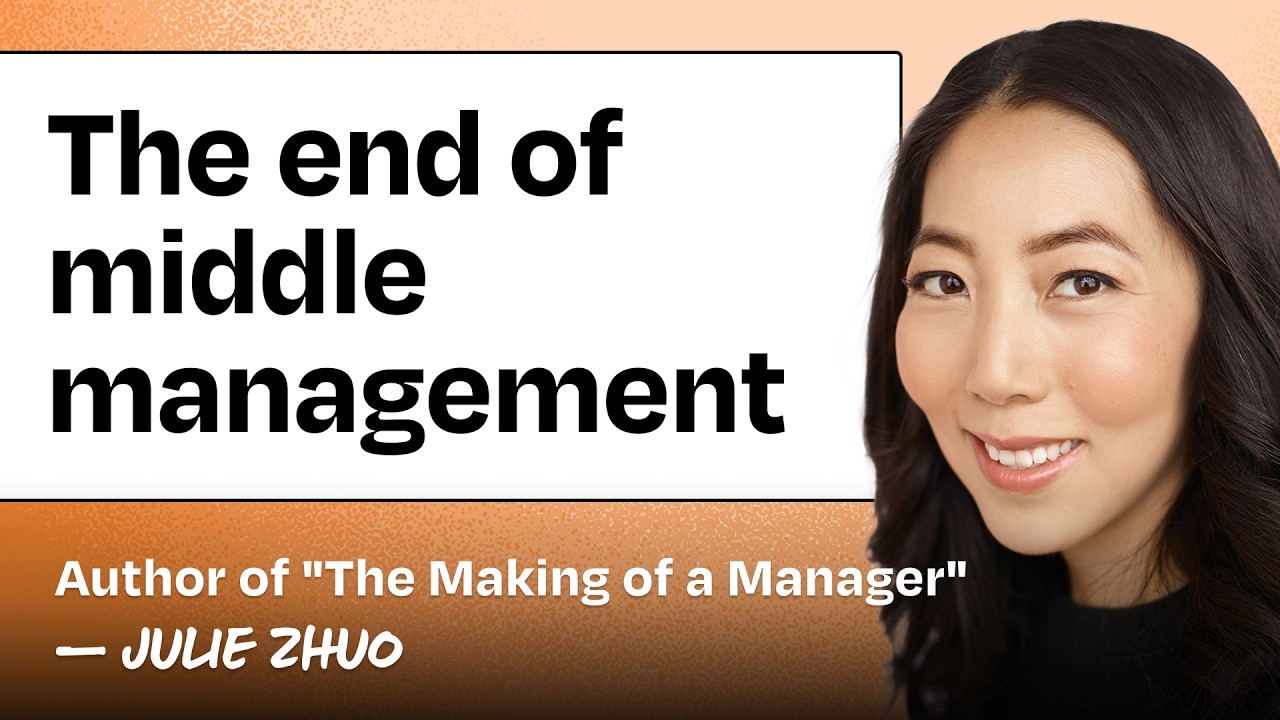
Julie Zhuo, the former head of design at Meta and author of The Making of a Manager, joins the podcast to explore how AI is fundamentally flattening organizational structures. We dive into why traditional role boundaries are dissolving, the secret to “diagnosing with data,” and how to maintain the sturdy flexibility of a willow tree in a world of accelerating change.
Core Question: How do the timeless principles of management translate into a world where we lead AI agents and cross-functional “builders” instead of siloed specialists?
Highlights
- The “Manager” title is evolving into “Builder” as AI empowers individuals to cross-pollinate between design, data, and engineering.
- Managing AI agents requires the same three pillars as managing people: defining the goal, establishing the purpose, and refining the process.
- The “Willow Tree” metaphor: Success in the AI era requires being rooted and sturdy while remaining extremely flexible.
- “Diagnose with data, treat with design”—a framework for using metrics to identify reality without letting them dictate creativity.
⏱️ Reading time: approx. 8 minutes · Saves you about 88 minutes vs. watching.
Want to take notes while watching? Click the image below and let AI Notebook capture the key points for you 👇

The Rise of the Agentic Builder
Dissolving Traditional Role Boundaries
We are currently witnessing a fundamental flattening of organizations where traditional boundaries between engineering, design, and product management are dissolving under the pressure of AI-driven acceleration. In the past, you needed to hire ten specialists to cover ten distinct skill sets, but today’s AI tools empower a single individual to perform at a high percentile across multiple domains simultaneously, effectively turning them into a “builder” rather than a specialist.
This shift doesn’t mean management is dying; rather, it’s becoming a universal skill set for anyone orchestrating complex, agent-integrated workflows.
Whether you are leading a team of humans or a swarm of AI agents, the fundamental requirements remain unchanged: you must define a clear North Star, provide high-level context, and understand the unique strengths of the “models” or people you are deploying. At Julie’s startup, Sundial, they have deliberately avoided hiring product managers to force engineers and designers to own the product definition and user experience themselves. This constraint prevents the “delegation of thinking” and ensures everyone stays in the weeds of what is actually possible.

💡 Digging Deeper
Q: Why does the title “Builder” matter more than traditional titles?
A: It removes the psychological crutch of “staying in your lane.” When you call yourself a builder, you take full ownership of the outcome, whether that requires writing code, designing a UI, or analyzing data.
Q: Can AI actually replace the function of a Product Manager?
A: It can’t replace the skill of product thinking, but it makes the dedicated role less essential. AI allows engineers to quickly grasp market context and designers to prototype complex logic, closing the gap that PMs traditionally filled as “glue.”
Data as a Diagnostic Tool
Balancing Intuition with Analytical Rigor
Many hyper-growth AI companies are currently operating on “good vibes” and intuition because their rapid expansion outpaces their data infrastructure, but this strategy inevitably hits a wall once organic growth begins to slow. Data isn’t there to tell you what to build next—it is there to reflect reality back to you so you can see if your instincts were actually correct.
Julie proposes a clarifying framework for the design-data tension: you should diagnose problems using data but treat them with design.
While data can illuminate exactly where a user flow is failing or where a business opportunity exists, it lacks the creative capacity to invent the actual solution, which still requires the “art” of human intuition and empathetic vision. Every great designer is ultimately obsessed with data because they are obsessed with reality, using metrics as a mirror to see if their work actually resonates with users in the real world.

💡 Digging Deeper
Q: How is AI changing how we analyze data?
A: We’re moving from simple click-tracking to “conversational analytics.” We now use LLMs to bucket user intent within chat interfaces, which is much more complex than measuring a button click.
Q: What is the “false precision” of numbers?
A: It’s the trap of believing that because a metric went up 5%, it’s a “scientific” success. In reality, choosing which metric to track and how to interpret that growth is a subjective art form.
The Willow Tree Leadership Model
Managing Yourself and the Rate of Change
To survive the accelerating rate of technological change, leaders must emulate the willow tree: remaining rooted and sturdy while their branches bend gracefully to the storm. This requires a level of “dimensionality,” which is the understanding that you are not a single fixed set of skills, but a complex profile of strengths and weaknesses that are often two sides of the same coin.
Managing others starts with managing yourself.
This involves recognizing that your greatest strengths—like being a highly thoughtful, deliberate thinker—often manifest as your greatest weaknesses, such as appearing indecisive or slow in high-pressure meetings. True mastery is not about eliminating these weaknesses but about reading the context of a situation to decide whether to lean into your natural thoughtfulness or push yourself toward rapid, assertive action for the sake of the team.

💡 Digging Deeper
Q: How do you deliver hard feedback effectively?
A: By treating it as a “gift” of information. You must first establish a “win-win” relationship and then state your nervousness out loud to humanize the interaction.
Q: What if you don’t agree with a company’s direction?
A: You must engage in a dialogue to decompose the disagreement into specific hypotheses. You can “disagree and commit” much more effectively when you’ve isolated the specific assumption you’re skeptical about.
Key Takeaways
The age of AI is not the end of management, but its democratization. As tools like ChatGPT and Cursor lower the barrier to technical execution, the skills of a manager—defining success, providing clarity, and managing process—become the essential skills of every individual “builder.” The most successful people in this new era will be those who refuse to stay in their traditional lanes and instead use AI to accelerate their learning and broaden their impact.
Ultimately, leadership in a high-growth environment requires a blend of radical reality-testing and emotional regulation. Whether you are using data to “diagnose” your product’s failures or using feedback to calibrate your own “dimensionality,” the goal is to remain in sync with the truth. By staying sturdy like the trunk of a willow tree but flexible in your methods, you can lead through the chaos of AGI and beyond without losing your sense of purpose.
Q&A
Q1: How do management skills translate to working with AI agents?
A: Management is just the orchestration of resources to reach an outcome. Whether those resources are people or models, you still need to define the “North Star,” assemble the right mix of talents, and create a process for them to interact.
Q2: Why is Julie not hiring Product Managers at her startup?
A: She finds that not having a PM forces engineers and designers to own the product requirements and communication. It prevents specialists from delegating the “thinking” and “alignment” work to someone else, resulting in a faster, more integrated team.
Q3: Can AI tools help with personalized learning?
A: Yes. Julie recommends feeding a 12-week curriculum into an AI and asking it to customize the program based on your learning style—for example, using more analogies or “explain like I’m five” examples.
Q4: What is the best way to seek feedback?
A: Treat it as a calibration against reality. Just as you use metrics to see if a product is working, you use feedback from others to see if your perception of your own performance matches the external truth.
Q5: How do you maintain conviction when things are changing so fast?
A: You must check in with yourself. If you are just parotting orders as a “soldier,” you won’t be effective. You need to understand the underlying hypotheses of a strategy so you can truly believe in the path you are leading others down.
Q6: How can AI be used in parenting?
A: Julie uses the Limitless pendant to record interactions with her kids and then asks for feedback. The AI can highlight moments where she might have cut them off or failed to listen fully, providing a “parenting coach” based on real-world data.
Q7: What is the most important skill for the next generation?
A: Emotional regulation. As technology makes life more “comfortable” and provides endless shortcuts, the ability to choose to do challenging things and sit with difficult emotions will be the ultimate differentiator.