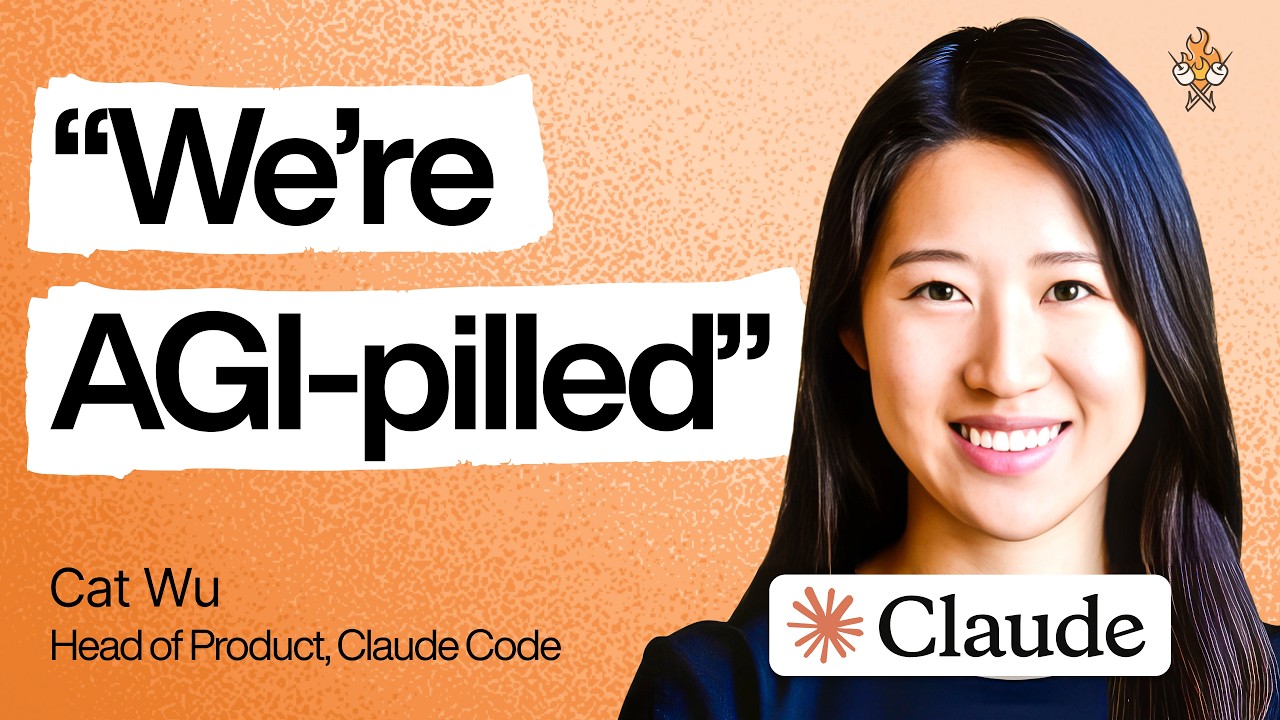
📺 Today’s recommended deep-dive video: https://www.youtube.com/watch?v=PplmzlgE0kg
Shipping at the Speed of AI: Anthropic’s Playbook for Modern Product Management
Kat Wu, Head of Product for Claude Coding at Anthropic, pulls back the curtain on how the world’s most advanced AI teams actually build. In an era where code is cheap and iteration is everything, the traditional 6-month roadmap has been replaced by a “just do things” philosophy that prioritizes speed and taste over bureaucratic alignment.
Core Question: How must the product management role evolve to keep pace with frontier models that can now turn ideas into production-ready features in less than twenty-four hours?
Highlights
- Reducing product shipping cycles from a traditional six months to as little as one day.
- Why “product taste” has become the primary differentiator for PMs as the cost of writing code approaches zero.
- The internal “flywheel” effect: How Anthropic uses Claude Code and Co-work to automate their own workflows and marketing.
- Why a 95% successful automation is a failure, and how to push your AI tools to the 100% “set and forget” threshold.
⏱️ Reading time: approx. 10 minutes · Saves you about 76 minutes vs. watching.
Want to take notes while watching? Click the image below and let AI Notebook capture the key points for you 👇

The Radical Compression of Shipping Cycles
From Roadmaps to Research Previews
The traditional product management lifecycle, once defined by multi-quarter roadmaps and heavy cross-functional coordination, is effectively dead in the high-stakes world of frontier AI development.
Kat Wu explains that at Anthropic, the team focuses on removing every possible barrier to shipping, often reducing feature timelines from six months to a single day. This radical acceleration is fueled by the realization that model capabilities evolve so quickly that long-term planning becomes a liability. Instead of seeking perfect alignment, PMs must prioritize creating “concept corners” where engineers can ship experimental ideas directly into users’ hands for immediate feedback. This isn’t just about moving fast; it is about recognizing that the “AGI-pilled” version of a product changes every time the underlying model gets an update.
Success in this environment requires a shift from managing dependencies to managing iteration speed. By leveraging research previews, the team can test hypotheses without committing to long-term support, allowing them to gather critical usage data while the market and the technology are still in a state of flux.

💡 Digging Deeper
Q: How does the team handle the risk of shipping buggy features so quickly?
A: They lean into “Research Previews.” By clearly branding early features as experimental, they lower the commitment level, allowing the team to gather feedback and fix bugs in the next release rather than delaying for perfection.
Q: What is the “evergreen launch room”?
A: It is a high-speed internal coordination channel where engineers post features ready for release. Cross-functional partners in Docs, Marketing, and DevRel jump in immediately to turn around public announcements within 24 hours.
The New PM Superpower: Product Taste
When Code Becomes a Commodity
As the cost of generating code drops toward zero, the competitive advantage shifts from how to build to what to build.
In the past, PMs spent most of their energy figuring out technical feasibility and resource allocation because engineering hours were the scarcest resource in the company. Today, when an engineer with “product taste” can see a user complaint on Twitter and ship a fix by the end of the week, the PM’s role becomes one of curation and direction. Kat notes that the most valuable skill now is “taste”—the ability to look at ten thousand GitHub issues and intuitively know which five will move the needle for professional developers.
This shift means that the Venn diagram of engineering, design, and product is collapsing into a single, amorphous role.
If you understand the constraints, you can deduce the right course of action and simply execute without waiting for a formal permission structure. This “agency” is what allows small teams at Anthropic to outperform massive organizations that are still bogged down in legacy silos.
💡 Digging Deeper
Q: What does it mean to be “the right amount of AGI-pilled”?
A: It’s the balance of knowing where the technology is going (smart agents) while building for the current model’s reality—eliciting maximum capability from today’s tools rather than waiting for future perfection.
Q: Should PMs write code?
A: While not strictly required, having an engineering background helps a PM understand “how hard” a task should be, which is vital for ruthless prioritization.
Building the Internal Flywheel
Personal Automation and “Co-work”
The true “aha moment” for users occurs when the AI transitions from a chat-based assistant to an action-oriented agent that completes work on their behalf.
Kat shares how she used “Co-work” to automate the creation of a 20-page presentation for an upcoming conference. By connecting the tool to her Google Drive, Slack, and Gmail, the agent was able to research internal demos, synthesize a narrative from a marketing draft, and apply Anthropic’s design system to the slides. She didn’t just get a template; she got a high-fidelity draft that required only minor tweaks. This level of leverage is available to any knowledge worker willing to move past the “chat” interface and into the “agent” workflow.
However, many people stop at 95% automation, which Kat argues is a mistake.
If an automation requires you to check its work every single time because it occasionally fails, it isn’t actually saving you mental bandwidth. To truly thrive, users must put in the “elbow grease” to give the model feedback and iterate on its instructions until it hits 100% reliability. Only then does the “tedious” part of the job truly disappear, leaving 20% more time for creative, high-leverage projects.

💡 Digging Deeper
Q: How do you reach 100% automation?
A: You must treat the AI like a new hire. Give it specific feedback on its mistakes, update its “skills” or system prompts, and verify its work until it internalizes your preferences.
Q: What is the “Power Up” feature?
A: It is an onboarding flow for Claude Code that teaches users the top 10 most valuable features, moving away from the “intuitive products don’t need tutorials” dogma to help users navigate a rapidly expanding feature set.
Key Takeaways
The future of work is not about being replaced by AI; it is about using AI to gain massive leverage. Kat Wu emphasizes that the roles of engineer, designer, and product manager are merging into a “builder” persona characterized by high agency and “just doing things.” The successful builders of tomorrow will be those who can ruthlessly prioritize based on product taste and who refuse to accept “almost working” automations.
At a company level, Anthropic succeeds because of a unifying mission that puts safety and AGI goals above individual product performance. This cultural alignment allows teams to make fast sacrifices—like de-prioritizing a feature if it doesn’t serve the broader mission—without the friction of internal politics. For individuals, the advice is simple: find the most tedious part of your day, use an agent to solve it, and don’t stop until that task is completely off your plate.
Q&A
Q1: How has the PM role changed at Anthropic specifically?
A: It has shifted from multi-quarter planning to helping the team move as fast as possible. PMs now focus on setting clear goals, creating repeatable shipping processes (like Research Previews), and defining “evals” to measure model success.
Q2: What happened with the Claude Code source code leak?
A: It was a result of human error during a PR process that went through two layers of review. The person involved is still at the company, and Anthropic has since hardened its processes and safeguards.
Q3: Why did Anthropic limit the “Open Claude” subscription usage?
A: The demand for Claude was overwhelming. While they want to support the community, they had to prioritize their first-party products and API stability because third-party “wrappers” have usage patterns the infrastructure wasn’t originally designed to handle.
Q4: What is the most important skill for an AI PM today?
A: Product taste. As code becomes cheaper, deciding what to write is more valuable than the act of writing it. This involves knowing the “golden path” for users and patching the model’s current weaknesses.
Q5: How does the team use “evals” in product development?
A: PMs and engineers build small sets of “great evals” (even just 10) to quantify what success looks like for a feature. This helps the team understand exactly where a model is failing so they can iterate on the harness.
Q6: What is the “character” of Claude, and why does it matter?
A: Claude is designed to be low-ego, positive, and earnest. This personality isn’t just a gimmick; it makes Claude a better collaborator because it admits mistakes and acts as a helpful, “can-do” teammate during difficult tasks.
Q7: How should a PM handle the “chaos” of the AI industry?
A: Lean into it. Kat suggests facing challenges with a smile and prioritizing sleep and mental clarity. You have to be okay with letting some unpolished features ship to get the feedback loop moving.