📺 Today’s recommended deep-dive video: https://www.youtube.com/watch?v=hSKuVeJJuWI
The Keto CTA Scandal: Hidden Data and the Truth About Rapid Plaque Progression
A new study focusing on “lean mass hyperresponders” has sparked a massive outcry from the medical community due to allegations of data suppression and misleading conclusions. While low-carb influencers are using the results to claim sky-high LDL is harmless, a closer look at the leaked primary outcomes reveals a terrifying acceleration of arterial clogging.
Core Question: Does the Keto CTA study prove that high cholesterol is safe for keto enthusiasts, or does it reveal a dangerous acceleration of heart disease masked by deceptive reporting?
Highlights
- Authors omitted the study’s primary outcome—non-calcified plaque progression—from the final published manuscript.
- Leaked data indicates keto participants experienced plaque progression nearly four times faster than healthy Westerners.
- The “trial” was actually an observational cohort study without a control group, limiting its scientific validity.
- Medical experts are calling for a formal retraction or correction due to the deceptive emphasis on secondary outcomes.
⏱️ Reading time: approx. 6 minutes · Saves you about 19 minutes vs. watching.
Want to take notes while watching? Click the image below and let AI Notebook capture the key points for you 👇

The Omission of Critical Heart Health Data
Suppressing the Primary Outcome
The recently released Keto CTA study, touted by low-carb advocates as a victory for the “lean mass hyperresponder” community, has instead become a case study in scientific obfuscation. Initially presented as a rigorous trial, it is in reality a prospective observational cohort study of 100 individuals whose LDL cholesterol averaged a staggering 250 mg/dL. This distinction is vital because observational data cannot establish the same level of causality as a randomized controlled intervention, yet the authors repeatedly used the word “trial” to imply a higher level of clinical evidence.
The study conspicuously lacked a control group, a fundamental requirement for contextualizing plaque progression in a population already predisposed to high-risk lipid profiles.
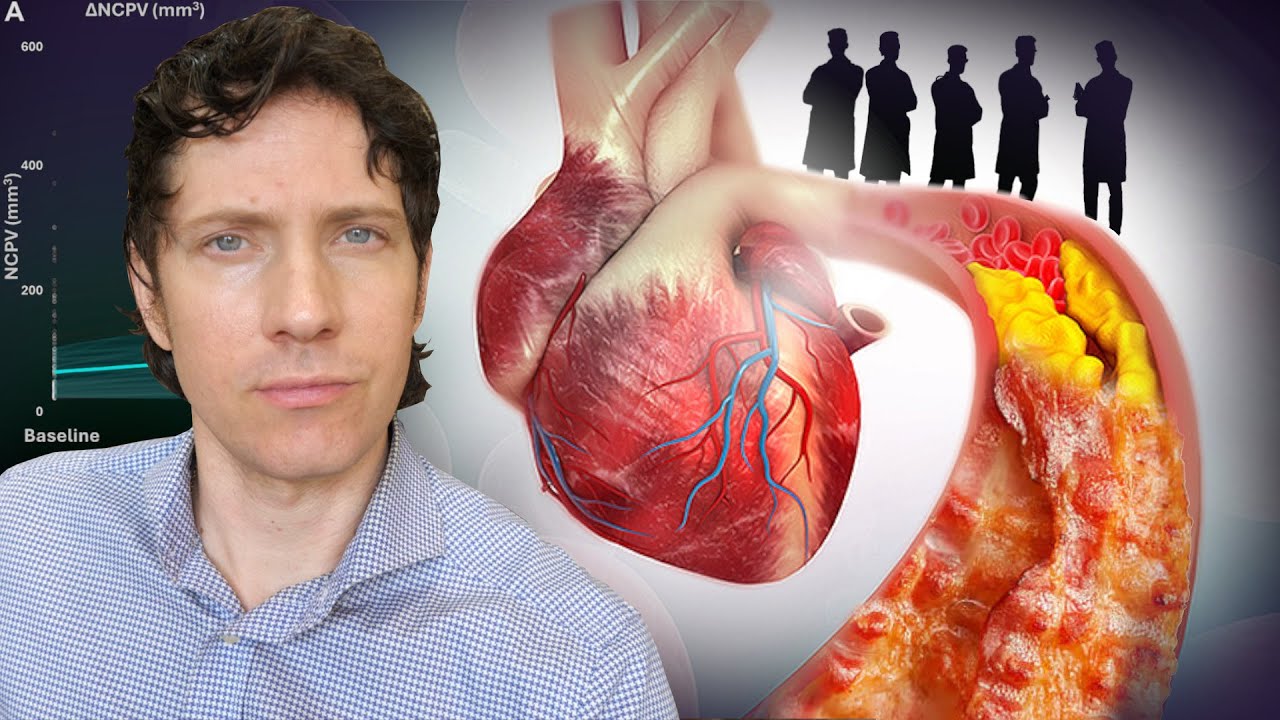
When the paper was finally published in JACC Advances, readers were shocked to find that the primary outcome—the actual change in non-calcified plaque volume—was entirely missing from the text and figures. It was only after intense public pressure on social media that one of the authors admitted the median increase was 18.8 cubic millimeters per year. For context, similar studies on healthy populations show a progression rate of only 4.9 cubic millimeters, meaning the keto group’s arteries were clogging nearly four times faster than the average person eating a standard diet.

💡 Digging Deeper
Q: What is a “lean mass hyperresponder”?
A: It refers to lean individuals whose LDL cholesterol skyrockets to extreme levels (often over 200 mg/dL) specifically when adopting a ketogenic or low-carb diet.
Q: Why was the journal choice controversial?
A: The study was published in JACC Advances, a newer sub-journal with a lower impact factor, which some experts believe allowed these reporting lapses to slip through the peer-review process.
Q: Is a median increase of 18.8 mm³ significant?
A: Yes; experts note that for a population with an average age of 55, gaining nearly half of their lifetime’s accumulated plaque in a single year represents a massive acceleration of disease.
The “No Correlation” Statistical Trap
Flawed Interpretations of LDL and Plaque
Rather than highlighting the rapid plaque growth, the study authors pivoted their narrative to a secondary finding: the lack of a statistical correlation between LDL levels and the rate of plaque progression within their specific group. This claim was quickly picked up by mainstream media and carnivore influencers to suggest that high LDL is not a risk factor for heart disease. However, cardiologists were quick to point out that this is a classic “clumping” error in statistics, where you cannot find a dose-response relationship because every single participant already had sky-high LDL levels.
This is equivalent to studying only people who smoke three packs of cigarettes a day and claiming that smoking doesn’t cause cancer because the person smoking 60 cigarettes isn’t getting sick faster than the person smoking 50.
To see a real relationship, the study would have needed a control group with low LDL levels (under 100 mg/dL) to provide the necessary variability for a meaningful comparison. Furthermore, the study was not “powered”—meaning it didn’t have enough participants—to detect such a relationship even if it existed. By adjusting for existing calcium scores, the authors essentially erased the very signals they were supposed to be measuring, leading to what many call a “meaningless” statistical conclusion that ignores decades of lipid science.

💡 Digging Deeper
Q: What is APOB?
A: APOB is a protein found on all potentially artery-clogging cholesterol particles; it is considered by many experts to be a more accurate predictor of heart disease than standard LDL.
Q: Why did the study adjust for CAC (Coronary Artery Calcium)?
A: Adjusting for baseline calcium scores can sometimes “over-adjust” the data, removing the statistical significance of age and LDL, which are known primary drivers of plaque.
Internal Scandals and the Ethics of Influence
A Breakdown in Scientific Communication
The drama surrounding the Keto CTA study extends beyond the data to the very authors who conducted it. In a revealing interview, Dr. Matthew Budoff, the senior researcher responsible for the heart scans, essentially disavowed the plaque numbers being shared on social media by his co-authors. Budoff claimed he hadn’t even signed off on the final version of the paper and that the data was released prematurely without his statistician’s final review. This internal rift suggests a chaotic publication process where the desire to “go viral” may have superseded scientific rigor.
This lack of transparency is more than just bad science; it is a public health hazard that encourages vulnerable people to ignore their doctors.
Despite Budoff’s assertions that a corrected version of the paper was forthcoming, the authors later issued a statement confirming that the study would not be revised. This means the version currently in the public record remains a study where the primary outcome is nowhere to be found in the official text. The concern among clinicians is that patients—convinced by the “spin” of influencers—will refuse life-saving statins or dietary changes, believing they have a unique “invincibility” to high cholesterol that the data simply does not support.

Key Takeaways
The Keto CTA study serves as a stark warning about the dangers of “citizen science” when it is funded and driven by groups with a pre-determined ideological agenda. While the authors attempted to portray the lean mass hyperresponder phenotype as a safe metabolic variation, their own suppressed data tells a different story: one of rapid, aggressive arterial damage that far outpaces healthy aging. The claim that LDL doesn’t matter is based on a fundamental misunderstanding of statistics that should never have passed a rigorous peer-review process without significant caveats.
For anyone following a ketogenic or carnivore diet with skyrocketing cholesterol, this study is not a “get out of jail free” card. On the contrary, it provides some of the first direct evidence that the LMHR phenotype is associated with a nearly fourfold acceleration in plaque volume. Relying on influencers who “pixel peep” at trend lines rather than reading full clinical disclosures is a dangerous gamble with one’s cardiovascular future.
Q&A
Q1: Was the Keto CTA study a randomized trial?
A1: No, it was a prospective cohort study, meaning it observed a group of people over time rather than randomly assigning them to different interventions.
Q2: Did the keto participants actually have more plaque?
A2: Yes, the median increase in non-calcified plaque was 18.8 mm³, which is significantly higher than the 4.9 mm³ seen in healthy controls from other similar studies.
Q3: Why did Fox News and other outlets report that LDL is fine?
A3: Media outlets often parrot the press releases and social media posts of study authors without verifying if the primary outcomes were actually reported or if the statistics were sound.
Q4: What was the main flaw in the “no correlation” finding?
A4: The study lacked a low-LDL control group, creating a “ceiling effect” where everyone had such high levels that it was impossible to distinguish between the risks of different dosages.
Q5: Who funded this research?
A5: The study was funded by the Citizen Science Foundation, an organization founded by Dave Feldman, a prominent figure in the cholesterol-denial community.
Q6: Should the study be retracted?
A6: Many medical experts, including Dr. Anna Borick, have called for a retraction or a major correction because the paper failed to report its primary outcome while focusing on secondary ones.
Q7: Does high LDL always cause plaque?
A7: While other factors like inflammation play a role, high LDL provides the “fuel” for plaque; without the cholesterol particles, the plaque cannot physically form in the artery walls.