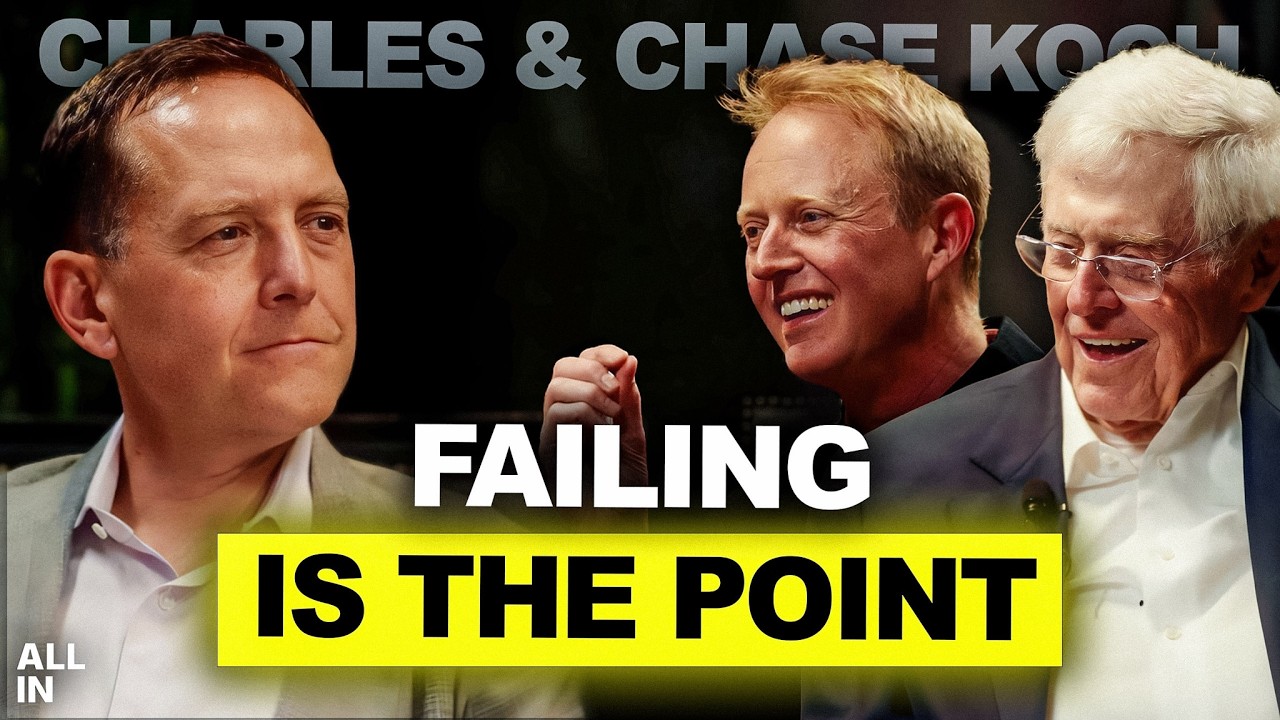
📺 Today’s recommended deep-dive video: https://www.youtube.com/watch?v=EIo3AuyvV84
Principles of Progress: Inside the Operating Model of Koch Industries
For decades, Koch Industries has operated as one of the world’s most successful private business empires, scaling from a small oil-gathering firm into a global conglomerate. In this rare conversation, Charles and Chase Koch break down the specific management principles that fueled a 9,000-fold increase in company value.
Core Question: How can a business achieve exponential growth and social impact by abandoning top-down control in favor of human empowerment and “capability-bounded” strategies?
Highlights
- The transition from being “industry-bounded” to “capability-bounded” as a primary engine for growth.
- Why hiring for values must always take precedence over talent or Ivy League credentials.
- How the “Republic of Science” model prevents a massive conglomerate from becoming a stagnant bureaucracy.
- The application of “Creative Destruction” to both internal business units and national social systems like education.
⏱️ Reading time: approx. 12 minutes · Saves you about 83 minutes vs. watching.
Want to take notes while watching? Click the image below and let AI Notebook capture the key points for you 👇

The Evolution of a Global Powerhouse
From Fractionating Trays to 130,000 Employees
Charles Koch joined the family business in 1961 when it was a modest operation with only 300 employees and two primary lines: oil gathering and the design of fractionating trays. At the time, the culture was protectionist and top-down, with management obsessed with controlling every minute detail of employee spending and design secrets.
The transformation began when Charles realized he was “plum wore out” by traditional engineering and instead turned his focus toward the math of human action. By shifting the focus to creating value for customers and empowering employees to act as internal entrepreneurs, the company began a 60-year climb that resulted in a 9,000-fold increase in value.
Today, the company is a “Republic of Science” rather than a traditional conglomerate. Unlike a siloed holding company, Koch Industries operates as an integrated set of capabilities—logistics, trading, and operations—that can be pointed at any industry where they can create superior value.

💡 Digging Deeper
Q: What does it mean to be “capability-bounded”?
A: It means you don’t limit your growth to one industry (like oil). Instead, you define yourself by what you are good at (like chemical processing) and apply that skill to any sector where it fits.
Q: Why remain a private company in Wichita, Kansas?
A: Being private allows the firm to ignore short-term quarterly earnings pressure. Staying in Wichita provides a “competitive advantage” by isolating the leadership from the over-socialized monoculture of Silicon Valley or Wall Street.
The Culture of Creative Destruction
Embracing Failure and Values-First Hiring
Failure is not just a byproduct of innovation at Koch; it is a prerequisite for progress. Charles and Chase are remarkably candid about the “Gas to Bread” disaster of the late 90s—a failed attempt to control an entire value chain from natural gas to pizza crusts. This failure cost hundreds of millions but taught the firm a vital lesson: never violate the principle of comparative advantage by trying to do everything yourself.
The organization’s hiring philosophy is equally radical: Values first, talent second, and credentials last. Chase highlights the story of their current CIO, who started by striping lines in the company parking lot without a college degree but rose through the ranks by demonstrating a “contribution-motivated” mindset.
A business thrives when it rewards people based on their actual contribution to the future, not their title or seniority. This alignment of incentives ensures that employees aren’t afraid to “creatively destroy” their own roles if a better way exists.

💡 Digging Deeper
Q: How do you prevent middle management from becoming risk-averse?
A: By rewarding “good” failures. If the value of the knowledge gained from a failed experiment is higher than the cost of the experiment itself, the person is rewarded, not punished.
Q: What is the “Republic of Science” model?
A: It is a decentralized system where knowledge flows freely between business units, allowing a refinery in Minnesota to share innovations with a consumer products plant in Georgia.
Beyond the Bottom Line: Social Change
Transforming Education and Philanthropy
The Kochs are now applying their business principles to social challenges through “Stand Together,” a community of nearly 1,000 business leaders focused on bottom-up empowerment. They view the current education system as a “teach-to-test” relic that suppresses individual gifts. By funding micro-schools and “gamified” learning platforms, they aim to move toward individualized education that meets kids where they are.
Charles argues that most people today are trapped in a cycle of seeking “power or pleasure” because they haven’t found a “meaning to live for.” True meaning, according to the Koch philosophy, comes from discovering one’s unique gift and using it to help others succeed.
The ultimate goal of their civic engagement is to help the country live up to the promise of the Declaration of Independence by removing barriers like occupational licensing and a broken criminal justice system. They believe that people are not “problems to be solved” but the actual source of the solutions.

💡 Digging Deeper
Q: Why did Charles shift away from traditional partisan politics?
A: He realized that working through only one party was a mistake. He now follows Frederick Douglass’s advice: “Work with anyone to do right, and no one to do wrong.”
Q: What is the “Principle Companion” app?
A: It is an AI tool powered by Koch’s management principles that uses the Socratic method to help employees and partners solve problems by asking the right questions rather than giving mandates.
Key Takeaways
The success of Koch Industries is not an accident of the energy market; it is the result of a rigorous adherence to Principle-Based Management. By treating every business unit as a “laboratory” for experimental discovery, the organization remains agile enough to disrupt itself before competitors do. This requires a level of humility from leadership that is rarely seen in the Fortune 500—an openness to being proven wrong by the “farm team.”
Ultimately, the Koch legacy is built on the belief that human potential is the ultimate resource. Whether in the boardroom or the classroom, the goal is to shift from a world of top-down mandates to one of bottom-up empowerment. As Charles Koch enters his tenth decade, his focus remains on “unscrambling the eggs” of broken social systems to ensure every individual has the opportunity to realize their own version of the American Dream.
Q&A
Q1: How did Charles Koch transform the culture of a failing Italian plant in the early days?
A1: He replaced the top-down, secretive management with a philosophy centered on creating value for customers and empowering local employees to own the design process.
Q2: What is the most important trait Koch looks for in a leader?
A2: A “contribution-motivated” mindset, meaning the individual wants to succeed by helping others succeed, rather than seeking power or control for its own sake.
Q3: How does Koch Industries view the threat of AI?
A3: They embrace “permissionless innovation,” viewing AI as a tool for human empowerment that can help individuals learn and solve problems 100x faster than traditional methods.
Q4: Why did Chase Koch “fire himself” from the presidency of the fertilizer business?
A4: He realized he was an “innovator/builder” rather than a “steady-state operator,” and that the business would thrive more under someone whose comparative advantage was optimization.
Q5: What was the “Gas to Bread” strategy and why did it fail?
A5: It was an attempt to own every part of the value chain from natural gas to grocery store bread. It failed because it ignored comparative advantage and became a bureaucratic, top-down nightmare.
Q6: What is the core mission of the “Stand Together” movement?
A6: To act as a catalyst for social change by betting on “social entrepreneurs” who have bottom-up solutions for poverty, addiction, and failing education systems.
Q7: How does Charles Koch respond to public criticism and “notices of his imminent death”?
A7: He maintains a sense of humor and remains focused on his “nature,” which is to continue applying his gifts toward human progress rather than retiring to a beach.