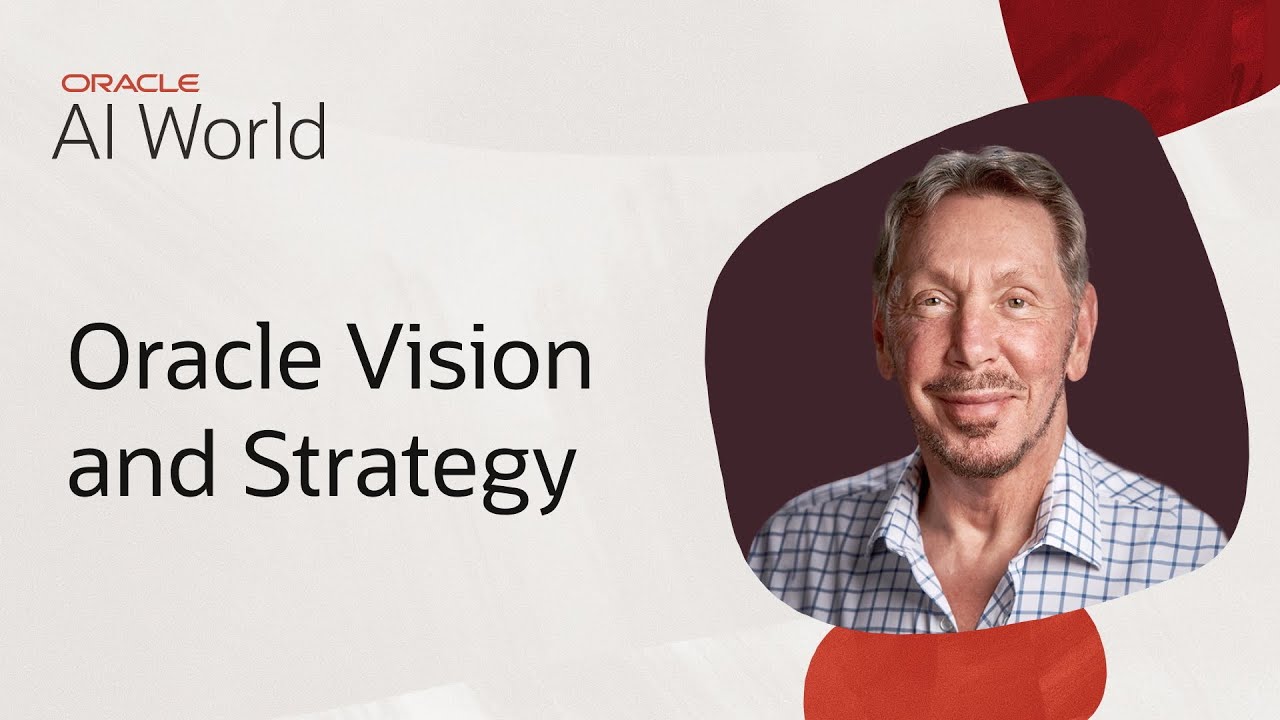
📺 Today’s recommended deep-dive video: https://www.youtube.com/watch?v=4eCFmbX5rAQ
The 1.2 Billion-Watt Electronic Brain: Oracle’s Vision for the AI Era
Oracle CTO Larry Ellison outlines a future where massive infrastructure and specialized neural networks converge to solve humanity’s most complex challenges. From the construction of zettascale data centers to the total modernization of the global healthcare ecosystem, the shift from training models to utilizing “electronic brains” is redefining industry and biology.
Core Question: How is Oracle leveraging massive-scale infrastructure and private data integration to move AI from general training to specialized, ecosystem-wide problem solving?
Highlights
- The construction of a 1.2 billion-watt AI cluster in Texas, capable of powering one million homes.
- The critical role of RAG (Retrieval-Augmented Generation) in bringing high-value private data to multimodal models.
- Automating entire industry ecosystems—such as healthcare and utilities—rather than isolated departmental functions.
- Using AI-driven biomineralization to manage atmospheric CO2 levels through modified agricultural crops.
⏱️ Reading time: approx. 10 minutes · Saves you about 85 minutes vs. watching.
Want to take notes while watching? Click the image below and let AI Notebook capture the key points for you 👇

The Infrastructure of Intelligence
Building the World’s Largest AI Clusters
We are currently witnessing the fastest-growing business in human history, an era defined by the creation of massive electronic brains. These multimodal models function much like the human cortex, utilizing specialized neural networks to perceive vision, language, and logic simultaneously across a digital architecture.
The scale of these projects is truly staggering.
Oracle is currently constructing a massive data center in Abilene, Texas, which will eventually house half a million NVIDIA GPUs and require 1.2 billion watts of power. This infrastructure is not merely a computer room; it is a full-scale engineering marvel involving natural gas pipelines, dedicated power generation, and advanced liquid cooling systems to support a single, massive workload.
Training these models requires a fortune, but the real value emerges during the reasoning phase.

💡 Digging Deeper
Q: Why is 1.2 billion watts necessary for a single cluster?
A: To support the massive compute requirements of 450,000+ NVIDIA GPUs, providing enough power to simulate the complex reasoning capabilities of a trillion-parameter multimodal model.
Q: How does a multimodal model mimic the human brain?
A: It uses distinct neural networks for different tasks—Convolutional Neural Networks (CNN) for vision, Transformers for language, and specialized layers for motion detection and logic.
Q: What is the difference between training and reasoning?
A: Training is the billion-dollar process of teaching a model using public data; reasoning is the application of that “brain” to solve specific, real-world problems using both public and private information.
Bridging the Private Data Gap
RAG and the Evolution of “Vibe Coding”
While models like GPT-4 are trained on the entirety of the public internet, their peak value remains untapped until they can access high-value, private enterprise data. Most of the world’s most important information lives in Oracle databases, and we have adapted this technology to make that data accessible for AI reasoning through a process called Retrieval-Augmented Generation (RAG).
The Oracle AI Database doesn’t just store information; it vectorizes it.
By converting private records into a vector format that AI models can understand, we allow companies to ask complex questions of their own data without compromising security. This enables “vibe coding,” where developers can describe their intent in plain English to generate complex, scalable, and secure applications without writing a single line of manual syntax.
Generative AI ensures that these new applications are stateless and reliable from the moment of creation.
If a server fails in one location, the AI-generated application can immediately resume in another data center without losing a single beat of progress or customer data. This inherent resilience, combined with the ability to scale to millions of users automatically, marks the end of departmental, low-code “toys” and the beginning of robust, AI-native enterprise software.

💡 Digging Deeper
Q: What is “Vibe Coding”?
A: It is the practice of using natural language (English) to describe the intent of a program, allowing an AI generator like Apex to build the full, functional, and secure code automatically.
Q: Can Oracle’s AI reason on data stored in other clouds?
A: Yes, the Oracle AI Database can go into Amazon S3 or OCI Object Store to vectorize data and create indexes for reasoning, regardless of where the data resides.
Q: Why is “statelessness” important in AI-generated apps?
A: It ensures that the application can be restarted in any data center at any time if a hardware failure occurs, providing built-in zero-downtime reliability.
Automating Entire Ecosystems
Beyond Hospitals: The Full Healthcare Chain
To truly transform an industry, you cannot simply automate a single department; you must follow the “Elon Musk rule” and build the entire ecosystem. Just as Tesla had to build a global charging network to make electric cars viable, Oracle is rebuilding the healthcare system by integrating patients, providers, payers, and regulators into a single, automated flow.
We are rewriting the entire Cerner codebase using AI agents.
Our new AI agents can solve the “best possible care that is fully reimbursable” problem by simultaneously analyzing medical literature and insurance policies. For instance, in the UK, an agent can check if a patient’s BMI qualifies them for specific drugs under NHS rules, ensuring the doctor prescribes the most effective treatment that the government will actually pay for.
This level of automation eliminates the administrative friction that currently bogs down medical professionals.
By automating the financial side—such as clinical trials, insurance reimbursements, and even hospital bank loans based on receivables—we free up doctors and nurses to focus entirely on patient care. The AI handles the “boxes of paper” and the complex regulatory hurdles that have historically made the development of new drugs and the operation of clinics prohibitively expensive.

💡 Digging Deeper
Q: Why did Oracle buy Cerner?
A: To use it as a foundation for automating the entire healthcare ecosystem, moving from simple record-keeping to proactive, AI-driven clinical and financial management.
Q: How do AI agents help with hospital staffing?
A: Specialized HR systems for hospitals handle the complex “gig economy” nature of nursing, tracking certifications and shift-trading across multiple facilities automatically.
Q: What role does banking play in Oracle’s healthcare vision?
A: AI agents can verify that medical reimbursements meet all rules, allowing banks to confidently provide low-interest loans to hospitals based on those guaranteed receivables.
Solving Humanity’s Enduring Challenges
From Biomineralization to Metagenomic Safety
AI’s potential extends far beyond business efficiency into the very survival of our planet and species. We are currently working on biomineralization techniques that allow agricultural crops like wheat and corn to capture atmospheric CO2 and convert it into inert calcium carbonate. This essentially turns our global food supply into a massive, free carbon-capture system.
Agriculture is also being revolutionized by robotic indoor greenhouses.
These facilities use 90% less water than traditional farming and utilize AI-driven rail systems to move plants through optimal CO2 environments without human contamination. By growing food in high-CO2, humid environments near urban centers, we can produce fresher, more nutritious produce while drastically reducing the carbon footprint of transportation and the need for nitrogen fertilizers.
On the medical front, metagenomic testing is the new frontier of pandemic prevention.
Instead of testing for a specific “panel” of known viruses, new AI-powered sensors can sequence every fragment of DNA in a blood sample. This allows us to detect novel pathogens before they become pandemics and identify “circulating tumor DNA” at Stage 1, long before cancer becomes symptomatic. This proactive approach to health and the environment represents the true dawning of the AI era.

💡 Digging Deeper
Q: How does AI help manage climate change?
A: By designing crops that are more efficient at photosynthesis and can convert excess CO2 into solid minerals (calcium carbonate), effectively “mining” carbon from the air.
Q: What is the benefit of metagenomic sequencing?
A: It identifies any living organism in a sample—bacteria, fungus, or virus—even if it has never been seen before, providing an early warning system for new diseases.
Q: Will AI drones replace police chases?
A: Yes, using autonomous drones with infrared cameras is safer and more efficient for tracking suspects or finding lost hikers than high-speed ground chases.
Key Takeaways
The transition from the “Cloud World” to the “AI World” is characterized by a shift in scale and intent. Oracle’s commitment to building billion-watt data centers reflects a reality where the most powerful “electronic brains” require the energy equivalent of a major city. This infrastructure is the prerequisite for the next generation of multimodal models that don’t just process text, but perceive and reason across vision, audio, and logic.
However, the hardware is only half of the story. The real revolution lies in the “ecosystem” approach to automation. By utilizing RAG to integrate private data and deploying AI agents to bridge the gaps between disparate entities—like hospitals, banks, and government regulators—Oracle is removing the administrative waste that has crippled productivity for decades. Whether it is modernizing Cerner or engineering nitrogen-fixing crops, the goal is to solve the problems that were previously too complex for human engineers alone.
Ultimately, this technology is a tool designed to enhance human capability rather than replace it. Biometric security will eliminate the “idiocy” of passwords, while robotic surgery and metagenomic testing will extend human life. We are entering a period where the precision of AI-driven tools allows us to manage the atmosphere, our food supply, and our health with a level of accuracy that was previously unimaginable.
Q&A
Q1: What is the significance of the 1.2 billion-watt data center in Texas?
It represents the massive scale required for modern AI. It provides the power for 450,000 GPUs, allowing for the training and operation of the world’s most advanced multimodal models for partners like OpenAI.
Q2: How does Oracle ensure data privacy while using AI models?
Through the Oracle AI Data Platform, companies can use RAG to allow models to reason on their private data. The data is vectorized and indexed within a secure environment, so it is never used to train public models or shared with third parties.
Q3: What is the “Elon Musk rule” in the context of healthcare?
It means you cannot just automate one part of a problem. To fix healthcare, you must automate the entire ecosystem—the patient, the doctor, the insurance company, the regulator, and the bank—simultaneously.
Q4: How can AI help reduce carbon levels in the atmosphere?
Through biomineralization, AI can help engineer crops like wheat to convert CO2 into calcium carbonate, an inert mineral. This allows global agriculture to act as a carbon sink, removing CO2 from the air at virtually no cost.
Q5: Why is Oracle moving away from manual coding?
AI code generators like Apex are more efficient, secure, and reliable. They produce applications that are stateless and scalable to millions of users, eliminating human errors like security holes or memory leaks.
Q6: What is metagenomic testing?
It is a process where AI sequences every bit of DNA/RNA in a sample. This can find early-stage cancer fragments or identify new, unknown pathogens before they cause a pandemic, surpassing the limitations of traditional PCR tests.
Q7: How will AI change the experience of being a patient?
Patients will benefit from more precise robotic surgeries, constant home monitoring via IoT devices, and AI agents that ensure they receive the best possible care that is fully covered by their insurance.