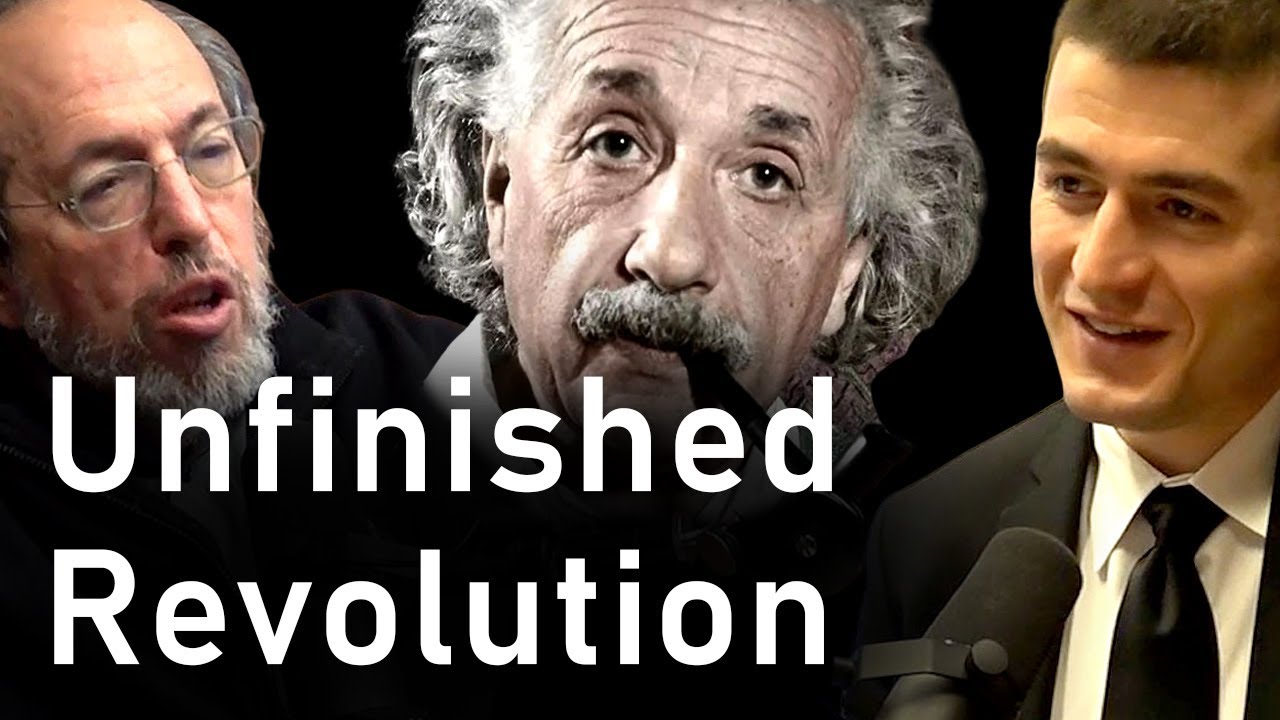
📺 Today’s recommended deep-dive video: https://www.youtube.com/watch?v=EvSObcZBvfM
Beyond the Quantum Fog: Completing Einstein’s Unfinished Revolution
For over a century, physics has lived in a house divided between the vast reaches of general relativity and the chaotic micro-world of quantum mechanics. Lee Smolin argues that the revolution Albert Einstein started remains incomplete because we have mistaken mathematical abstractions for physical reality.
Core Question: Can we unify the laws of the universe by recognizing time and causality as fundamental while treating space and locality as emergent illusions?
Highlights
- The “unfinished revolution” refers to the failure to reconcile the physics of the very large with the physics of the very small.
- Time is likely the only fundamental aspect of the universe, whereas space is an emergent construction of events.
- Experimental evidence from Bell’s Theorem proves that Einstein’s traditional view of locality is definitively false.
- The Many-Worlds Interpretation fails to adequately explain the “Born rule” and the existence of physical probability.
⏱️ Reading time: approx. 5 minutes · Saves you about 21 minutes vs. watching.
Want to take notes while watching? Click the image below and let AI Notebook capture the key points for you 👇

The Quantum Schism
The Measurement Paradox
Physics today is an unfinished symphony, a discordant mix of general relativity for the large and quantum mechanics for the small.
Einstein’s greatest frustration wasn’t that quantum mechanics was weird, but that it was incomplete, lacking the necessary degrees of freedom to describe individual phenomena. He spent his later years searching for a theory that would resolve the wave-particle duality and the measurement problem, where reality seems to shift depending on whether an observer is looking. This “unfinished revolution” persists because we haven’t found a single framework that governs everything from atoms to galaxies.
The measurement problem creates a logical paradox where physical systems evolve smoothly until someone looks, at which point the rules suddenly change. This contradiction suggests that quantum mechanics, as currently formulated, is merely a useful approximation rather than a fundamental truth about our reality.

💡 Digging Deeper
Q: Why did Einstein call quantum mechanics “incomplete”?
A: He believed it provided a statistical description of ensembles rather than a complete description of each individual physical phenomenon.
Q: What is the primary goal of finishing the revolution?
A: To find a theory that incorporates space-time and gravity into a completed version of quantum mechanics.
The Primacy of Time
Causality Over Space
Time is the activity of the continual creation of events from existing events, making it the most fundamental layer of the universe.
While we perceive ourselves as living within a smooth, four-dimensional geometry, this “space-time” is actually an intellectual construction rather than a basic building block. In a sufficiently complex universe, the three-dimensional position of objects emerges from a deeper web of causal relationships. This shift in perspective suggests that while the past is a story of events that have occurred, the future does not yet exist; it is being actively constructed by the present.
Events are the true atoms of reality.

💡 Digging Deeper
Q: If space isn’t fundamental, what is it?
A: It is an emergent property, similar to how temperature emerges from the motion of molecules, arising from the complexity of causal events.
Q: Is the future predetermined in this view?
A: No, the theory posits that the future does not exist until it is created by the activity of time.
The Death of Locality
Beyond the Speed of Light
We live in a world where we expect our actions to only affect things close to us, a concept known as locality.
However, John Bell’s experiments with quantum entanglement have proven that this intuition is fundamentally flawed. When two particles become entangled, a measurement on one instantaneously correlates with the state of the other, regardless of the distance between them. This phenomenon, which has been tested over dozens of kilometers, suggests that the universe possesses a non-local character that violates Einstein’s traditional expectations of spatial separation.
Locality is a survival instinct, not a law of nature.
Physics must move toward a realist perspective that accepts these non-local connections. By abandoning the strict requirement that everything must happen “locally” in space, researchers can begin to build models that account for the strange, interconnected behavior observed in the quantum realm. This requires a sociological shift in the physics community, moving away from isolated “hills” of theory and toward a collaborative valley of new ideas.

The Multiverse Mirage
The Problem with Many Worlds
The Many-Worlds Interpretation attempts to solve the measurement problem by suggesting every possible outcome happens in a branching universe.
While this idea has gained popularity through advocates like Sean Carroll, it faces a significant mathematical hurdle: the derivation of probability. In a universe where every outcome occurs with 100% certainty in some branch, the concept of “likelihood” or “chance” becomes difficult to define. Experimentalists rely on the Born rule to calculate probabilities, but if the Many-Worlds view is correct, those probabilities may have no grounding in the actual mechanics of the system.
Betting on a multiverse is a gamble without a house.
For those who seek a realist completion of physics, the Many-Worlds view is often seen as a “magical realist” distraction. Rather than imagining an infinite number of unobservable universes, Smolin and his collaborators propose focusing on the one real world that happens once. This requires solving the hard problems of causality and time rather than delegating them to an infinite series of branching realities.
Key Takeaways
The path to finishing Einstein’s revolution lies in accepting that our current understanding of quantum mechanics is a bridge, not a destination. By recognizing that time and causality are the fundamental substrates of reality, we can begin to see space and locality as emergent phenomena that appear only at certain scales. This radical rethink allows us to move past the contradictions of the measurement problem and toward a unified theory.
Furthermore, the sociological structure of the physics community must evolve. The current landscape of competing “theoretical hills” prevents the cross-pollination of ideas necessary for a breakthrough. Only by descending into the “valleys” to debate the foundational principles of realism and probability can the next generation of physicists hope to resolve the dualities that frustrated Einstein until his final days.
Q&A
Q1: What is the “unfinished revolution”?
A1: It is the incomplete unification of general relativity (gravity/large scale) and quantum mechanics (particles/small scale), a task Einstein pioneered but could not complete.
Q2: Does Smolin believe quantum mechanics is wrong?
A2: Not wrong, but “incomplete.” He believes it needs additional degrees of freedom to provide a full description of each physical event.
Q3: Why is time considered fundamental while space is not?
A3: Time is viewed as the constant creation of new events via causality. Space is seen as a secondary, emergent property that arises from the relationships between those events.
Q4: What is the significance of Bell’s Theorem?
A4: It experimentally proves that the “local realism” Einstein hoped for is impossible; particles can be correlated in ways that ignore spatial distance.
Q5: What is the main critique of the Many-Worlds Interpretation?
A5: It struggles to explain where probability comes from (the Born rule) if every possible outcome is guaranteed to happen in some branch of the multiverse.
Q6: How does Smolin define an “event”?
A6: An event is a primitive, elementary occurrence where something changes or particles interact, forming the basic building block of a causal history.
Q7: What is the “measurement problem”?
A7: The contradiction between how quantum systems evolve smoothly when not observed versus how they “collapse” into a specific state when a measurement is made.