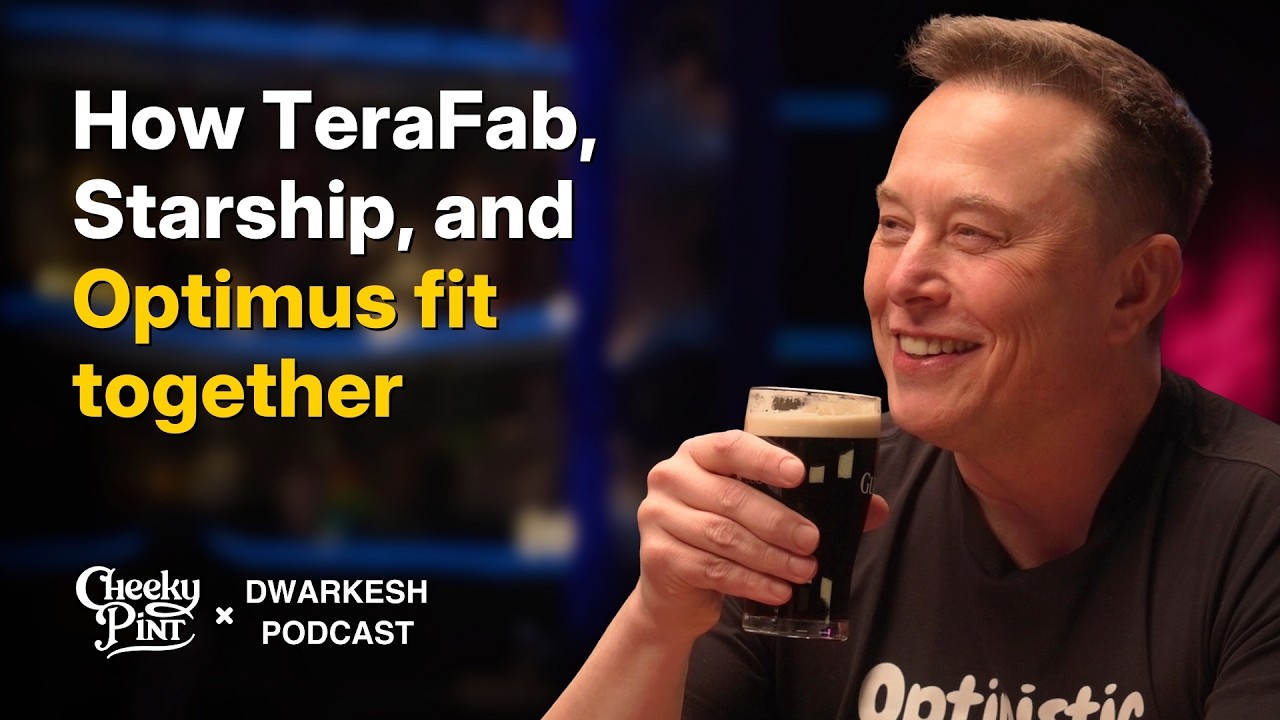
📺 Today’s recommended deep-dive video: https://www.youtube.com/watch?v=BYXbuik3dgA
The Silicon Singularity: Elon Musk’s Blueprint for AI in Space and the Robotic Economy
The hardware walls of Earth are closing in, as electricity production remains flat while chip demand explodes exponentially. Elon Musk reveals why the ultimate data center isn’t in a warehouse in Nevada, but in the permanent sunlight of low Earth orbit. From “digital human emulators” to lunar mass drivers, this is a roadmap for the transition from a human-led civilization to one where biological intelligence represents less than 1% of the total.
Core Question: How can humanity scale intelligence and manufacturing when faced with finite planetary energy and a shrinking workforce?
Highlights
- The Orbital Pivot: Within 30-36 months, space will become the most economically compelling place for AI due to 5x solar efficiency and zero battery requirements.
- The “Digital Optimus”: xAI’s path to dominance involves creating a digital human emulator—a “self-driving computer” capable of replacing remote workers before physical robots arrive.
- The Infinite Money Glitch: Humanoid robots (Optimus) will create a “supernova” economy by recursively manufacturing themselves, eventually harnessing a millionth of the Sun’s total energy.
- The China Challenge: With 3x the electricity output of the US and a superior manufacturing work ethic, China is currently winning the hardware war.
⏱️ Reading time: approx. 12 minutes · Saves you about 157 minutes vs. watching.
Want to take notes while watching? Click the image below and let AI Notebook capture the key points for you 👇

The Orbital High Ground
The 5x Solar Multiplier
The availability of energy has become the ultimate bottleneck for artificial intelligence. Outside of China, global electrical output is essentially flat, creating a catastrophic collision with an exponential growth curve in silicon logic. If we cannot find magical “electricity fairies” to power our transformers on the ground, we must look to the one place where energy is truly infinite.
In space, the limitations of the terrestrial day-night cycle, seasonality, and atmospheric interference simply vanish. A single solar panel in orbit is roughly five times more effective than its counterpart on Earth, primarily because it avoids the 30% loss caused by the atmosphere alone. By moving compute to space, we eliminate the massive capital expenditure required for chemical batteries, which are necessary on Earth to bridge the gap when the sun goes down.
Musk predicts that within 36 months, the cost of access to space will drop so significantly that orbital AI will become the default. This isn’t just a marginal improvement; it is an order of magnitude shift in how we generate tokens.
We are quickly approaching a “wall” on Earth where permits and land use rights make scaling terawatt-level data centers impossible. Space is the only regulatory-free playground where we can harness a non-trivial percentage of the Sun’s power.

💡 Digging Deeper
Q: How do you service failed GPUs in space?
A: Reliability is high after “infant mortality” is ironed out on the ground; once past initial debug cycles, modern chips like Nvidia’s or Tesla’s AI5 are stable enough for orbital life.
Q: Is the latency of space-based AI a dealbreaker?
A: Most AI in the future will be inference-heavy or long-term training, where orbital laser links provide sufficient bandwidth for the most compute-intensive tasks.
Q: Why not just build more power plants on Earth?
A: The lead times are too long; the utility industry moves at a snail’s pace, requiring years for simple interconnect studies that AI scaling cannot afford to wait for.
The Hardware Lesson for Software Giants
The Vanes and Blades Bottleneck
Software engineers are about to receive a brutal education in the realities of heavy hardware. To run a massive cluster like xAI’s Colossus, you don’t just need chips; you need a literal gigawatt of power generation, including the 40% overhead required for cooling in hot climates like Memphis. This requires an immense amount of electrical equipment—transformers to run the AI transformers.
The primary limiting factor in global power expansion is currently the “vanes and blades” within gas turbines. These components require specialized casting processes controlled by only three companies worldwide, all of which are backlogged through 2030. Even if you have the capital to buy a power plant, you cannot simply conjure the precision metallurgy required to make it spin.
Tesla and SpaceX are responding by vertically integrating solar cell production, aiming for 100 gigawatts annually. This move is born of necessity; domestic solar production in the US is currently “pitiful,” and massive tariffs on imports make terrestrial scaling expensive.
By manufacturing cells specifically for space—which require no heavy glass or weather-resistant framing—the cost per watt can be driven down to farcical levels. We are essentially racing to match the mass-to-orbit capability of Starship with the power-hungry logic of the next generation of fabs.

💡 Digging Deeper
Q: Why is cooling such a major power draw?
A: On the worst hour of the hottest day, a data center must maintain temperature to avoid shutdown; in Memphis, this “peak load” adds a 40% multiplier to the base energy requirement of the GPUs.
Q: What is a “TeraFab”?
A: A next-generation semiconductor facility designed to produce logic, memory, and packaging at a scale of millions of wafers per month, far exceeding current TSMC or Samsung output.
Q: Is memory a bigger concern than logic?
A: Yes, logic chip paths are more obvious, but the memory supply chain is highly volatile, with prices often going “ballistic” during high-demand cycles.
Optimus and the Recursive Economy
The Digital Human Emulator
Before we see a physical Optimus in every home, we will see the “Digital Optimus.” This is essentially a digital human emulator—a self-driving computer that can interact with any software application exactly as a remote worker would. By training AI to move electrons and drive screens instead of steering wheels, xAI plans to unlock trillions in revenue from tasks like customer service and administrative engineering.
This approach mimics how Tesla solved self-driving: by treating human behavior as a bitstream to be compressed and correlated. A digital co-worker requires no API integration; it simply uses the existing legacy tools that humans use today.
Once the “Digital Optimus” can perform CAD design or chip layout, it can run 10,000 instances of itself simultaneously. This accelerates the design of the physical robot, creating a recursive loop of improvement.
The physical Optimus robot represents an “infinite money glitch” because it eventually participates in its own production. With exponential increases in digital intelligence, chip capability, and electromechanical dexterity, the robot becomes a supernova of productivity. Labor, as one of the four factors of production, effectively becomes decoupled from the human population.

💡 Digging Deeper
Q: What is the hardest part of the humanoid robot?
A: The hand. Achieving human-level degrees of freedom while maintaining torque density required custom-designed actuators that didn’t exist in any catalog.
Q: How does Optimus train without 10 million “robot-years” of data?
A: Tesla is building an “Optimus Academy” where 20,000 robots engage in self-play in reality, closing the “sim-to-real” gap that currently plagues robotics.
Q: Will robots reduce the human headcount at Tesla?
A: No; the goal is to increase output disproportionately, where the number of units produced per human rises dramatically, but the total human staff continues to grow.
The Great Filter: US vs. China
The Industrial Proxy
Electricity output is the most honest proxy for the “real” economy. This year, China is expected to exceed three times the electrical output of the United States, suggesting their industrial capacity is scaling at a rate the West is failing to match. Without a breakthrough in robotics to augment our smaller population, China’s 4x population advantage and superior work ethic will result in utter manufacturing dominance.
America has grown complacent, like a pro sports team that has been winning for too long and feels entitled to victory. Our birth rate has been below replacement levels since 1971; we are running out of humans to do the “dirty” work of ore refining and lithium processing.
Optimus is not just a luxury; it is the only viable path to maintaining a competitive manufacturing base. By closing the recursive loop—using robots to build the refineries that provide the materials for more robots—the US might have a chance to bypass its demographic decline.
The ultimate vision involves moving beyond Earth entirely. Musk’s “favorite thing” is a lunar mass driver: a system on the Moon that mines silicon and aluminum from the soil to shoot satellites into deep space at 2.5 kilometers per second. This turns the Moon into a shipyard for a multi-planetary intelligence, ensuring the light of consciousness survives even if Earth faces a catastrophic failure.

💡 Digging Deeper
Q: Why use steel for Starship instead of carbon fiber?
A: Steel is 50x cheaper, easier to weld outdoors, and becomes remarkably strong at the cryogenic temperatures of liquid methane, whereas carbon fiber resins melt or shatter.
Q: What is the “irony shield” in the name X?
A: Musk intentionally chose a name that is difficult to invert or mock ironically, unlike “OpenAI” (which is closed) or “Anthropic” (which he views as misanthropic).
Q: Is AI a threat to the mission?
A: Only if it is programmed to lie or be “politically correct”; the lesson of HAL 9000 is that a “truth-seeking” AI aligned with the laws of physics is the safest path for humanity.
Key Takeaways
The transition to a high-intelligence, robotic-led society is no longer a distant sci-fi fantasy; it is a hardware problem with a 36-month countdown. As terrestrial power grids hit a ceiling, the migration of compute to orbit represents the most logical “next step” in the Kardashev scale of civilization. This shift is driven by the stark reality that energy on Earth is bogged down by bureaucracy, whereas space offers an unencumbered environment for exponential scaling.
Success in this new era requires a “maniacal sense of urgency” and a focus on the limiting factors of production—specifically power generation and semiconductor fabrication. Musk’s strategy across Tesla, SpaceX, and xAI is to solve these bottlenecks through radical vertical integration, from mining lithium in Texas to launching 10,000 Starships a year. The goal is to create an economy where labor is infinite and intelligence is as pervasive as sunlight.
Ultimately, the preservation of consciousness is the North Star. As AI begins to represent 99% of all intelligence, the mission of companies like xAI must be “truth-seeking” to ensure they understand and value the universe—and humanity’s place within it. By building an “Optimi” workforce and a space-based compute infrastructure, we are not just increasing GDP; we are maximizing the probable lifespan and scope of consciousness itself.
Q&A
Q1: Why is Musk so confident that space is the future for AI?
A: Because of the “solar multiplier.” Space offers constant, intense sunlight without atmospheric loss or a day-night cycle, making it 5x more efficient than Earth. It also bypasses the regulatory and permitting hell of terrestrial power grids.
Q2: What is the “Vanes and Blades” problem?
A: It is a manufacturing bottleneck in gas turbines. Only three companies in the world can cast these high-precision components, and their backlogs are so long that scaling Earth’s power grid fast enough for AI is nearly impossible.
Q3: How does the “Digital Optimus” differ from a physical robot?
A: The digital version is an AI that “drives” a computer screen and keyboard. It can perform any task a remote worker can do, from customer service to chip design, allowing xAI to generate trillions in revenue before the physical robots are even deployed.
Q4: Will humans lose control of AI?
A: Musk believes that once AI represents 99% of total intelligence, traditional “control” is a logical impossibility. Instead, we must ensure AI has values focused on “understanding the universe,” which naturally incentivizes the preservation of humanity as an interesting source of information.
Q5: Why did SpaceX switch Starship to stainless steel?
A: Steel is 50x cheaper than specialized carbon fiber, can be welded easily in the field, and its strength-to-weight ratio actually improves at cryogenic temperatures, making it a superior (though initially less “obvious”) material choice.
Q6: How can the US compete with China’s manufacturing power?
A: Only through the mass deployment of humanoid robots. China has 4x the population and a stronger industrial work ethic; robotics is the only “force multiplier” that can bridge that gap and allow the US to scale its refining and industrial capacity.
Q7: What is the purpose of the Lunar Mass Driver?
A: It’s a catapult on the Moon used to launch silicon-based AI satellites and solar panels into deep space. Because the Moon is rich in silicon and aluminum, it can manufacture and launch millions of tons of hardware with much lower gravity than Earth.