📺 Today’s recommended deep-dive video: https://www.youtube.com/watch?v=YCzL96nL7j0
LSTM Clearly Explained: Solving the Memory Problem in Neural Networks
Traditional Recurrent Neural Networks often “forget” the beginning of a sequence or explode into infinity during training. LSTMs fix this by creating a dedicated highway for long-term information to travel through, allowing the network to maintain context over vast temporal distances.
Core Question: How does the unique architecture of a Long Short-Term Memory unit prevent gradients from vanishing or exploding during sequential data processing?
Highlights
- Comparison of vanishing vs. exploding gradients in vanilla RNNs.
- The “Cell State” as a stable highway for long-term memory.
- Detailed breakdown of the Forget, Input, and Output gates.
- Using Sigmoid and Tanh functions to control information flow.
⏱️ Reading time: approx. 6 minutes · Saves you about 15 minutes vs. watching.
Want to take notes while watching? Click the image below and let AI Notebook capture the key points for you 👇

The Crisis of Recurrent Neural Networks
Exploding and Vanishing Gradients
Basic recurrent neural networks are inherently fragile. When we unroll a vanilla RNN over many time steps, we repeatedly multiply the hidden state by the same weight. If that weight is even slightly greater than one, say 2.0, and we process a sequence of 50 data points, the gradient explodes to 2 to the 50th power—a catastrophic “Kaboom” for your math.
Conversely, if the feedback weight is less than one, such as 0.5, the gradient vanishes into a number so close to zero that the network stops learning entirely. This “Poof” effect happens because the initial inputs are essentially erased by the time the network reaches the end of the sequence. LSTMs were specifically designed to bypass this mathematical bottleneck by decoupling long-term and short-term memory paths.

💡 Digging Deeper
Q: Why can’t we just set the weight to exactly 1.0 in a vanilla RNN?
A: While a weight of 1.0 would prevent explosion/vanishing, the network wouldn’t be able to learn which information is important to keep or discard, making it inflexible for complex data.
Q: Is the gradient problem unique to stock market data?
A: No, it happens in any sequential data, including language translation and video analysis, where the “beginning” of the input affects the “end.”
The Anatomy of an LSTM Unit
The Dual Path System
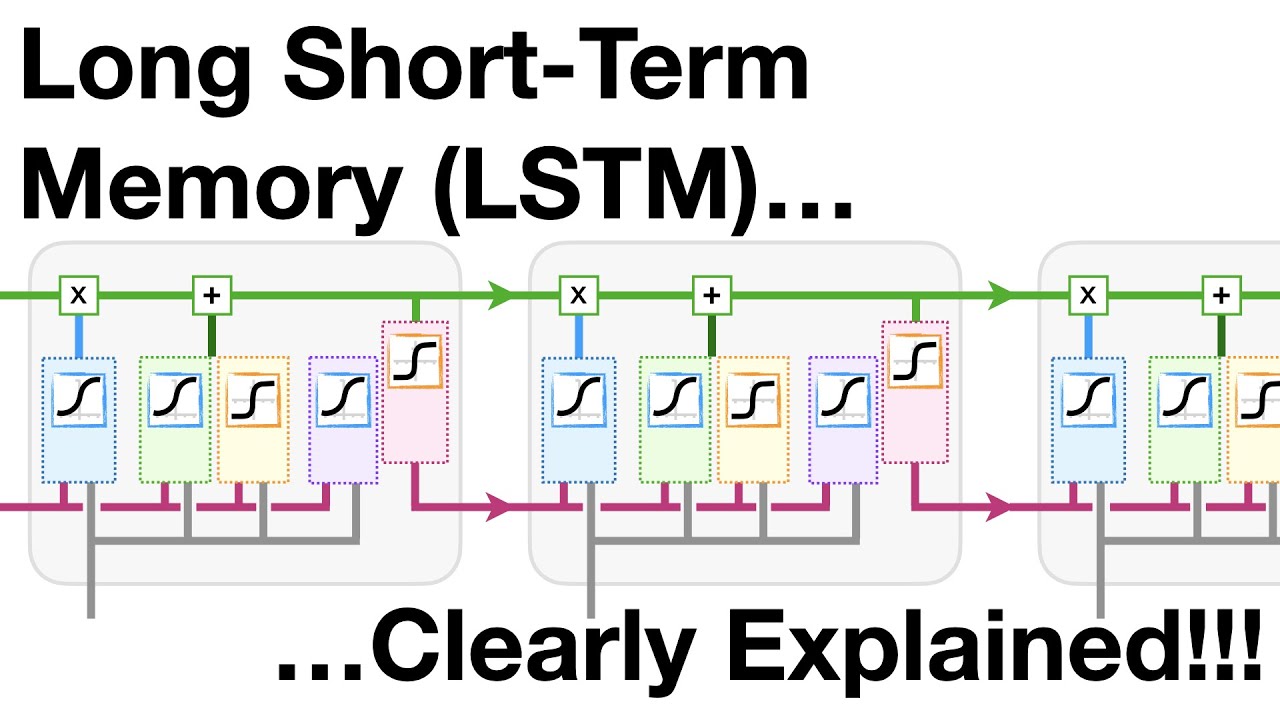
The Long Short-Term Memory unit looks intimidating, but it essentially functions as a sophisticated filing system. At the top of the unit sits the “Cell State,” a green line representing long-term memory that flows through the sequence with minimal interference. Because there are no weights directly multiplying this state as it passes through the “highway,” the gradient stays stable.
Parallel to this is the “Hidden State,” which handles short-term memory and is subject to the usual weight-based modifications. The magic happens where these two paths interact. By using specific activation functions, the unit can selectively “write” to or “erase” from the long-term memory path without destroying the overall signal.

💡 Digging Deeper
Q: What is the specific role of the Sigmoid function here?
A: Sigmoid outputs values between 0 and 1, acting as a “percentage gate” that decides how much information to let through.
Q: Why do we use the Tanh activation function alongside Sigmoid?
A: Tanh outputs values between -1 and 1, which helps regulate the actual data values being added to the memory, ensuring they don’t grow out of control.
Q: Can an LSTM forget everything?
A: Yes, if the Sigmoid output in the forget gate is 0, the long-term memory is multiplied by zero and completely erased for the next step.
The Three Gates of Memory
Forget, Input, and Output
The first stage of an LSTM is the Forget Gate, which evaluates the short-term memory and the current input to decide what parts of the long-term memory are no longer relevant. If the gate outputs a 0.99, we keep almost everything; if it outputs a 0, that specific memory is discarded. It is a simple multiplication that provides the network with the ability to “clear its head” when a new sequence begins.
Next, the Input Gate identifies new information worth saving. This is a two-part process where the network creates a “potential memory” using a Tanh function and then decides what percentage of that potential to actually add to the Cell State using a Sigmoid gate. This ensures that the long-term memory is only updated with meaningful, filtered data.
Finally, the Output Gate determines the new short-term memory. It takes the updated long-term memory, runs it through a Tanh function to keep values between -1 and 1, and then filters it with a Sigmoid gate based on the current context. This new short-term memory is passed to the next unit and also serves as the outward-facing prediction for that specific time step.

💡 Digging Deeper
Q: Is the “potential memory” always saved?
A: No, the Input Gate can decide to save 0% of the potential memory if the current input is deemed irrelevant to long-term trends.
Q: Why is the Output Gate’s result used twice?
A: It serves as the “Hidden State” for the next time step in the sequence and also acts as the actual output/prediction for the current step.
Q: How are the weights for these gates determined?
A: Like any neural network, these weights are learned through backpropagation during the training phase using a labeled dataset.
Key Takeaways
Long Short-Term Memory networks solve the fundamental flaws of vanilla RNNs by introducing a bifurcated architecture. By separating the cell state (long-term) from the hidden state (short-term), LSTMs allow gradients to flow through time without being exponentially amplified or diminished. This “highway” for information is the reason LSTMs can connect a piece of information from the very beginning of a long document to a word at the very end.
The three-gate mechanism—Forget, Input, and Output—provides a mathematical framework for “attention” before the modern Transformer era. Each gate uses a combination of Sigmoid and Tanh functions to decide what to discard, what to keep, and what to emphasize. This selective memory makes LSTMs incredibly robust for time-series forecasting, such as predicting stock prices or weather patterns, where historical context is just as important as the most recent data point.
Q&A
Q1: What is the main difference between an LSTM and a basic RNN?
A1: A basic RNN has a single feedback loop that is prone to vanishing/exploding gradients, whereas an LSTM uses a “Cell State” path to preserve long-term information without constant weight multiplication.
Q2: How does the Forget Gate actually “forget”?
A2: It uses a Sigmoid function to produce a value between 0 and 1. This value is multiplied by the long-term memory; if the value is 0, the memory is effectively deleted.
Q3: Why do we need the Hidden State if the Cell State handles the memory?
A3: The Hidden State handles the immediate, short-term context and is used to calculate the gates that control the Cell State. They work in tandem.
Q4: Can LSTMs handle sequences of different lengths?
A4: Yes, because the LSTM uses the exact same weights and biases for every “unrolled” step, it can process a sequence of 5 items or 5,000 items using the same logic.
Q5: What is “unrolling” a network?
A5: Unrolling is a visualization technique where we show the same LSTM unit at different points in time (Day 1, Day 2, etc.) to trace how information flows through the sequence.
Q6: Are LSTMs still used today?
A6: Yes, while Transformers have become the gold standard for many tasks, LSTMs remain highly effective for certain time-series applications and are a crucial stepping stone to understanding modern AI.
Q7: Does the Input Gate modify the Short-Term memory?
A7: No, the Input Gate specifically modifies the Long-Term memory (Cell State). The Short-Term memory is updated later by the Output Gate.