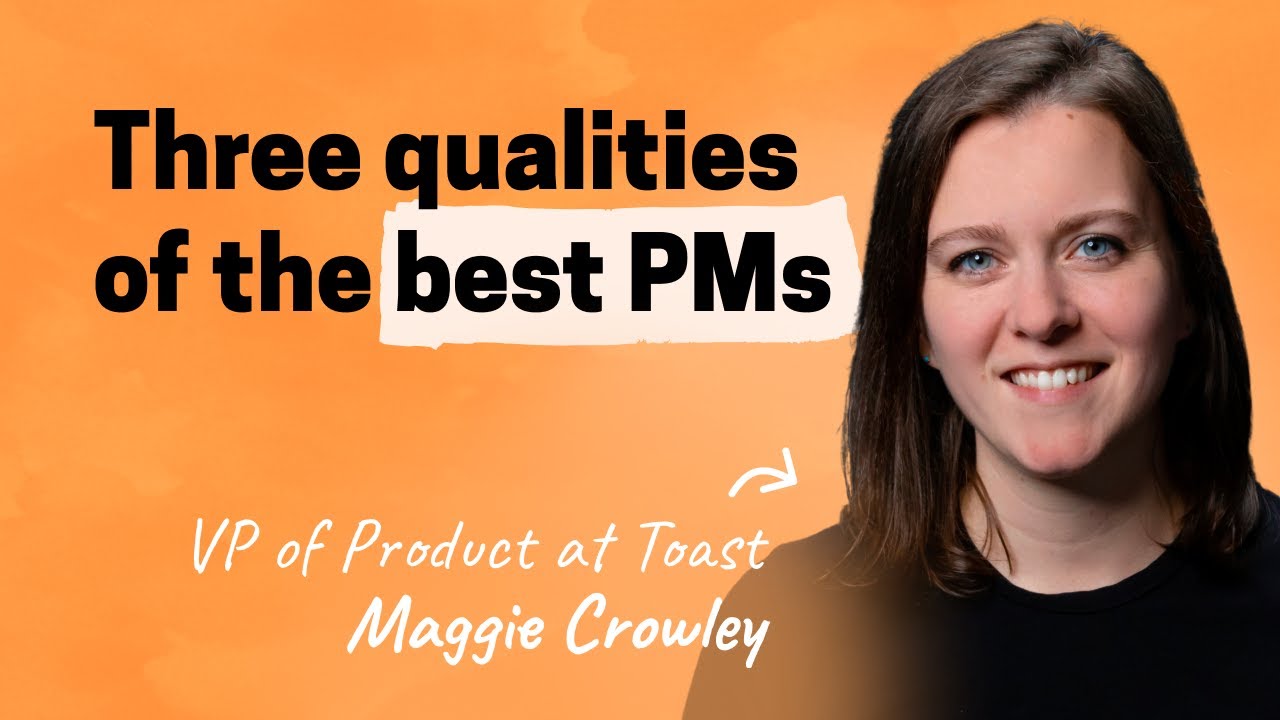
📺 Today’s recommended deep-dive video: https://www.youtube.com/watch?v=4LjddcccYIo
Beyond the Frameworks: Maggie Crowley on the Radical Reality of Product Management
Many aspiring product managers focus on high-level vision and fancy frameworks, but elite performance is actually found in the grit of unglamorous execution and the discipline of simplification. Maggie Crowley, VP of Product at Toast, argues that the most successful PMs are those willing to “carry the water” and do the work no one else wants to do.
Core Question: What are the specific traits and tactical frameworks that distinguish great product managers from those who simply manage tasks?
Highlights
- The “Three Threads” of elite PMs: Simplification, following up on results, and radical ownership.
- A deep-dive strategy template that moves from high-level mission to tactical execution without losing the logic chain.
- Why “Why Now?” is the most overlooked but critical question in any product specification or one-pager.
- Practical advice for breaking into the industry by securing the “PM Stamp” through lateral moves or startups.
⏱️ Reading time: approx. 8 minutes · Saves you about 48 minutes vs. watching.
Want to take notes while watching? Click the image below and let AI Notebook capture the key points for you 👇

The Three Pillars of Elite Product Management
Simplification as a Competitive Advantage
The best product managers act as filters for their teams, taking infinite complexity and boiling it down into a singular, executable priority. In a large company, you might face thousands of possible projects and dozens of conflicting OKRs, but the elite PM has the gumption to pick one thing and stay with it until it is finished.
Greatness requires the ability to ignore the “crapola” and focus only on the core message.
This simplification extends deeply into written communication; Crowley suggests that most documents can be improved by simply deleting the first two paragraphs. By reading your work out loud, you quickly identify where the language becomes too academic or convoluted, allowing you to replace “corporate-speak” with the clear, conversational insight you would actually say to a colleague.
The Missing Loop: Following Up
One of the rarest traits in product management is the discipline to return to a feature months after launch to report on its actual performance. Many PMs write a metric in a spec but forget to check the dashboard once the next “fire” starts, missing the vital learning cycle that builds long-term intuition and expertise.
If you are the person who proactively tells leadership, “Remember that thing we shipped? Here is exactly how it moved the needle,” you instantly build an aura of reliability and competence that few others possess.
Carrying the Water
Success is often built on “bullshit work” like QA testing, customer support, and writing copy—tasks that many PMs incorrectly believe are “not their job.” In reality, because the PM is responsible for the final outcome, every gap in the process is their responsibility to fill to ensure the product succeeds.

💡 Digging Deeper
Q: How do you identify a “complexifier” in an interview?
A: Look for candidates who answer simple questions with jargon or who struggle to explain a past project’s core value in one sentence.
Q: How long does it actually take to get “good” at product?
A: It usually takes about four to five years of shipping real products and seeing the consequences of your decisions before you develop true confidence.
Q: Is “Ownership” the same as Maggie’s “Carrying the Water”?
A: Not quite; “carrying the water” implies a lack of ego regarding menial tasks, whereas “ownership” can sometimes be misinterpreted as just having power.
The Logic Chain of Product Strategy
Building the Landscape Document
Strategy isn’t a vague “vision” statement; it is a rigorous accounting of the market, the technical hurdles, and the competitive landscape that leads to a specific bet. Crowley uses a deep Google Doc that starts with the company mission and moves into an “honest accounting” of current state, including technical debt and support ticket trends.
By putting every risk and market dynamic on paper, you align the team’s information set before you ever propose a solution.
This process is primarily for the PM’s own homework to ensure they aren’t making a blind bet based on incomplete data. When you share this “Landscape” doc, you aren’t asking for permission; you are showing the logic chain so that if someone disagrees, they have to point to the specific data point or assumption they think is wrong.
The “Why Now?” Test
Every one-pager or spec should explicitly answer why a problem matters specifically at this moment, rather than six months ago or six months from now. This question acts as a forcing function for prioritization, helping the team distinguish between “main quests” and “side quests” that can be deferred.

💡 Digging Deeper
Q: Do small features need this level of strategy?
A: No, over-complicating small user feedback items is a waste of time; save the deep strategy docs for annual planning or major pivots.
Q: Who should be the first person to review a strategy doc?
A: Your engineering counterpart. Ask them to “shred it” and find every hole in the logic before it goes to leadership.
Q: How long should a comprehensive strategy document be?
A: It can be 20 pages long because it serves as a repository for screenshots, market research, and data, though the summary must be concise.
Breaking In and Staying Relevant
Securing the “PM Stamp”
The hardest part of a product career is getting the initial title on your resume, as hiring managers almost exclusively screen for prior PM experience. Crowley recommends two primary paths: making a lateral move within your current company or joining a high-growth startup where you can prove your value through sheer output.
Once you have the title, the next hurdle is being able to articulately answer the question: “What have you shipped and what was the impact?”
The Danger of Online Content
There is a significant gap between the “ideal version” of product management described in newsletters and the messy, “waterfall-ish” reality of most successful companies. Many experts share frameworks that they don’t actually use in their daily work, which can lead new PMs to feel like they are failing when their process feels chaotic.
Real product work is often about managing emotions and keeping the team optimistic through the “grind” of shipping.

💡 Digging Deeper
Q: Is business school a good way to enter PM?
A: It was for Maggie, but today it’s just one of many paths; networking and hounding hiring managers at startups is often more effective.
Q: Why is being “data-driven” sometimes a red flag?
A: Because if you wait for perfect data to make every decision, you will move too slowly; great PMs use data to inform intuition, not replace it.
Q: How do you stay motivated during the “bullshit work” phases?
A: Remember that the PM is the emotional center of the team; if you lose optimism, the engineers and designers will too.
Key Takeaways
Elite product management is less about mastering complex frameworks and more about the disciplined application of common sense and radical responsibility. To move faster and drive more impact, PMs must prioritize simplification—in their writing, their roadmaps, and their team’s focus. If a document or a plan feels too complex, it usually means the PM hasn’t done the hard work of thinking through the core problem yet.
The most successful leaders are those who treat their role as a “gap-filler,” doing whatever is necessary to move the product toward a successful business outcome. Whether it is following up on data months after a launch or QA-ing a bug at midnight, the willingness to do the unglamorous work is what builds the credibility necessary to eventually lead larger organizations.
Ultimately, strategy is a logic chain, not a creative writing exercise. By grounding every roadmap decision in an honest accounting of the landscape and technical reality, PMs can move from “guessing” to making high-conviction bets. This transparency builds trust with engineering and design, turning the triad into a powerful engine for shipping meaningful software.
Q&A
Q1: What is the “Minto Principle” Maggie mentions for writing?
A1: It is the “Pyramid Principle” where you put your conclusion and headline first, followed by the supporting arguments. Never make a busy executive wait until the end of a document to find out what you want.
Q2: How can I practice simplification daily?
A2: Read every email and Slack message out loud before sending it. If you stumble over a sentence or find it sounds “fake,” delete it and write exactly what you would say in a conversation.
Q3: What should I do if my roadmap doesn’t match my strategy?
A3: This is a common leadership challenge. Use the strategy document to highlight the misalignment to stakeholders and force a conversation about which “legacy” items can be cut to make room for the new strategy.
Q4: Is it better to bounce between companies or stay deep?
A4: While job-hopping can increase salary, staying through two or three product cycles allows you to see the long-term consequences of your decisions, which is where the deepest learning happens.
Q5: What is “the triad”?
A5: It is the core partnership between Product, Design, and Engineering. Maggie believes the PM should treat the Engineering and Design leads as co-owners of the strategy.
Q6: Why is the “Landscape” section of the strategy doc so long?
A6: Because it needs to account for the “honest state” of everything—technical debt, competitor moves, and customer complaints—so that the final “bet” feels inevitable rather than random.
Q7: How do you handle a manager who says you aren’t “strategic”?
A7: Use Maggie’s strategy template to create a demonstrable logic chain. It’s hard for a manager to say you aren’t strategic when you’ve mapped the entire market landscape and technical debt to your current plan.