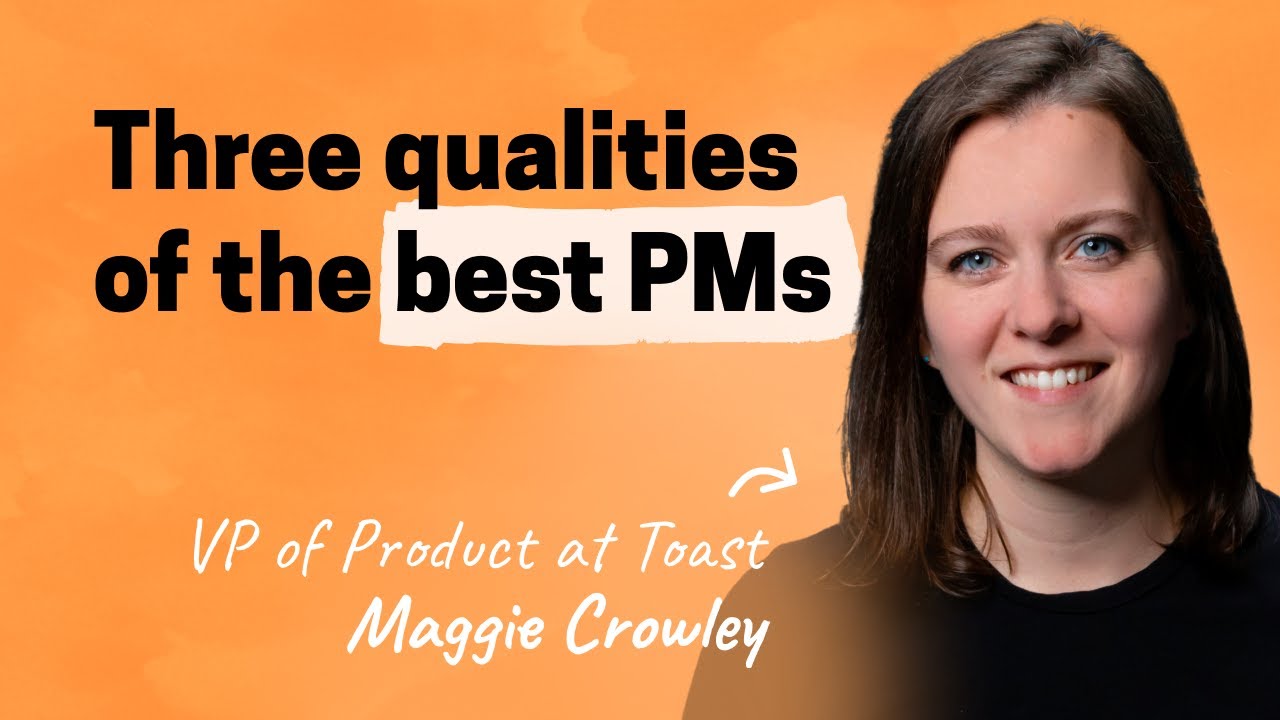
📺 Today’s recommended deep-dive video: https://www.youtube.com/watch?v=4LjddcccYIo
The Unfiltered Reality of High-Impact Product Management
Most product management advice focuses on glamorous strategy and high-level vision, but the true path to success is often found in the unglamorous trenches of execution. Maggie Crowley, VP of Product at Toast, breaks down the tactical habits and mental shifts that separate elite PMs from the rest, exposing why most online “best practices” fail when they hit the real world.
Core Question: What are the three non-negotiable traits of successful product managers, and how can they build strategies that actually drive results?
Highlights
- The three pillars of elite PM performance: Simplification, following up on results, and “carrying the water.”
- A step-by-step framework for building a deep-dive product strategy that earns executive trust.
- Why the “Why Now” question is the most critical (and ignored) component of a product spec.
- The “PM Stamp” reality: How to navigate the catch-22 of breaking into the role without prior experience.
⏱️ Reading time: approx. 7 minutes · Saves you about 49 minutes vs. watching.
Want to take notes while watching? Click the image below and let AI Notebook capture the key points for you 👇

The Anatomy of a World-Class PM
The Three Pillars of Performance
Success in product management isn’t about being the smartest person in the room; it is about being the most effective at removing noise.
Great PMs are relentless simplifiers who can look at a mountain of data, hundreds of OKRs, and thousands of potential projects to identify the one thing that truly moves the needle. They don’t just pick a priority and walk away; they possess the resilience to stay with that single initiative for six months or a year until it is finished, regardless of the fires burning around them. This ability to maintain focus amidst chaos is what allows products to actually reach the market.
Beyond simplifying, the best managers distinguish themselves by following up on results weeks or months after a launch. This creates an aura of reliability where leadership trusts that threads will never be dropped, even when the initial excitement of the release has long since faded.

💡 Digging Deeper
Q: How do you identify if someone is a “complexifier” in an interview?
A: Look for how they describe problems; if they can’t boil a project down to its core essence, they will likely struggle to lead a team through ambiguity.
Q: Why is following up on metrics so rare?
A: Most PMs are already focused on the next launch, but those who return with data on past bets build the most credibility with leadership.
Q: Is simplification just about cutting features?
A: No, it’s about shortening the logic chain so every team member understands exactly why the current work matters most.
Building a Strategy That Leaders Respect
Mapping the Landscape
Often, PMs receive feedback that they aren’t “strategic” enough, which is usually code for not providing enough context for their decisions.
To combat this, you should build an exhaustive landscape document that maps out market dynamics, competitor moves, and current business realities before ever proposing a solution. A truly robust strategy can reach 20 pages because it serves as your “homework”—it is the place where you prove you have considered the SWOT analysis, the technical debt, and the specific hurdles that could sink your plan. By documenting the landscape first, you ensure that if an executive disagrees with your plan, the conversation shifts to a specific data point rather than a vague feeling.
Strategy is only 5% of the work, but it provides the logical foundation for every single resource you commit to a project.
If you don’t answer “What has to be true for this to work?” you aren’t doing strategy; you are just making a wish list. This transparent logic chain turns potential conflicts into productive alignment exercises for the entire triad of product, engineering, and design.

💡 Digging Deeper
Q: Does every feature need a strategy document?
A: Absolutely not. Over-complicating small user improvements is a waste of time; save the deep-dive docs for quarterly or annual planning.
Q: Who is the first person who should read your strategy?
A: Your engineering lead. They should be encouraged to “shred” the document and find the technical flaws before it reaches an executive.
Q: How do you handle a strategy that contradicts the current roadmap?
A: Use the document to spark a conversation about resource allocation, even if you don’t have the final agency to change the plan immediately.
The Unglamorous Reality of “Carrying the Water”
Ownership Beyond the Spec
There is a growing cachet around product management, leading newcomers to believe they are the “CEO of the product” who simply tells others what to do.
The reality is much messier, involving endless hours of QA, customer support, and writing copy that no one else wants to touch. If you ever find yourself thinking a task isn’t your job, that is exactly the task you should probably be doing. As a PM, you are the emotional center of the team, responsible for maintaining optimism when projects hit the inevitable middle-of-the-road slump.
You must be willing to do the hard, boring, and unglamorous work to ensure the product succeeds.
Engineering builds code and design builds experiences, but the PM fills every single gap in between to ensure the project doesn’t fail. This “carrying the water” mentality is what separates those who ship successful products from those who just write beautiful specs that never see the light of day.

💡 Digging Deeper
Q: What is the best way to break into PM without experience?
A: Aim for a lateral move within your current company or join a startup where you can wear multiple hats and eventually “stamp” yourself with the title.
Q: Why is “Why Now” so important in a one-pager?
A: It forces you to justify why this specific problem is more urgent than the hundreds of other “side quests” your team could be pursuing.
Q: How long does it take to actually become a good PM?
A: Usually four to five years of shipping and seeing the long-term consequences of your decisions across multiple product cycles.
Key Takeaways
Becoming a great product manager requires a blend of extreme focus and humble execution. You must be willing to stay with a single problem long enough to see it through to completion, while simultaneously being the person who does the “crapola” work—like manual QA or customer implementation—that keeps the wheels turning. Success isn’t found in a fancy framework, but in the ability to simplify a complex landscape into three clear bets.
Longevity at a single company can be a secret weapon for your career. Staying through two or three cycles of the same product allows you to see the actual impact of your choices, which provides a level of intuition that “job hopping” simply cannot offer. When you finally possess the “PM stamp” on your resume, your focus should shift entirely to what you have shipped and the business results those shipments produced.
Q&A
Q1: What is the “Minto Principle” in PM writing?
A1: It is a communication style where you put the conclusion and headline first, followed by supporting arguments, rather than building up to a point.
Q2: How should a PM handle technical debt in their strategy?
A2: It must be an honest part of the “accounting” phase of your strategy; ignoring technical hurdles is the fastest way to lose the trust of your engineering team.
Q3: Is the “PM as CEO” analogy accurate?
A3: Only in terms of responsibility, not authority. You are responsible for the outcome, but you often have to do the manual labor to ensure that outcome is achieved.
Q4: How many priorities should a strategy doc have?
A4: Use the “Rule of Three.” If you have a fourth priority, you need to either cut it or find a way to merge it, as teams struggle to focus on more than three major bets.
Q5: What should you do if your manager doesn’t give you feedback?
A5: Create a “peer group” or a small Slack community of other product leaders where you can share documents and get the honest critiques your manager might be too busy to provide.
Q6: Why is reading your own documents out loud helpful?
A6: It immediately reveals where your writing is too complex or doesn’t make sense, forcing you to use the simple language you would use in a real conversation.
Q7: What is the most common reason people fail to break into product?
A7: They lack a “shipped” record. Hiring managers primarily look for people who have already proven they can get a product out the door and into the hands of users.