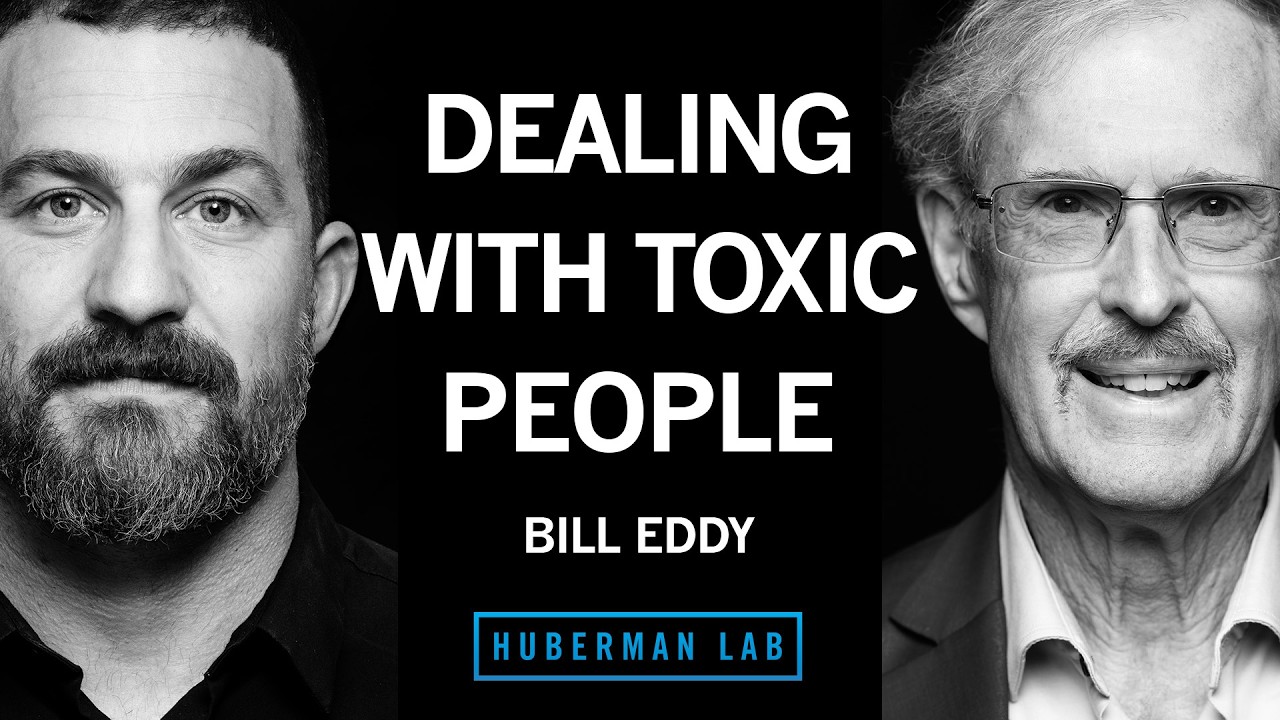
📺 Today’s recommended deep-dive video: https://www.youtube.com/watch?v=SuR0DaYoe0Y
Decoding the High-Conflict Personality: Tools for Resolution and Survival
Conflict is often less about the legal or logical issue at hand and more about the personalities driving the dispute. Bill Eddy, a lawyer and therapist, explains that “high-conflict personalities” (HCPs) are individuals pathologically preoccupied with blaming others, often lacking the self-reflection necessary to resolve disagreements.
Core Question: How can we identify high-conflict personalities and use structured communication tools to protect ourselves and resolve disputes?
Highlights
- The “First Year Rule”: Why you must wait twelve months before committing to a partner or business associate.
- The WEB Method: Using Words, Emotions, and Behavior to spot high-conflict traits before they escalate.
- The CARS Method: A four-step framework (Connecting, Analyzing, Responding, Setting Limits) to manage volatile interactions.
- The BIFF Response: How to communicate in a way that is Brief, Informative, Friendly, and Firm to end hostile cycles.
⏱️ Reading time: approx. 12 minutes · Saves you about 147 minutes vs. watching.
Want to take notes while watching? Click the image below and let AI Notebook capture the key points for you 👇

The Anatomy of a High-Conflict Personality
Blame as a Way of Life
A high-conflict personality is defined primarily by a narrow, persistent pattern of behavior characterized by a preoccupation with blaming others. Unlike most people who feel temporary anger during a dispute, the HCP sees every problem as the fault of a “Target of Blame,” refusing to take any responsibility for their own role in a situation.
While these traits often overlap with Cluster B personality disorders—such as Narcissistic, Borderline, or Antisocial disorders—Eddy notes that not everyone with a disorder is high-conflict. The distinguishing factor is the externalization of conflict; where a typical person might experience internal sadness or bargaining when things go wrong, the HCP gets stuck in a loop of denial and rage. This makes them incredibly resistant to traditional feedback or common-sense resolution.
High-conflict personalities come in two primary flavors: the overtly combative, who enjoy the argument, and the passive victims, who leverage “negative advocates” to fight their battles for them.

💡 Digging Deeper
Q: Are high-conflict people inherently “bad”?
A: Not necessarily; many develop these patterns as survival mechanisms in early childhood or have genetic predispositions, but their behavior is destructive to those around them.
Q: How common are these personalities?
A: Research suggests roughly 10% to 15% of the general population may have a personality disorder, with about half of those exhibiting high-conflict traits.
Q: Why do they attract so many supporters?
A: They recruit “negative advocates” by sharing one-sided, emotionally charged stories that hook the listeners’ amygdalas, making the advocate feel like a hero protecting a victim.
Spotting the Signs: The WEB Method
Words, Emotions, and Behavior
To protect yourself, you must move beyond a person’s surface-level credentials or charm and analyze their patterns using the WEB method. High-conflict people often use “all-or-nothing” language, labeling people as entirely good or entirely evil, and they frequently react with disproportionate intensity to minor slights.
Your own gut feeling is a data point. If you feel a “cold” sensation or a sense of dread that doesn’t match the person’s polite words, your brain may be detecting a mismatch between their affect and their intent. HCPs are often highly skilled at “reality distortion,” making their extreme behavior seem reasonable to an uninformed observer.
One of the most dangerous traits is “extreme behavior”—doing things that 90% of people would never do, such as shoving an airline worker or publicly shaming a janitor.

The First Year Rule
Eddy strongly advocates for the “First Year Rule”: never marry, move in with, or enter a deep business partnership with someone until you have known them for at least a full year. High-conflict people can often mask their traits for six months, but the stress of a long-term, close relationship eventually triggers their fear of abandonment or inferiority.
Close relationships are the primary stage where personality disorders manifest. You might see someone who is a star employee at work, yet a terror behind closed doors where the emotional stakes are higher and the audience is smaller.
Wait for a full cycle of seasons and stresses—holidays, illnesses, and minor failures—to see if a pattern of blame emerges.
Strategic Management: The CARS Method
De-escalation Through Structure
When you are forced to interact with an HCP—whether as a co-worker, an ex-spouse, or a neighbor—you cannot use logic to change them. Instead, you must manage the interaction using the CARS method: Connecting (with empathy, attention, or respect), Analyzing (presenting choices), Responding (with a BIFF statement), and Setting Limits.
Connecting does not mean agreeing with their delusions; it means offering an “EAR statement” (Empathy, Attention, Respect) to calm their overactive amygdala. For example, saying “I can see how frustrated you are, and I want to hear your concerns” can momentarily de-escalate a person who feels unheard and attacked.
Analyzing shifts the conversation from emotions to problem-solving. By asking the HCP to write a list of solutions or choose between two options, you force their brain to move from the reactive limbic system to the logical prefrontal cortex.

The BIFF Response for Hostile Emails
The BIFF response—Brief, Informative, Friendly, and Firm—is the gold standard for handling high-conflict digital communication. HCPs often send “blame-speak” emails designed to provoke a defensive reaction; responding with a long, emotional defense only feeds the conflict.
A BIFF response should contain only neutral facts. Avoid asking questions that invite more hostility, and end the exchange by stating when the next necessary interaction will occur. By being “firm” and “friendly,” you close the loop of the argument without becoming a Target of Blame yourself.
Setting Limits and The “Forget About Its”
The Futility of Insight
The most common mistake people make is trying to give an HCP “insight” into their behavior. Telling a narcissist they are being narcissistic, or explaining to a high-conflict person why they are at fault, will almost always result in an explosive counter-attack.
You must “forget about” three things: giving them insight, arguing about the past, and focusing on their emotions. Instead, focus entirely on future actions and objective rules. High-conflict people do not experience the typical grieving process of “acceptance,” so they will loop back to past grievances indefinitely if you allow them.
Limits must be paired with consequences. In a professional or personal setting, simply stating a rule is insufficient; you must be prepared to impose a consequence—such as ending a phone call or filing a formal report—if the behavior persists.
Key Takeaways
Dealing with high-conflict personalities requires a fundamental shift in how we perceive human interaction. We must accept that a small percentage of people operate on a different “operating system”—one that prioritizes the avoidance of internal shame through the externalization of blame. Understanding this prevents us from wasting years trying to “fix” people who do not believe they are broken.
By using tools like the CARS method and BIFF responses, we can protect our own emotional well-being while maintaining the necessary boundaries for professional and personal survival. The goal isn’t to demonize the HCP, but to recognize their patterns and adapt our communication to minimize the damage they can cause.
Finally, the “First Year Rule” remains the most powerful preventative tool at our disposal. Time is the only filter that consistently reveals the difference between a high-achieving personality and a high-conflict one.
Q&A
Q1: What is the most common trait of all high-conflict personalities?
A: A preoccupation with blaming others and an inability to take responsibility for their own problems or behaviors.
Q2: Should I tell someone I think they are a “narcissist” or a “high-conflict person”?
A: Absolutely not. Labeling them will likely trigger an intense defensive reaction and make you their primary “Target of Blame.” Use the knowledge to adapt your behavior, not to diagnose them.
Q3: What if I have to co-parent with a high-conflict ex-spouse?
A: Focus on “New Ways for Families.” Teach your children flexible thinking and how to manage their own emotions, rather than bad-mouthing the other parent, which only fuels the conflict.
Q4: How do I handle a high-conflict person who plays the victim?
A: Be careful of “negative advocates”—people they have recruited to fight for them. Stay neutral, provide factual information (BIFF), and avoid getting sucked into the emotional drama.
Q5: What is “Hoovering”?
A: It is a tactic where a high-conflict person, fearing abandonment, switches from rage to intense seduction or pleading to “suck” their partner back into the relationship.
Q6: Why is the “Friendly” part of a BIFF response important?
A: A touch of friendliness (like “I hope you have a good weekend”) signals to the other person’s brain that you are not a threat, which can prevent them from escalating the argument further.
Q7: Can a high-conflict person ever be successful?
A: Yes. Some, like Steve Jobs, use their high-conflict traits to push boundaries and achieve greatness, but they usually succeed only if they have enough flexibility to listen to a team that pushes back.