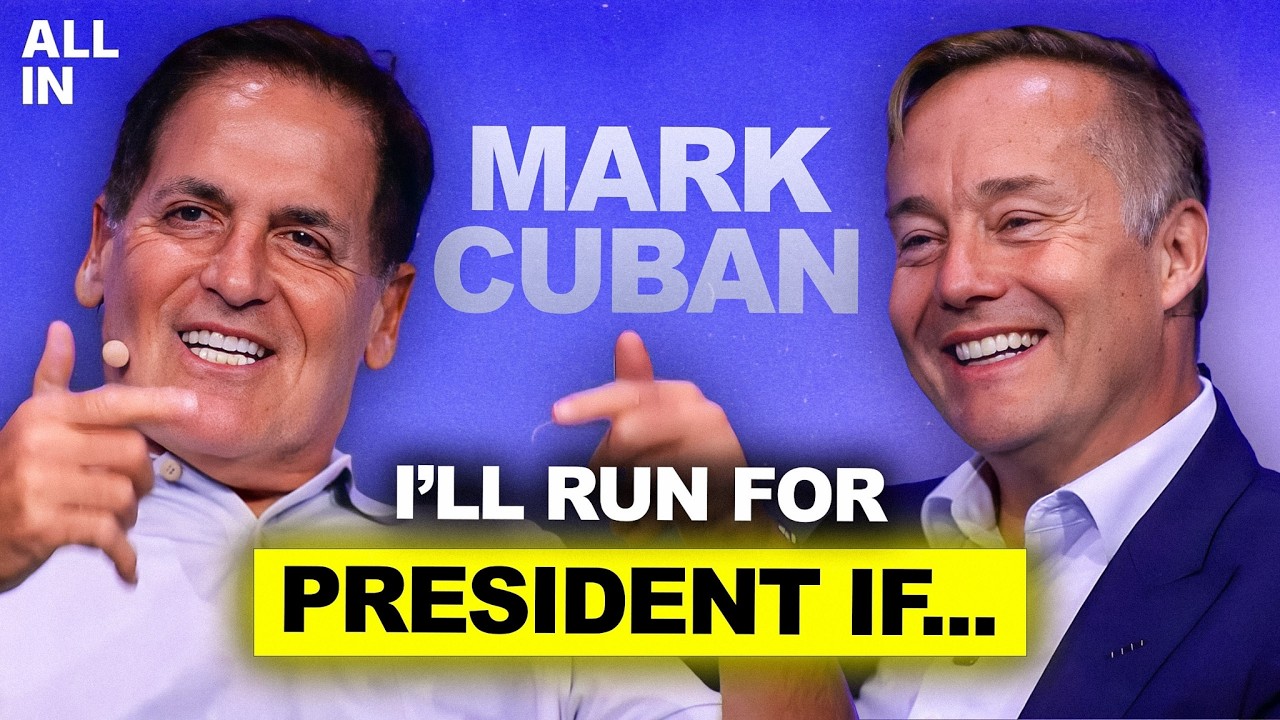
📺 Today’s recommended deep-dive video: https://www.youtube.com/watch?v=OY2Sjbjd_VE
Mark Cuban on the AI Reality Check: Why This Bubble is Different
Mark Cuban has seen his fair share of bubbles, but he believes the current AI frenzy isn’t the sequel to the dot-com crash everyone expects. Instead of a public market meltdown, we are witnessing a private capital reckoning that forces a shift toward enterprise utility, real-world models, and the “boring” work of implementation.
Core Question: Is the current AI investment wave a speculative bubble destined to pop, or a transformative technology hitting a difficult implementation wall?
Highlights
- The AI “bubble” is largely a risk for venture capitalists and private equity, not the general public, as companies aren’t going public without revenue.
- Enterprise AI implementation is proving much harder than consumer prompting, requiring significant human intervention and “forward-deployed engineers.”
- Video and “world models” are the next frontier that will push data center demand far beyond current text-based Large Language Models (LLMs).
- Large Language Models could act as objective “truth-seekers” to counter the engagement-driven bias of social media algorithms in politics.
⏱️ Reading time: approx. 8 minutes · Saves you about 34 minutes vs. watching.
Want to take notes while watching? Click the image below and let AI Notebook capture the key points for you 👇

The Bubble Paradox: VC Risk vs. Public Reality
A Shift from Public Markets to Private Exposure
The dot-com bubble was defined by cab drivers talking about revenue-less stocks, but today’s AI frenzy is a private capital game played by VCs and private equity firms. You don’t see the average person on the street buying shares of AI startups that have no traffic; instead, the risk is concentrated in the boardrooms of massive investment funds.
Back then, companies with no traffic went public and doubled in value overnight, impacting the entire economy when they crashed. Today, the risk is isolated to specific players going “all-in” on expensive private rounds for companies like Anthropic or SpaceX without the same immediate threat of public market contagion.
Cuban suggests that the lack of $100 million IPOs is actually a strategic disadvantage for disruptive companies. Without a public stock to use as “currency” for acquisitions, startups are forced to raise expensive private cash to buy out legacy competitors or acquire essential data sets. If the capital markets tighten, these private-heavy portfolios could be decimated while the general public remains relatively untouched by the fallout, though the VCs themselves will be destroyed.

💡 Digging Deeper
Q: Why should AI companies go public earlier?
A: Public stock acts as an “acquisition currency.” If a startup wants to buy a legacy business or a data-rich competitor, using stock is far cheaper than raising high-interest private debt.
Q: Is there a risk of “dark fiber” in the data center world?
A: Yes. If breakthroughs in technological efficiency reduce power requirements, we might see a surplus of data centers that ends up being underutilized, similar to the overbuild of fiber optic cables in the early 2000s.
Q: What is the “pricing to perfection” problem?
A: Investors are deploying capital based on the assumption that AI companies will return not just revenue, but massive earnings and margins. If those margins don’t materialize, the valuations collapse.
The Implementation Wall: Why Enterprise AI is Hard
The Myth of Instant Disruption
Despite the hype of Artificial General Intelligence (AGI), enterprise AI is currently a high-friction environment that requires a small army of engineers to actually function correctly. You can prompt an agent to help you cheat on a test or write a basic email, but integrating that into a mission-critical corporate workflow is proving to be incredibly difficult.
We were told two years ago that 50% of white-collar jobs would disappear, yet employment continues to grow as companies realize prompting isn’t enough. The truth is that most CEOs have no idea how to actually deploy these tools, necessitating human “harnesses” to make the models reliable enough for professional use.
Cuban notes that even advanced agents struggle with basic systems thinking, like setting a recurring email report based on specific data searches without outputting “slop.” This creates a massive opportunity for AI-literate workers who can bridge the gap between flawed model outputs and actual business needs. We aren’t seeing mass layoffs; instead, we’re seeing a widening productivity gap between those who embrace AI tools and those stuck on metaphorical “legal pads.”

💡 Digging Deeper
Q: Why are companies like Microsoft and Anthropic hiring thousands of “forward-deployed engineers”?
A: Because AI isn’t “plug-and-play” yet. If it were truly smart, you wouldn’t need engineers to help customers implement it; you would just ask the AI to install itself.
Q: What happens when agents “drift”?
A: As underlying LLMs are updated, the agents programmed on top of them can become brittle or stop working correctly, requiring constant human maintenance and oversight.
Q: How should young employees approach AI?
A: They should become “AI First.” The productivity gap between an employee who uses AI to solve five pressing issues and one who doesn’t is becoming as vast as the gap between a PC user and someone using a legal pad in the 90s.
Beyond Text: World Models and the Future of Scale
The Transition to Visual Intelligence
The next decade of AI will be defined by its transition from text-based processing to understanding the physical world through video and spectrography. While text and pictures are the foundation, they are not enough to reach the level of reasoning required for truly autonomous systems or advanced robotics.
Current LLMs are trained on static data, but they lack the fundamental “world model” of a two-year-old who knows that pushing a cup off a high chair results in a mess and a reaction from a parent. To reach true intelligence, AI needs to ingest massive amounts of video data to understand physics, cause, and effect, which will require a magnitude more tokens and inference power than we currently anticipate. This is the one factor that might actually justify the current tens of billions being spent on massive data center build-outs—the hunger for video processing is insatiable.
Cuban remains bullish on the long-term impact of robotics and world-sensing technology, even if the road there is longer than the hype suggests. He cites companies like Open Evidence for medical data and Lovable for app generation as early winners, but notes that we are still a long way from an AI having the “common sense” of a seeing-eye dog.

Key Takeaways
The AI “bubble” is not a repeat of the dot-com crash in terms of its impact on the average person’s 401(k). Because the current mania is fueled by private venture capital rather than public stock speculation, the “pop” will primarily destroy over-leveraged VCs and private equity funds. For the rest of the world, AI represents a massive productivity tool that is currently undergoing a “trough of disillusionment” as enterprises realize that implementation is harder and more human-dependent than the marketing promised.
We are moving toward a world where “AI Literacy” is the new basic requirement for the workforce. The displacement of jobs isn’t happening in a vacuum; instead, the roles are evolving to require systems thinking and the ability to manage AI agents that are prone to boredom, drift, and errors. Meanwhile, the technological frontier is shifting toward “World Models” that incorporate video and physical sensing, which will drive the next massive wave of infrastructure spending.
Finally, the social impact of AI might be its most surprising benefit. By acting as “truth-seeking” engines, LLMs have the potential to break the polarization caused by engagement-driven social media algorithms. If voters begin to use AI to vet political claims and find balanced policy solutions, we may see a return to a more objective and less fevered public discourse.
Q&A
Q1: How does the current AI bubble compare to the 1999 dot-com bubble?
A: In 1999, companies with no revenue were going public and the general public was buying them, leading to a widespread crash. Today, the bubble is driven by private capital, so if it pops, it will mostly hurt VCs and private equity firms rather than the average consumer.
Q2: Will AI really take away 50% of white-collar jobs?
A: Not in the near term. AI is currently too hard to implement at the enterprise level and lacks the systems thinking required for many jobs. It is creating more demand for AI-literate people rather than simply replacing them.
Q3: What are “world models” and why do they matter?
A: World models are AI systems that understand physical reality (like gravity or cause and effect) through video, rather than just predicting the next word in a sentence. They are essential for robotics and advanced autonomy.
Q4: How can AI improve personal health care?
A: AI allows for self-directed health care by analyzing long-term trends in blood work and wearable data. It won’t replace doctors, but it will allow them to make better decisions by providing them with years of personalized data benchmarks.
Q5: Why does Mark Cuban think AI will help politics?
A: Unlike social media, which is designed to keep you engaged through outrage, LLMs are designed to provide correct answers to maintain trust. This makes them “truth-seekers” that can give objective information on policy.
Q6: What is the “Second Apron” in the NBA and how does it relate to AI strategy?
A: The second apron is a highly punitive salary cap rule that forces teams to be much smarter about roster building and parity. Much like AI in business, it forces management to be more efficient and lucky with “rookie-contract” talent to succeed.
Q7: Is there an opportunity for entrepreneurs in the current AI failures?
A: Yes. Because AI is brittle and agents often fail or drift, there is a massive opportunity for entrepreneurs to build services that fix these implementation gaps for small and large businesses.