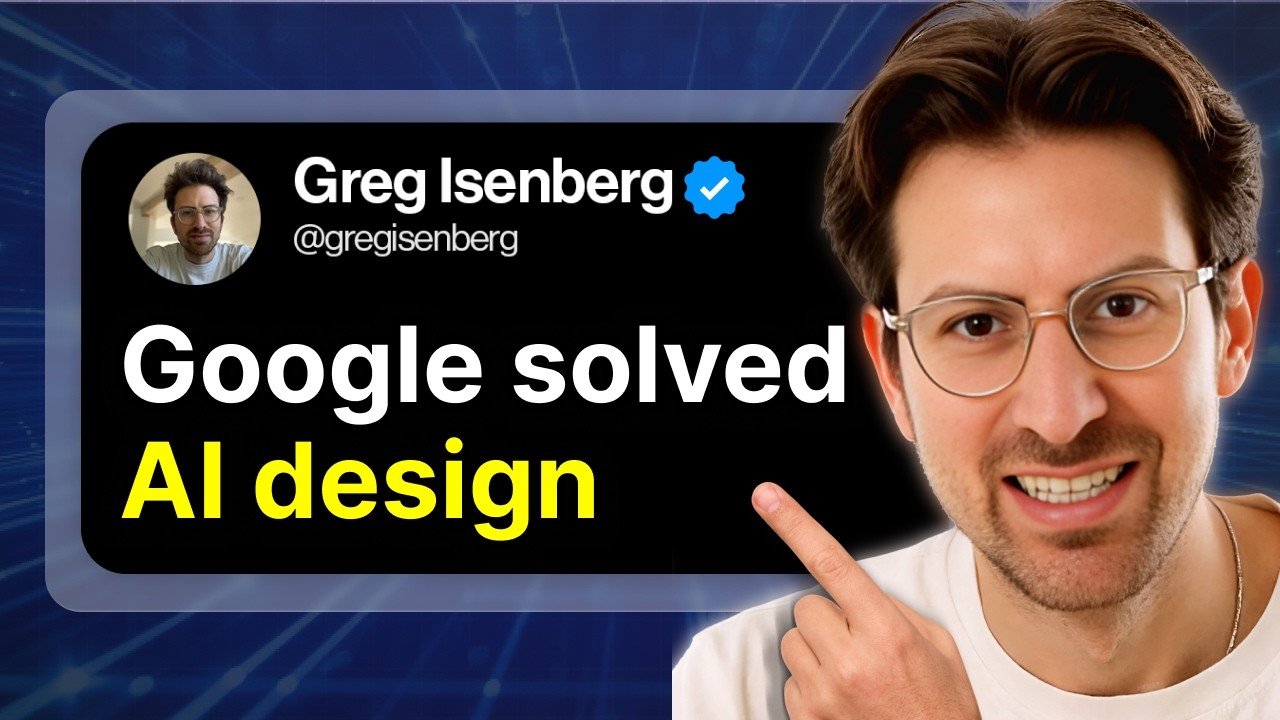
📺 Today’s recommended deep-dive video: https://www.youtube.com/watch?v=oLu32YpiIJw
Beyond Vibe Coding: Mastering Design.md for High-End AI Apps
Most AI-generated websites look generic, suffering from “design drift” and uninspired purple gradients that signal a lack of craftsmanship. Design expert Meng To reveals how a simple markdown file can act as the DNA for your entire product ecosystem, turning anyone into a top-tier designer capable of competing with major agencies.
Core Question: How can founders use Design.md and structured AI “skills” to maintain visual consistency and high-end aesthetic value across web, mobile, and motion platforms?
Highlights
- Design.md acts as a portable blueprint for typography, colors, and motion rules that AI agents can actually digest.
- The shift from manual pixel-pushing to “judgment per minute” defines the new era of the elite solo creator.
- High-end special effects, like WebGL-powered lasers, serve as a critical moat against the sea of generic SaaS templates.
- Parallel product development is now possible by queuing iterative prompts and maintaining a centralized design memory.
⏱️ Reading time: approx. 7 minutes · Saves you about 44 minutes vs. watching.
Want to take notes while watching? Click the image below and let AI Notebook capture the key points for you 👇

The Blueprint of Visual Consistency
Ending the Era of Design Drift
Design.md is an open-source standard that functions as a bridge between high-end design systems and the AI agents currently building our software. It captures the essential soul of a brand—its spacing, typography, and color logic—in a structured text format that Large Language Models can process with incredible precision.
Meng explains that while a one-shot prompt might get you a decent landing page, the real struggle is maintaining that quality as you scale into footers, secondary pages, and mobile views. Without an underlying markdown-based design system, the AI starts guessing, leading to a “generic” look where elements feel disconnected and the visual identity slowly degrades into a standard bootstrap template.
This markdown file isn’t the finished dish; it is the recipe.
By attaching this file to your agent’s prompt, you ensure that every generated component shares the same DNA, regardless of which platform or tool you are currently using to build.
💡 Digging Deeper
Q: Why is design.md better than just sharing a Figma link with an AI?
A: Figma files are high-fidelity but conceptually “noisy” for AI; Markdown provides the pure structural logic and CSS-ready rules an agent needs to execute code accurately.
Q: Can I use this system for existing brands?
A: Absolutely. You can extract the typography and color variables of any site and port them into a Design.md file to “teach” an agent the brand’s specific visual language.
Q: Does this replace the need for a designer?
A: It replaces the manual labor of a designer, but elevates the need for “taste”—the ability to recognize which iterations align with the brand’s soul.
Mastering the AI “Skills” Arsenal
The Secret Sauce of Special Effects
Skills are the specific ingredients—the secret sauce like 3D globes, skeuomorphic shading, or “lickable” buttons—that elevate a project from a basic wireframe to a jaw-dropping digital experience. These are essentially modular prompts that focus on one high-level aesthetic or functional capability, such as WebGL-powered motion or advanced copywriting frameworks.
Meng emphasizes that “lasers” and complex special effects are a weirdly effective moat in the current market; users respond to high-end motion because it feels premium and cinematic. By creating specific skill prompts for these effects, you can inject personality into a product without having to manually code complex physics or shader math every time you want a visual glow.
These skills aren’t just about vanity; they include spacing rules that ensure every element feels intentional rather than randomly generated.

💡 Digging Deeper
Q: What is the most effective “skill” for increasing user conversion?
A: Special effects like WebGL motion (lasers/glows) and high-end typography smoothing; these signals of “care” build immediate trust with the user.
Q: How do “skills” differ from general system prompts?
A: Skills are modular and targeted; you might apply a “Skeuomorphism Skill” to a button but keep the “Flat Design Skill” for the overall layout logic.
From Lone Wolf to Fleet Commander
Judgment Over Labor
The role of the designer has pivoted from a manual laborer to a high-level curator making “judgment calls per minute.” You are no longer resizing rectangles or hunting for hex codes; you are directing an orchestra of agents to execute a vision that was previously locked in your head.
Meng reveals a startling “thousand-iteration” workflow, proving that AI doesn’t make the creative process easier—it makes the creative output deeper. Because you can iterate so quickly, you are forced to confront more micro-decisions about the “soul” of the product, resulting in a level of polish that manual coding could never achieve in the same timeframe.
Solo founders are now effectively operating as fleet commanders of creative agents.
Building four products simultaneously is only possible when you stop thinking about one-shot prompts and start thinking about iterative queuing. By setting up multiple chat threads with sub-agents and feeding them the same Design.md DNA, a single person can maintain the creative output of a mid-sized design agency.

💡 Digging Deeper
Q: How do you handle the technical limitations of AI memory during long projects?
A: Use “Open Codex” or local agents that can read your entire folder structure; this allows the agent to maintain context of the whole project history.
Q: What is the biggest mistake people make when building with AI?
A: Settling for the “one-shot.” People see a decent result and stop, whereas a pro uses that result as the baseline for a thousand tiny refinements.
Key Takeaways
Taste is the ultimate value in a world where the cost of production has dropped to near zero. If your website looks like every other Shopify store or generic SaaS landing page, its perceived value drops by 10x to 100x because it lacks authenticity. Developing your taste means being a “skills maxi”—obsessively collecting prompts for unique visual effects and following niche makers rather than looking at general trends.
The transition from a builder to a curator requires a new kind of creative stamina. You must be willing to iterate 1,000 times on a single component to find its “soul,” using tools like Design.md to ensure that those 1,000 iterations don’t stray from your core brand identity. As AI agents become more powerful, your ability to make micro-decisions quickly will be the only thing that separates your product from the noise.
Q&A
Q1: What exactly is in a Design.md file?
A: It’s a markdown file containing tables and code blocks that define typography (font sizes, weights), color palettes (hex codes for primaries, secondaries, and accents), spacing rules (margins, padding), and even motion parameters (animation curves and durations).
Q2: Can someone without any coding or design background really use this?
A: Yes, because you can “remix” existing Design.md files. You don’t have to write the CSS or design the system from scratch; you find a system you like, port it, and then use your “taste” to guide the AI in applying it to your specific idea.
Q3: Why does Meng suggest building products locally instead of in the cloud?
A: Local development allows you to use agents that have full access to your file system (Design Memory). This eliminates token limits on context and allows the AI to understand the relationships between different files in your project, which is much harder to do in a standard web-based chat interface.
Q4: What is the “moat” for a solo founder today?
A: The moat is “judgment per minute” and niche authenticity. Large companies are too slow to adapt to new AI models, and generic builders produce boring results. A solo founder with high taste and a mastery of the Design.md workflow can ship high-fidelity products faster than a corporate team.
Q5: How do “Lasers” or WebGL make a difference in business?
A: They serve as a “signal of effort.” When a user sees a unique, high-performance animation, they subconsciously associate it with a high-quality, trustworthy product. It breaks the “generic AI vibe” and makes the product feel like it was crafted by a human.
Q6: What is the difference between an iteration and a remix?
A: An iteration is a micro-adjustment to a design you already like (e.g., “make the button glow slightly more”). A remix is taking the DNA of one design and applying it to a totally different format, such as turning a landing page design into an Instagram slide deck.