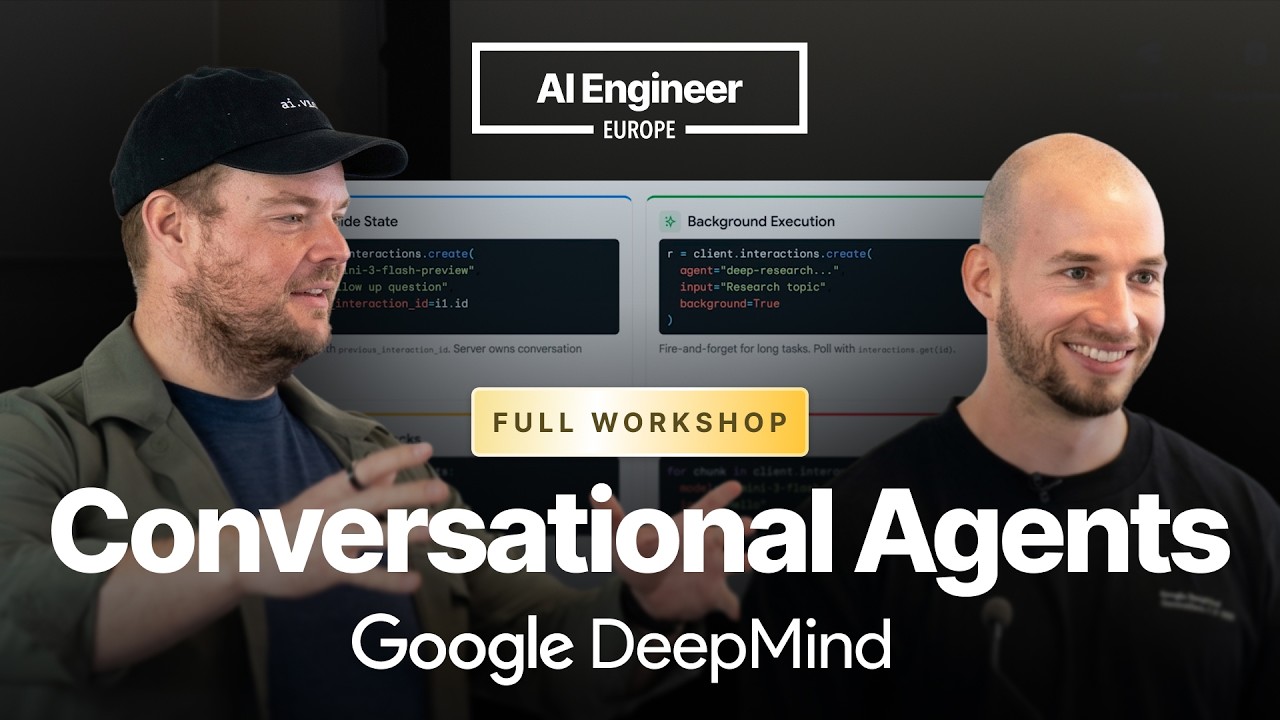
📺 Today’s recommended deep-dive video: https://www.youtube.com/watch?v=cVzf49yg0D8
Building the Future of AI Agents: Mastering Gemini’s Interactions and Live APIs
Move beyond basic chat completions and explore the next evolution of agentic workflows with server-side state and native multimodal streaming. This deep dive into Google DeepMind’s latest developer tools reveals how to build low-latency, conversational agents that can see, hear, and act.
Core Question: How can developers leverage the Gemini Interactions and Live APIs to build sophisticated, stateful agents with real-time multimodal capabilities?
Highlights
- The new Interactions API introduces server-side state management, reducing client-side complexity and cutting input costs by up to 90% via implicit caching.
- Gemini 3.1 Flash Live enables native audio-to-audio communication, bypassing traditional text-transcription bottlenecks for lower latency and more natural prosody.
- Developers can now utilize “Agent Skills” and MCP (Model Context Protocol) to give models specific tools like file system access and bash command execution.
- Multimodal sessions can be extended through context window compression and secured via ephemeral tokens for direct client-to-API communication.
⏱️ Reading time: approx. 12 minutes · Saves you about 96 minutes vs. watching.
Want to take notes while watching? Click the image below and let AI Notebook capture the key points for you 👇

The Evolution of the Interactions API
From Stateless Chats to Stateful Agents
The Interactions API represents a fundamental shift in how Google handles agent state, moving logic from the client to the server.
By using persistent Interaction IDs, developers no longer need to manage complex history arrays or manually prune tokens to stay within context limits. The server remembers the previous turns, ensuring that the model maintains its reasoning chain across multiple asynchronous requests without breaking the internal cache.
One of the most significant performance optimizations comes from implicit caching, which can reduce input token costs by up to ninety percent. When you use server-side state management, the system can reliably reuse encoded tokens for follow-up requests because the input remains consistent. This is a massive advantage for startups building long-running agents where repeating the entire context for every turn would otherwise become prohibitively expensive and slow.

💡 Digging Deeper
Q: How long is the state stored on the server?
A: For free tier users, state is stored for 24 hours. For paid API keys, the duration extends to 55 days, allowing for long-term “asynchronous” research tasks.
Q: Can I still manage my own context if I don’t trust the server-side state?
A: Yes. The API is flexible; you can still send an array of roles (user/model) if you need to perform manual context engineering or specific pruning.
Hands-On: Building a Coding Agent
Leveraging Skills and Tool Calling
The modern development workflow utilizes “Agent Skills”—specialized instructions and schemas that inform a model about its environment and capabilities.
Instead of hardcoding every tool, developers use a .agents folder to store skills that the model can fetch dynamically. This approach keeps the model’s “brain” updated without requiring a full redeployment of the application logic every time a tool’s documentation changes.
During the workshop, a live coding assistant was constructed using Gemini 3 Flash. Despite being a smaller model, its high reasoning speed and ability to ingest specialized skills allowed it to create files, execute bash commands, and even debug its own Python scripts in a continuous loop. This “closed-loop” execution is what differentiates a simple chatbot from a true agent that can verify its own work.

💡 Digging Deeper
Q: Is Gemini 3 Flash powerful enough for complex coding tasks?
A: It excels at task execution and planning when provided with clear skills and system instructions. For high-level architectural decisions, it can be paired with larger models via the unified Interactions interface.
Q: What happens if a model calls a tool that isn’t implemented?
A: The client-side loop should catch the missing mapping in the tools_map and return an error to the model, which often prompts it to “reason” through an alternative approach.
Native Multimodal: The Gemini Live API
Real-Time Sight and Sound
Gemini 3.1 Flash Live is a native audio-to-audio model, which means it processes sound tokens directly rather than converting them to text first.
This architectural shift allows for incredibly low latency and the preservation of emotional nuance, accents, and interruptions. Because the model “hears” the audio, it can detect tone and background noise, making it far more responsive than traditional cascading pipelines that rely on separate STT (Speech-to-Text) and TTS (Text-to-Speech) engines.
Beyond audio, the Live API supports a video feed at one frame per second. This is sufficient for “looking” at a user’s screen or a camera feed to provide real-time coaching or technical support. For example, a developer can share their IDE with the model, allowing it to “see” the code as they talk about a specific bug, creating a collaborative pair-programming experience.

💡 Digging Deeper
Q: How do you handle authentication for client-side WebSockets?
A: Use ephemeral tokens. The server generates a short-lived token using the main API key, which the client then uses to establish the WebSocket connection without exposing the master key.
Q: Can the model’s voice be customized beyond the 30 base options?
A: Yes. Because the model has deep audio understanding, you can use system instructions to tell it to speak with a specific accent (e.g., “friendly Irish accent”) or adopt a specific persona.
Scaling and Production Challenges
Context Management and Hallucinations
As sessions grow longer, developers must implement context window compression to prevent the model from hitting its token limit.
For audio-only sessions, the native limit is about 15 minutes, while video sessions drop to roughly 2 minutes due to the high token cost of image frames. Implementing a “sliding window” allows the agent to maintain the most recent parts of the conversation while gracefully “forgetting” the beginning to ensure the session never terminates abruptly.
Hallucinations remain a hurdle, particularly with real-time tools like Google Search grounding. If the system prompt isn’t robust, the model might invent data instead of calling the search tool. Best practices include using strict system instructions and “thinking” levels (low/high) to force the model to verify its facts before speaking them out loud.
Key Takeaways
The transition from stateless LLMs to stateful, multimodal agents marks a new era for developer productivity. The Interactions API simplifies the backend by managing history on the server and optimizing costs through implicit caching. This allows developers to focus on building “hands and eyes” for their models via tool calling rather than managing infrastructure.
Meanwhile, the Live API’s native audio processing removes the “uncanny valley” of voice assistants. By integrating real-time video and audio, companies like Shopify and Waymo are already exploring more human-centric interfaces. While challenges like context window limits and grounding persist, the move toward unified, multimodal, and stateful APIs provides the necessary foundation for the next generation of AI software.
Q&A
Q1: What is the main difference between Generate Content and the Interactions API?
A1: Generate Content is stateless and requires the developer to send the entire history with every request. The Interactions API is stateful, storing history on the server and using Interaction IDs to maintain context across turns.
Q2: When will the Interactions API be available on Vertex AI?
A2: It is currently in beta on the Gemini API (Google AI Studio). Integration into Vertex AI is planned and will likely follow the same unified interface once it reaches general availability.
Q3: Does the Live API store audio transcripts?
A3: No, the raw transcripts are not stored by the API. If you need logs for observability or compliance, you must capture the WebSocket events and store them on your own backend or use a partner integration like LiveKit.
Q4: How does “Context Window Compression” work in real-time?
A4: It functions as a sliding window. Once the token limit is approached, the system discards the oldest parts of the conversation or summarizes them to make room for new multimodal input.
Q5: Can the Live API differentiate between multiple speakers?
A5: Currently, the model listens to all audio in the stream. It does not have a native “voice fingerprinting” feature to ignore specific speakers, though it can often be instructed via system prompts to ignore irrelevant background chatter.
Q6: What is an ephemeral token?
A6: It is a short-lived, restricted-access token generated by your server. It allows a client (like a mobile app) to connect directly to the Gemini API without needing the developer’s permanent, secret API key.
Q7: Can I use Google Search grounding with my own custom tools?
A7: Yes. A recent update allows for “tool combination,” meaning you can now provide the model with both Google Search access and your own specific function definitions in the same session.