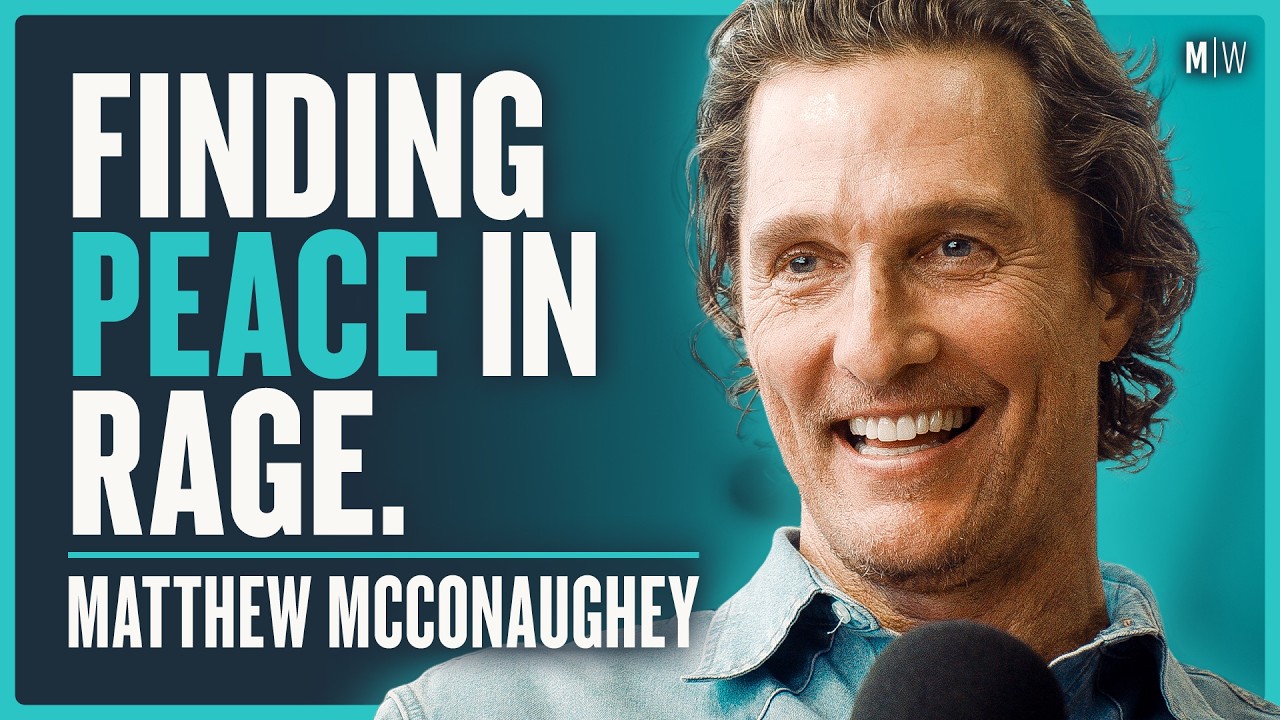
📺 Today’s recommended deep-dive video: https://www.youtube.com/watch?v=y_woFP79F0Q
Finding the Rhyme: Matthew McConaughey on Risk, Faith, and the Art of Living
In this landmark 1,000th episode, Matthew McConaughey joins Chris Williamson to deconstruct the “greenlights” and “daymares” that define the human experience. Moving beyond Hollywood anecdotes, they explore why true success requires a “profit” in character and how to maintain a soul in an increasingly digitized world.
Core Question: How can we navigate the tension between self-reliance and faith to achieve a life that prioritizes quality over mere longevity?
Highlights
- The “Third Eye” philosophy: Finding the overlap and balance between contradictory forces like technology and culture.
- The 100/8 Rule: Why taking 100 risks to get 8 wins is spiritually superior to taking 8 risks to get 7 wins.
- The “Daymare” concept: How self-betrayal creates a living hell that haunts our waking hours.
- Redefining Masculinity: Moving from “macho” to being a “good man” who is reliable and stands for convictions.
⏱️ Reading time: approx. 12 minutes · Saves you about 106 minutes vs. watching.
Want to take notes while watching? Click the image below and let AI Notebook capture the key points for you 👇

The Rhythms of Life and the “Third Eye”
Modeling the Rise, Not the Result
Matthew McConaughey reflects on the “rhyme” of life, suggesting that while generations change, the fundamental debits and assets of human culture remain remarkably balanced.
We often think of love and hate or heaven and hell as contradictory forces pulling us apart.
McConaughey posits that the truth is found in the “third eye,” the overlap where these extremes balance themselves out. For every advancement in technology, we pay a debit in old culture, yet the total sum remains ecclesiastical—there is a time to plant and a time to gather. This perspective transforms life from a series of random events into a rhythmic, almost musical experience where history doesn’t just repeat; it harmonizes with the present, requiring us to look for the “math” behind our instincts.

💡 Digging Deeper
Q: Why does McConaughey prefer “rhyme” over “reason”?
A: Reason is often “neck up” and intellectual, while rhyme implies a rhythmic, soulful connection to the timing and flow of life events.
Q: What is the “hands on the wheel” theology?
A: It is the belief that God applauds self-reliance; faith isn’t a replacement for responsibility, but a partner to it.
Q: How does he define “deja vu”?
A: He calls it “vu deja”—a sign that life is rhyming and you are exactly where you are supposed to be in the divine math.
Accountability and the Living Hell
The Mirror and the “Daymare”
Forgiveness is not just about letting go; it is about the work required to ensure the transgression never happens again.
When we betray others, we can seek reconciliation, but the real challenge is forgiving ourselves when we look in the mirror. McConaughey describes “daymares”—the lingering guilt that haunts your waking hours—as a unique form of living hell. If you repeat an offense, you lose your reputation with yourself, creating a cycle of self-distrust that no amount of external success can ever truly compensate for or fix.
The buck stops with the individual, as God doesn’t want to do everything for you; some of the navigation is strictly your burden.
Owner’s Mentality vs. Renter’s Mentality
So many people approach relationships and careers with a transient, transactional mindset that prevents anything from truly taking root.
An “owner” enters a relationship hoping it is a “lifer,” investing the equity needed to turn a house into a home. When you rent, you are always looking for the exit, which ensures the experience remains superficial and ultimately unsatisfying. This commitment to ownership is what transforms a simple transaction into a life-altering, transformational experience.

Redefining the Masculine Compass
Beyond Macho: The Reliability of the Good Man
True masculinity has been “sterilized” by recent cultural movements, leaving many men confused about their role in a modern society.
McConaughey argues that a truly masculine man is not an oppressor or a “macho” caricature, but someone who is fundamentally reliable.
The “good man” stands for ideals and creates consequences for those who trespass against his values or family. This isn’t about dominance, but about the “composure and competence” required to provide a stable foundation for others to lean on. When a man is in synchronicity with his head, heart, and loins, he becomes an asset to his community rather than a source of toxicity.

The 100/8 Rule of Risk
We often overpraise balance and safety, yet greatness almost always demands a period of intense, focused imbalance and hustle.
If you take only eight risks and succeed seven times, you are playing it too safe and failing to grow. It is far better to take 100 risks and miss the mark 92 times, because those eight successes will be earned through a depth of experience that the “safe” player can never understand. Sin, in its original definition, means to “miss the mark,” and if you aren’t missing the mark, you aren’t aiming high enough.
Quality Over Quantity in the Age of AI
Soul vs. Digits
In a world obsessed with longevity and “bio-hacking,” we risk extending our lives without actually improving the texture of our existence.
Time is not an enemy to be raced against, but a partner to dance with through deliberate presence and humor.
As AI speeds up information processing, McConaughey observes that people don’t necessarily sound smarter—they just sound “faster” and more fragmented. We are gaining quantity of data but losing the “bass guitar” of the soul, the underlying thread that gives information its meaning. Real success is “success with profit,” where profit is measured by the quality of your relationships and the peace of your mind.

Key Takeaways
To live a life that “rhymes,” one must accept the necessity of both self-reliance and faith. It is not enough to pray for a result; you must keep your hands on the wheel and do the work, knowing that God (or the universe) applauds the effort of the individual who takes responsibility for their own path. This synergy between the human and the divine is where true confidence is born.
We must shift our focus from “modeling the result” to “modeling the rise.” If you only look at the end product of a successful person, you miss the “hustle,” the “out-of-balance” years, and the risks that made them who they are. Success is a verb, not a noun, and it requires the courage to be an “outlaw” who is willing to be misunderstood while they build their legacy.
Finally, humor and humility are the essential tools for navigating the “daymares” of existence. Admitting we have more to learn is the highest form of humility, and laughter is the primary way we “untie the knots” of a crisis. By choosing to see time as being on our side rather than an enemy, we can slow down, breathe, and ensure that our life’s work is as vital as the life we are actually living.
Q&A
Q1: What is the difference between a “nice guy” and a “good man”?
A1: A nice guy seeks to get along and lacks discernment, while a good man has clear ideals he will stand for and against, even if it makes him unpopular.
Q2: How does McConaughey view the role of rage in achieving peace?
A2: He believes peace isn’t “Kumbaya” but requires “punk rock” effort and sweat equity; sometimes rage is the only emotion that “moves the needle” toward real change.
Q3: What was the “bigger risk” McConaughey took in his personal life?
A3: He viewed the “affirmative action” of marriage as a bigger risk than staying single, seeing it as a deep-dive covenant rather than just a traditional social step.
Q4: Why does he play Candy Crush?
A4: He finds it a great tool for focus and has even derived life lessons about strategy and persistence from the game’s mechanics.
Q5: What is the “Inner Citadel”?
A5: It is a psychological retreat where, if we can’t get what we want, we teach ourselves to want only what we can get, which McConaughey warns can lead to spiritual death.
Q6: How does he define vulnerability?
A6: Vulnerability is the act of speaking your truth in spite of the consequences, especially when the situation is frightening.
Q7: Why does he feel “at home” in the desert?
A7: He appreciates the cleanliness and lack of mildew; in the desert, things either survive or they dry up and rot without bacteria, providing a sense of energetic purity.