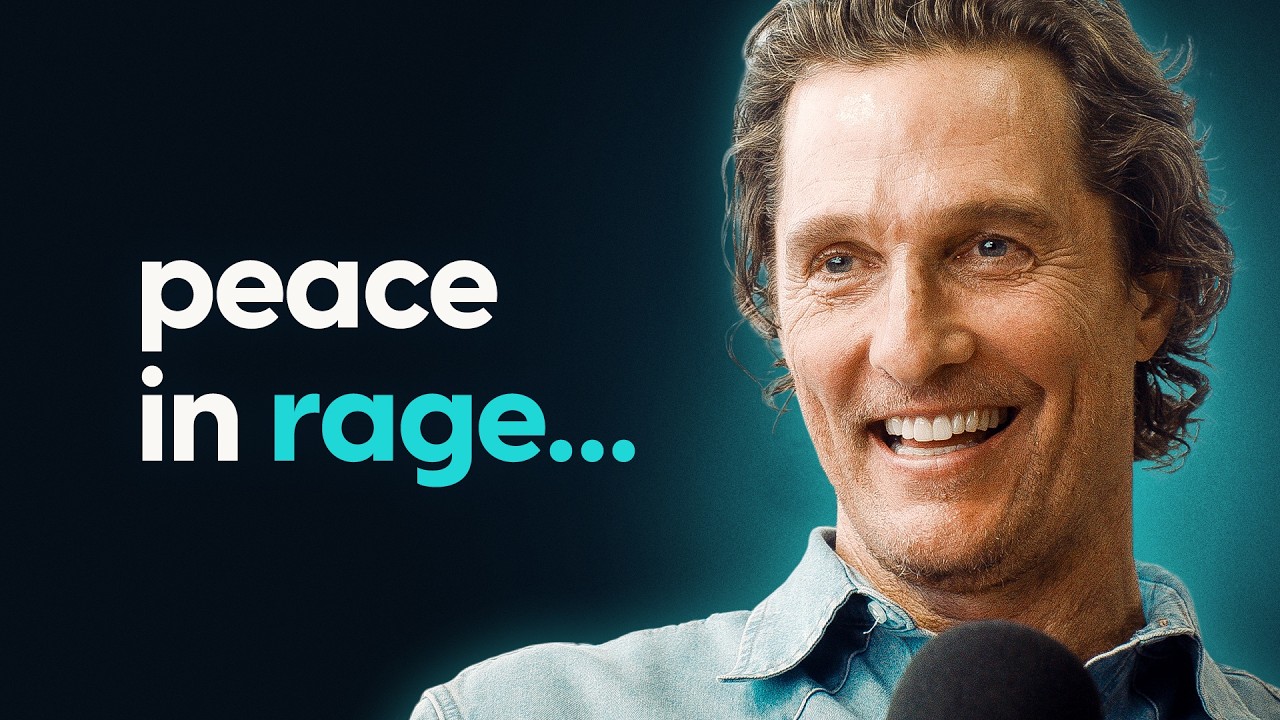
📺 Today’s recommended deep-dive video: https://www.youtube.com/watch?v=y_woFP79F0Q
Beyond the Greenlights: Matthew McConaughey on the Rhyme of Life and the Rage of Peace
To celebrate the monumental 1,000th episode of Modern Wisdom, Matthew McConaughey returns to a setting that mirrors his cinematic journey to discuss the deeper mechanics of the human soul. He explores why true peace requires a “punk rock rage,” the danger of being a “repeat offender” in forgiveness, and why we should stop modeling the results of successful people and start modeling their rise.
Core Question: How can we navigate the “daymares” of self-betrayal to build a life defined by profit in quality rather than just quantity?
Highlights
- Why “life rhymes” through the constant trade-off between new technology and old culture.
- The critical distinction between a “nice guy” who just gets along and a “good man” who stands for something.
- Why vulnerability isn’t just “opening up” but the courageous act of speaking truth regardless of the consequences.
- The “Owner’s Mentality” in relationships and why transactional living leads to a spiritual living hell.
⏱️ Reading time: approx. 12 minutes · Saves you about 106 minutes vs. watching.
Want to take notes while watching? Click the image below and let AI Notebook capture the key points for you 👇

The Ecological Balance of Life and Faith
Finding the Rhyme in History
McConaughey reflects on the Alberta set of Interstellar, noting that the transition from a father leaving his children to the liftoff of a rocket happens in a heartbeat. He views this as a metaphor for the human drama—the constant pull between what we are meant to do and what we must leave behind. This leads to his core philosophy that “life rhymes,” a concept borrowed from Mark Twain’s observation on history.
History doesn’t repeat, but it certainly echoes across generations.
For every new technology we embrace, there is a corresponding debit in our old culture; as we gain speed, we lose the ritual of the slow. McConaughey suggests that the truth exists in the “third eye” where these contradictions overlap and eventually balance themselves out. We aren’t necessarily doing anything new under the sun; we are simply changing the labels on the same eternal struggles between heaven and hell, hate and love.

💡 Digging Deeper
Q: What is the relationship between science and God?
A: Science is the practical pursuit of a God we will never fully prove, which is why faith is required for the parts science cannot reach.
Q: Is self-reliance an alternative to faith?
A: No, they are complimentary; McConaughey believes God “applauds” when we keep our hands on the steering wheel rather than just praying for a miracle.
Q: What is a “Vu Deja”?
A: It is the opposite of Deja Vu—flipping a familiar situation upside down to see it from a completely different, often backward, perspective.
The Debt of Forgiveness and the Living Hell
The Trap of the Repeat Offender
Forgiveness is often used as a crutch by those who have no intention of changing their behavior. McConaughey challenges the traditional religious view of “sinning all week and asking for forgiveness on Sunday,” arguing that if you know exactly what you are doing and do it anyway, you aren’t an accidental sinner; you are a repeat offender.
True reconciliation requires the offender to do the work so they never have to ask for forgiveness for the same thing twice.
When we forgive too quickly, we often do it just to clear our own conscience of spite, but we fail to hold the other person—or ourselves—accountable. This lack of penance creates a “living hell” where our own shadow chases us down in the middle of the night. If the buck doesn’t stop with a change in volition, the ledger remains permanently imbalanced, regardless of how many “I’m sorrys” are exchanged.
Escaping the “Daymare”
Nightmares are manageable because you eventually wake up, but a “daymare” is the haunting reality of your own choices following you into the sun.
When you lose your reputation with yourself, you lose the ability to trust your own word, which is the most personal form of hell imaginable. You can move from city to city to outrun your public reputation, but you can never move away from the mirror. This internal dissonance creates a dizziness that eventually leads to self-implosion, as no amount of outward success can compensate for a lack of internal integrity.

Model the Rise, Not the Result
The Myth of Balance
We tend to overpraise balance as the ultimate goal, yet greatness almost always demands a period of radical imbalance.
McConaughey and host Chris Williamson discuss the “Model the Rise” concept, which suggests we should look at what a successful person did to get there, not what they do now. Warren Buffett reading the newspaper all day is a result of his success, but his younger self was a “hustler” who took massive risks. If you want to achieve exit velocity, you have to be willing to be an “outlaw” for a season, operating out of whack with the world.
The Rage of Peace
Peace isn’t found through a “Kumbaya” circle; it is won through a “punk rock rage” and a fierce pursuit of contentment.
McConaughey believes we are not yet an evolved enough species to behave as well as we intellectually agree we should. Sometimes lines must be drawn, and sometimes you have to “rage” against your own stagnation to reach the “inner citadel” of your soul. If you aren’t taking enough risks to occasionally miss the mark—which is the original meaning of “to sin”—then you aren’t actually playing the game.
Redefining Masculinity and the Owner’s Mentality
Beyond the “Me Too” Stasis
In the wake of the Me Too movement, many men felt “sterilized” rather than just “sanitized,” losing their sense of what it means to be masculine.
McConaughey argues that the best thing for women is more “good men,” not fewer masculine ones. A truly masculine man is not an oppressor or a chauvinist, but he is someone who wants to be relied upon and who has the competence to provide solutions. When his first child was born, McConaughey felt a synchronicity of head, heart, and loins that was the most “feral” and powerful he had ever been.
Choosing the Sacrament over the Risk
His transition from the “Rom-Com era” to more vital dramas was a courageous act of “rolling the dice” on his own career.
He stayed away from Hollywood for 20 months, turning down a $14.5 million offer to signal to the industry that he was no longer a “renter” of his roles but an “owner.” This owner’s mentality applies to life and relationships as well; many people treat life as transactional because it’s safer, but you can never turn a house into a home with a renter’s mindset. You have to be a “lifer” to get the real transformation.

Key Takeaways
Success without profit is a hollow victory. In McConaughey’s world, “profit” isn’t about the balance sheet but the quality of the years you live. We often obsess over longevity—how to live longer—at the expense of “living better.” Real profit is being able to sleep soundly because you didn’t burn your bridges or betray your character to reach the top. It is the realization that time is on your side only when you stop trying to beat it.
The “Good Man” is a harder path than the “Nice Guy” because it requires the courage to be unpopular and the strength to enforce consequences. This involves moving “below the neck,” getting out of the overthinking mind and into the heart. By treating life as a “verb”—a constant approach rather than a final result—we maintain the “beginner’s mind” necessary for evolution.
Finally, vulnerability is redefined as an offensive maneuver. It is not about weakness; it is about the “Jedi mind trick” of saying your truth when it is most scary. This creates a foundation of confidence built on actual “pulling things off” rather than just hoping they work. When we model the rise, embrace the rage, and adopt an owner’s mentality, we find the rhyme that makes the struggle of life a song worth singing.
Q&A
Q1: What does “Life is a Verb” mean?
A1: It means that there is no final result or “destination” in life; there is only the constant, evolving approach and the quality of the actions we take daily.
Q2: Why did McConaughey turn down $14.5 million for a rom-com?
A2: He wanted to signal a “one-way ticket out” of his current reputation. He needed to be anonymous for a while so that Hollywood would see him as a “new novel idea” for dramatic roles.
Q3: What is the difference between a “Nice Guy” and a “Good Man”?
A3: A nice guy is affable and avoids conflict to get along. A good man has ideals he will stand for and against, even if it makes him unpopular or requires causing consequences.
Q4: How does McConaughey advise overthinkers?
A4: He suggests recording yourself while you are overthinking and listening back. Usually, you’ll realize you are giving “significance” to things that have no real meaning, which helps you slow the brain down.
Q5: What was the “Canoe” lesson from the Squamish Nation?
A5: A chief gave him a paddle, explaining that the ore is the rudder and compass. It serves as a reminder to stay in your own power while traveling the “highway rivers” of life.
Q6: Is time an enemy or an ally?
A6: Time is on your side. As the saying goes, “be quick but don’t be in a hurry.” Rushing leads to missing the foundation, like a Lego set built with 12 pieces left over at the end.
Q7: What is “Barbituate Logic”?
A7: It is the practice of calming the brain to have “half the thoughts per hour” to gain twice the power and tell a more meaningful story with fewer words.