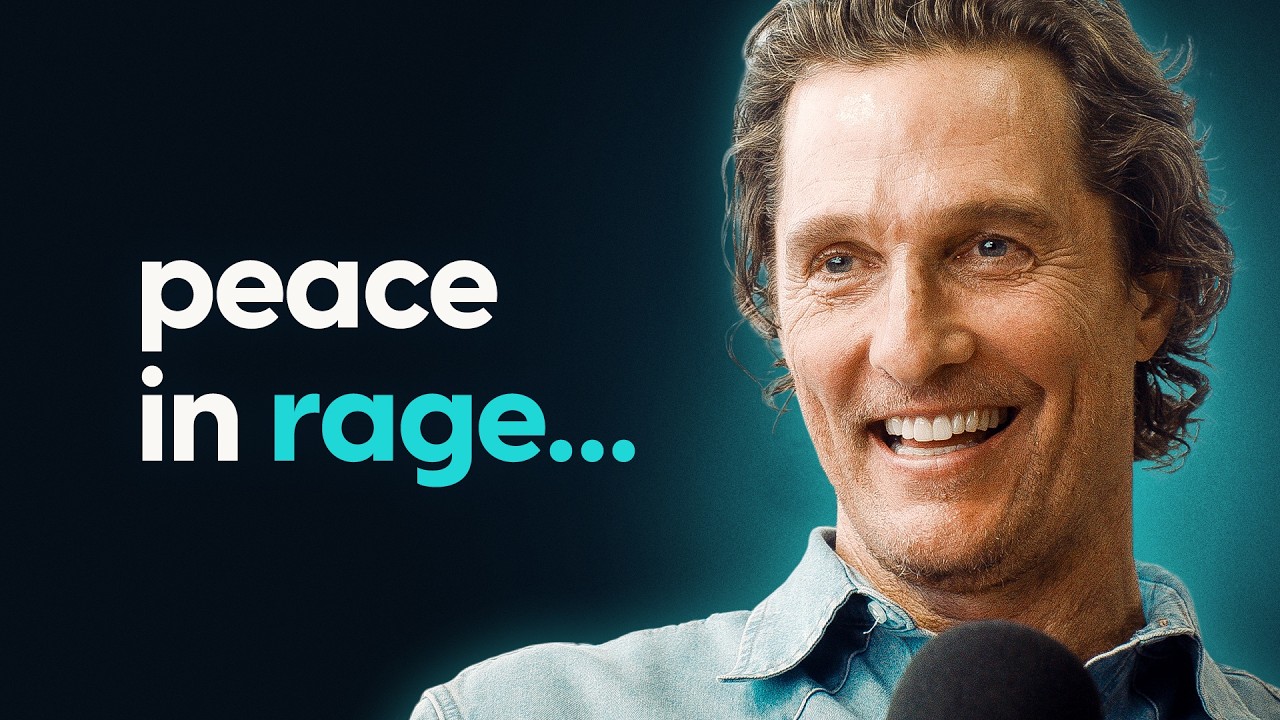
📺 Today’s recommended deep-dive video: https://www.youtube.com/watch?v=y_woFP79F0Q
Finding the Rhyme in the Chaos: Matthew McConaughey on Life, Legacy, and Meaning
Matthew McConaughey returns for the 1,000th episode of Modern Wisdom to explore the deep “rhymes” of human existence. From the cornfields of Interstellar to the grit of personal transformation, this conversation breaks down how to navigate the tension between who we are and who we hope to become.
Core Question: How can we align our internal moral compass with external success while finding beauty in the inevitable imbalances of life?
Highlights
- The critical distinction between being a “nice guy” and a “good man” with actual convictions.
- Why you should model a mentor’s “rise” (the hustle) rather than their current “result.”
- Redefining vulnerability as the courage to speak truth regardless of the scary consequences.
- How to stop “overthinking” by listening to the rhythm of the heart over the noise of the head.
⏱️ Reading time: approx. 12 minutes · Saves you about 106 minutes vs. watching.
Want to take notes while watching? Click the image below and let AI Notebook capture the key points for you 👇

The Architecture of Character
The Debt of Forgiveness
True reconciliation requires more than a simple “I’m sorry” to wipe the ledger clean, especially when the offense is a choice of volition rather than an accident. McConaughey argues that once grace is extended by the victim, the burden shifts entirely to the offender to ensure they never become a repeat offender. If you steal from someone three times and keep asking for forgiveness, you aren’t seeking redemption; you are using faith as a crutch for your own “tomfoolery.”
The buck has to stop with your own self-respect.
A living hell isn’t something that happens after death; it is the state of waking up every day and realizing you no longer trust the person looking back at you in the mirror. When you burn bridges and betray your own word, your world eventually becomes small, dizzy, and claustrophobic. You spend your life looking over your shoulder to see who you owe, creating a “daymare” that persists long after you wake up.

💡 Digging Deeper
Q: Why is self-reliance compatible with faith?
A: McConaughey believes God “applauds” when we take the wheel, suggesting that divine support is most present when we take full responsibility for our own actions and efforts.
Q: How do you handle betrayal?
A: You must flush the spite to avoid getting sick, but forgiveness of the deed does not necessitate the immediate restoration of trust in the person.
Modeling the Rise, Not the Result
The Hustler’s Paradox
We often look at successful icons like Warren Buffett and try to mimic their current, polished routines, but this is a fundamental tactical error. If you want to achieve what they have, you shouldn’t study what they do now—you must study what they did to get there, which usually involved being an “outlaw” or a “hustler.” Success is rarely born from a state of perfect balance; it is forged in the fires of obsession, risk-taking, and periods of radical imbalance.
Balance is a great pursuit, but the real magic is found in the rhyme of the imbalance.
Taking eight risks and succeeding seven times might seem efficient, but it is far less impressive than taking a hundred risks and succeeding eight times. The man who misses the mark more often is usually the one who is actually playing the game at a level that demands growth. If you aren’t failing, you aren’t taking enough risks to truly discover your capacity or move the needle on your own evolution.

💡 Digging Deeper
Q: What is the “Inner Citadel”?
A: It is a psychological retreat where people stop trying to play the game to avoid the risk of failure, effectively “chopping off their own leg” and claiming they never wanted to walk anyway.
Q: How do you overcome the “kicks in the nuts” from life?
A: By maintaining hope; even if there is no guaranteed “out of jail” card, having faith in a future version of yourself provides the best statistical chance of escaping misery.
Redefining the Modern Masculine
Good Men vs. Nice Guys
A “nice guy” is often someone who merely gets along because he lacks the discernment or the spine to stand for something, whereas a “good man” possesses rigid ideals that he will protect. During his “romcom era,” McConaughey felt he was being perceived as the affable nice guy, but his internal life was “feral with masculinity” due to the birth of his children. He eventually had to align his work with that internal vitality, even if it meant risking his entire career to seek out more challenging, dramatic roles.
Masculinity isn’t about oppression; it’s about the dignity of being relied upon.
We have moved through a period where men were told what masculinity isn’t (toxic, macho, chauvinist) without being given a clear blueprint for what it is. A truly masculine man is decisive, competent, and emotionally composed, yet he is also the first to speak his truth in spite of the consequences. This isn’t “macho” posturing; it is the “Super Secret Squirrel” technique of leading with a heart that acts as a two-factor authenticator for the head.

💡 Digging Deeper
Q: Why did McConaughey turn down a $14.5 million offer?
A: He needed to send a clear signal to Hollywood that he was no longer a “renter” in his career; he was an “owner” who was willing to walk away to change his reputation.
Q: What is the most masculine he has ever felt?
A: Immediately after the birth of his first child, when his head, heart, and loins were in total synchronicity.
The Soul in the Digits
Dancing with Time
In an age of AI and hyper-productivity, we are obsessed with “quantity success” without considering if we are actually profiting in terms of quality of life. Information is moving faster than ever, but people don’t necessarily sound smarter; they sound like they are lacking a “bass guitar” or a soul to hold their theme together. We must learn to be quick without being in a hurry, moving at a pace that allows for the “reverb” of our actions to actually settle.
Time is not an enemy; it is a dance partner that requires soul to lead.

💡 Digging Deeper
Q: How does McConaughey avoid overthinking?
A: He records himself babbling and listens back to realize how much of what he thought was “significant” is actually just clever noise that lacks utility.
Q: What is “Barbituate Logic”?
A: A desire to calm the brain to have 50% fewer thoughts per hour, thereby doubling the power of the thoughts that remain.
Key Takeaways
We often live our lives as “renters” rather than “owners,” keeping one foot out of our relationships and careers to protect ourselves from the pain of potential failure. This transactional mindset prevents us from ever achieving a transformational experience. Whether it’s a marriage or a business venture, you have to go in with the “owner’s mentality,” hoping for a “lifer” even if the statistics suggest otherwise.
True vulnerability is not about being soft; it is an offensive maneuver where you speak the truth regardless of the risk. By redefining humility as “having more to learn,” we can maintain our confidence while staying open to the growth required to reach our next “rhyme.”
Finally, we must remember that the “rise” is where the character is built. Don’t be afraid to take the 100 risks, and don’t be afraid to let the world go silent for a while if you need to redefine who you are. Life is a verb, not a noun, and the dance only works if you stay on the floor long enough to hear the song.
Q&A
Q1: What does it mean when Matthew says “life rhymes”?
A: It’s the idea that history repeats with different labels. For every new technology gained, an old culture is lost, yet the fundamental human debits and assets remain balanced.
Q2: How does he define the difference between hope and belief?
A: Hope is a wish for the future, but belief is grounded in “pulling something off.” Confidence comes from making a plan, executing it, and seeing it translate objectively to others.
Q3: What was the “Interstellar” environment like for him?
A: It was a transition from the “human drama” of a father leaving his kids to a world where time itself becomes the primary antagonist. He lived in an Airstream on set with his family to keep his life “vital.”
Q4: Is it okay to be a “hustler”?
A: Yes, McConaughey admits to faking his way into things and pulling stunts, but he distinguishes this from “lying, cheating, and stealing,” which eventually creates a “shadow” that chases you.
Q5: What is the “1,000 risks” theory?
A: It suggests that a life lived taking 100 risks and succeeding 8 times is more valuable and growth-oriented than taking 8 safe risks and succeeding 7 times.
Q6: How should we view the “Me Too” movement’s impact on men?
A: As a necessary rebalance that unfortunately “sterilized” some good behaviors along with the toxic ones. The goal now is to find a “Chesterton’s Fence” approach—respecting tradition while innovating behavior.
Q7: Why is “humor” so important in a crisis?
A: Humor doesn’t patronize the crisis; it provides the psychological “giggle” needed to untie the knot. It is a tool for humility and understanding rather than flipancy.