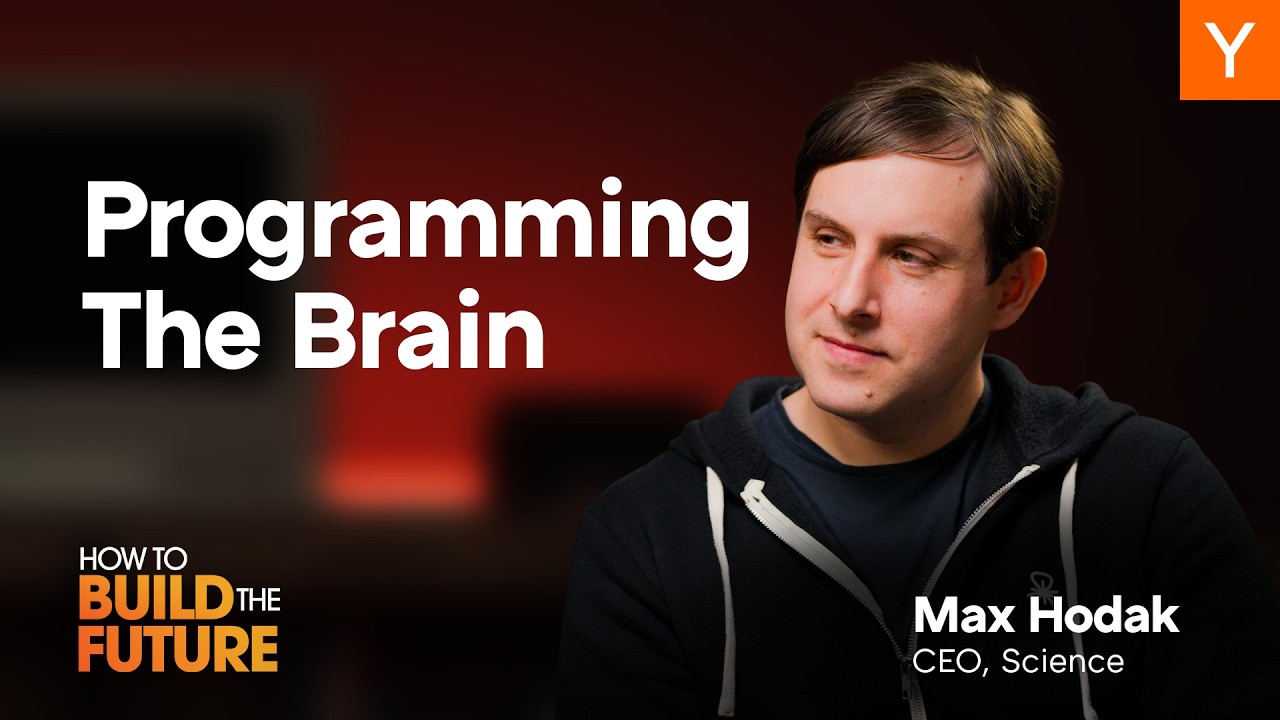
📺 Today’s recommended deep-dive video: https://www.youtube.com/watch?v=5gspRJVp9dI
The Takeoff Era: Merging Silicon and Synapse
For decades, biotechnology has crawled forward in tiny, incremental steps, often failing to deliver on its grandest promises. Max Hodak, the visionary founder of Science and co-founder of Neuralink, argues we have finally entered the “takeoff era” where brain-computer interfaces (BCIs) will fundamentally reframe the human condition.
Core Question: How will transitioning from a pharmaceutical-based medical model to a neural engineering paradigm allow us to restore lost senses and eventually expand human consciousness?
Highlights
- Science’s “Prima” implant has successfully restored form vision in clinical trials by using sub-retinal solar panels to bypass damaged photoreceptors.
- The “bio-hybrid” approach seeks to grow a new, biological “cabled nerve” between the brain and machines using engineered, hypoimmunogenic stem cells.
- Medical technology is shifting from “drug discovery,” which often leads to dead ends, toward “neural engineering” that treats biological failures as solvable hardware problems.
- Future BCI applications may include “digital pharmaceuticals” like ultrasound-based focus or sleep enhancers that do not require invasive surgery.
⏱️ Reading time: approx. 7 minutes · Saves you about 46 minutes vs. watching.
Want to take notes while watching? Click the image below and let AI Notebook capture the key points for you 👇

The Silicon Retina: Restoring the Gift of Sight
Bypassing Biological Blindness
We are no longer just dreaming of bionic eyes; we are actively constructing the hardware to bypass biological blindness and restore high-resolution vision.
Science’s Prima implant is a tiny 2mm by 2mm silicon chip placed beneath the retina, functioning essentially as a grid of microscopic solar panels that capture laser-projected light from specialized glasses. This elegant solution bypasses dead rods and cones entirely, exciting the bipolar cells directly above the implant to send a coherent visual signal back to the brain through the optic nerve.
Recent clinical trials involved forty patients, many of whom had been unable to see faces for a decade, yet they regained the ability to read letters on an eye chart. This represents the first time in history that “form vision”—the assembly of light into a mental image—has been successfully restored through a prosthetic, proving that the brain can still process complex images even after years of sensory deprivation.

💡 Digging Deeper
Q: Why target bipolar cells instead of the optic nerve?
A: The retina performs massive data compression; stimulating the “raw” input layer (bipolar cells) allows the brain to use its own natural processing logic rather than trying to reverse-engineer a 100x compressed signal.
Q: Is the vision color or black and white?
A: Currently, the Prima system provides black-and-white vision, but there is a clear engineering path toward 20/20 acuity and full-color restoration within the next decade.
Q: How many people could this help?
A: While initially focused on macular degeneration, the technology is agnostic to the cause of photoreceptor death, potentially helping 200 million people worldwide with various retinal diseases.
The Plasticity of the Machine
The Brain as a Computer
The human brain is a powerful computer encased in a bone shell, restricted by a limited set of biological “cables” known as the cranial and spinal nerves. This physical bottleneck defines our entire reality, but because the brain is highly plastic under feedback, it can learn to interpret almost any signal we provide.
If you give the cortex information and clear feedback, it is remarkably adept at extracting meaning and adapting to new sensory inputs.
While critical developmental periods exist where the brain “locks in” certain maps—such as vision—adult neuroplasticity remains underestimated; even a single neuron can be trained by a patient to control a computer cursor within minutes. We are moving toward a future where “digital Adderall” via ultrasound could stimulate specific regions to induce focus, potentially offering a consumer-grade application that bypasses the need for chemical drugs.

The Bio-Hybrid “Avatar” Connection
Growing New Nerves
Unlike traditional BCIs that rely on stiff metal wires or gene therapy, the bio-hybrid approach seeks to grow a new, biological “cable” between the brain and the machine. By culturing engineered stem-cell neurons directly onto the device, researchers can create a bridge that naturally wires into the existing neural architecture, effectively creating a new cranial nerve.
This concept draws inspiration from nature’s own solutions, such as the corpus callosum connecting the brain’s hemispheres, or rare cases of conjoined twins who share conscious experiences through a thalamic bridge.
The ultimate goal is to create an “internet nerve” that behaves like the organic ponytail connectors seen in James Cameron’s Avatar. This would allow for ultra-high-bandwidth data transfer without the risks associated with permanent open-skin ports or genetic modification of the patient’s own brain cells.

Reframing Healthcare as Engineering
From Molecules to Systems
The pharmaceutical industry is often a “bridge to nowhere,” spending billions on molecular drugs that offer marginal benefits for degenerative diseases. In contrast, neural engineering treats the body’s failures as hardware problems that can be bypassed through sophisticated signal processing and externalized life support.
We are transitioning from trying to fix broken molecules to simply replacing the entire sensory or motor pipeline with engineered alternatives.
This philosophy extends to projects like “Vessel,” which aims to miniaturize life-support technology so that a failing lung or kidney isn’t a death sentence, but a manageable hardware swap. If we can provide high-quality life through vision, hearing, and balance implants, the biological vessel becomes secondary to the consciousness it houses, potentially extending human life far beyond current limits.

Key Takeaways
We are standing at a unique precipice in human history where the “smartphone dividend” has finally made the electronics for high-performance BCIs small and efficient enough for human use. By treating the brain as an information processor with a defined API, we can move past the limitations of traditional medicine to restore functionality that was once thought lost forever.
The future of the field lies in the unification of AI and neuroscience, where latent space representations in models mirror the neural manifolds in our own heads. As we develop ultra-high-bandwidth, bio-hybrid connections, the line between human and machine will blur, leading to a world where “conscious machines” and “upgraded humans” are one and the same.
Q&A
Q1: What is the biggest hurdle for current BCI companies?
A1: The primary challenge is an electronics and power problem; devices must be small enough to be fully implanted and efficient enough not to generate excess heat that could damage brain tissue.
Q2: How does Science’s approach differ from Neuralink?
A2: While Neuralink focuses on high-precision thin-film electrodes, Science is exploring diverse modalities including the Prima retinal implant and bio-hybrid interfaces that use living neurons as the bridge.
Q3: Can someone born blind use these devices?
A3: It depends on the “critical period” of development; if the brain never learned to process visual signals during childhood, it may be unable to make sense of BCI input in adulthood, leading to overwhelming confusion.
Q4: What is “digital Ambien”?
A4: It is a theoretical application of ultrasound BCI that stimulates specific brain regions to induce sleep or relaxation on demand, without the side effects of chemical sedatives.
Q5: Why is “Vessel” important for BCI?
A5: Vessel focuses on perfusion and life support; for a BCI to be truly transformative, the patient needs a high-quality biological or mechanical support system to sustain the brain indefinitely.
Q6: Will healthy people get these implants soon?
A6: Not immediately; the risk-reward ratio currently favors severely disabled patients, but as functionality increases and surgery becomes less invasive, the “crossover point” for healthy adults will eventually be reached.
Q7: What is Max Hodak’s outlook for 2035?
A7: He believes we are in an era of exceptional change where the first people to live to 1,000 may already be alive, driven by the parallel advancement of AI and neural interfaces.