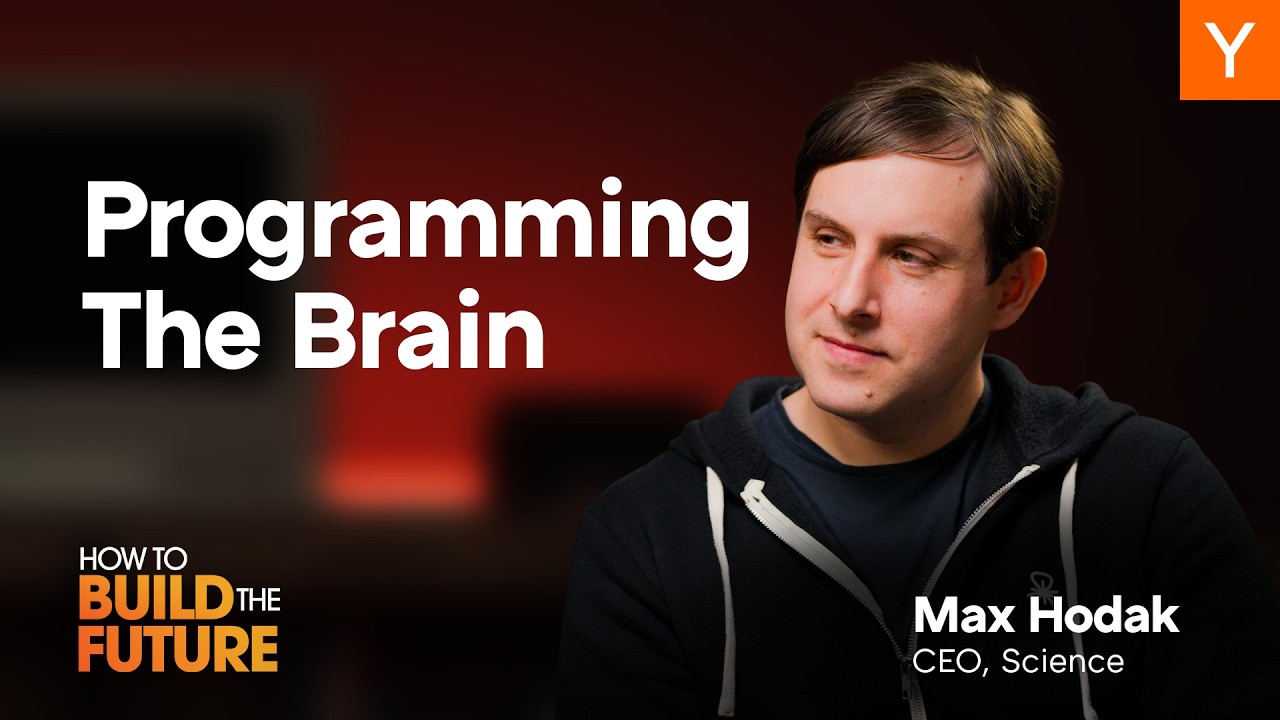
📺 Today’s recommended deep-dive video: https://www.youtube.com/watch?v=5gspRJVp9dI
The Takeoff Era: Engineering the Brain and the Future of Consciousness
For decades, biotechnology has moved at an incremental pace, but we are now entering a “takeoff era” where neural engineering can restore sight to the blind and eventually merge consciousness with silicon. Max Hodak, founder of Science and co-founder of Neuralink, explains how the human brain is the ultimate computer—one that we are finally learning to program. By moving away from traditional drug discovery toward direct neural interfaces, we are unlocking the ability to treat the untreatable and redefine what it means to be human.
Core Question: How will brain-computer interfaces shift the medical paradigm from treating chemical imbalances to fundamentally engineering neural input and output?
Highlights
- Science’s “Prima” implant allows blind patients to read letters by stimulating the retina’s bipolar cells, bypassing damaged photoreceptors.
- Neural engineering offers a predictable, engineering-based path to healing that is far more efficient than the high-failure rate of traditional drug discovery.
- The “bio-hybrid” approach uses engineered stem-cell neurons to create high-bandwidth, natural biological connections between machines and the cortex.
- BCI technology may eventually allow for direct brain-to-brain communication, providing a window into the fundamental nature of consciousness.
⏱️ Reading time: approx. 9 minutes · Saves you about 44 minutes vs. watching.
Want to take notes while watching? Click the image below and let AI Notebook capture the key points for you 👇

Restoring the Senses
The Prima Retinal Implant
We are witnessing the first time in history where “form vision”—the assembly of a coherent image in the mind’s eye—has been restored through an artificial neural interface.
The Prima device uses a tiny 2mm silicon chip implanted under the retina that acts as an array of tiny solar panels. Patients wear specialized glasses that project a laser image into the eye; these solar panels then absorb that light to excite the bipolar cells directly. By targeting this specific layer, the device bypasses dead rods and cones to deliver a high-fidelity visual signal back to the brain. This allows patients with geographic atrophy to regain functional sight.
Clinical trials have already demonstrated that patients who haven’t seen faces in a decade can now read eye charts. This success stems from a first-principles realization: the retina performs 100x compression before sending signals to the brain, so an interface must interact with the system before that compression occurs. If you stimulate the wrong layer, the brain receives “trash” data it cannot interpret.

💡 Digging Deeper
Q: How does neuroplasticity affect these implants?
A: The brain is incredibly plastic under feedback. In early experiments, researchers mapped simple “up/down” controls to specific neurons, and the brain learned to manipulate those signals within minutes to move a cursor.
Q: What is the “Qualia” of these devices like?
A: For the Prima retinal implant, patients experience normal, albeit black-and-white, vision. However, for more advanced interfaces, the experience might feel like a “third mode” of imaging, distinct from both open-eye vision and internal imagination.
Q: Can these devices help those born blind?
A: It is difficult. There are critical periods in early development where the brain wires itself to process sight. If missed, the brain may find the sudden influx of visual data overwhelming or impossible to interpret.
The Engineering Paradigm Shift
Biology as a Information Processing
Hodak argues that humanity is fundamentally poor at drug discovery because biology is complex and unpredictable. Traditional pharma often spends a decade on a single molecule only to face a binary failure in Phase 3 trials, leaving developers with no clear data on where to go next.
In contrast, neural engineering treats the brain as a computer architecture that processes information via spikes on cranial and spinal nerves. If we can map the latent space of these neural representations, we can bypass molecular breakdowns entirely by providing the correct electrical or biological signals directly to the brain’s processing centers. This shift allows for iterative, predictable improvements common in hardware and software, rather than the “lottery” of chemical trials.
The brain doesn’t care why a sensor failed; it only cares that the data stream is restored.

💡 Digging Deeper
Q: What was the “Smartphone Dividend” for BCI?
A: The massive investment by companies like Apple and Samsung into low-power, high-efficiency chips made it possible to shrink BCI electronics so they could be fully implanted without overheating the brain.
Q: How does AI research help neuroscience?
A: We’ve discovered that when you train AI image or language models, the internal “latent space” representations they create look remarkably similar to the neural representations found in the human brain.
Q: Is the brain literally a computer?
A: Yes, in the sense that it receives input through “cables” (cranial nerves), processes it, and sends commands to “actuators” (muscles). It is a different architecture than a PC, but its function is information processing.
Bio-Hybrids and the Vessel Program
Growing New Connections
While standard BCIs use metal electrodes, Science is pioneering “bio-hybrid” interfaces that engraft engineered stem-cell neurons onto the brain’s existing cortex. These cells are hidden from the immune system, allowing them to form natural biological connections without the risk of the body rejecting a foreign object or the one-way door of permanent genetic modification.
This concept mimics the corpus callosum—the 200-million-fiber cable connecting the brain’s hemispheres—to create what is essentially a new “internet nerve.” By seeding these neurons in a dish and then engrafting them, the device gains a high-bandwidth biological “connector” that traditional wires cannot match. This creates a native-feeling bridge between human consciousness and digital data.
Imagine an “Avatar-style” queue that allows you to plug into the digital world with biological fidelity.
Beyond the brain, the “Vessel” program aims to shrink massive ICU-scale heart-lung machines into portable devices. The goal is to turn perfusion—keeping organs alive outside the body—into a “destination therapy” rather than just a bridge to a transplant. This could allow patients with failed lungs or kidneys to live high-quality lives while carrying their support system in a backpack.

💡 Digging Deeper
Q: Why use a “bio-hybrid” instead of just more wires?
A: Biology is the best engineer for biology. Wires cause scarring and have limited bandwidth; cultured neurons can grow and wire themselves into the brain’s architecture naturally.
Q: What is the ethical dilemma of “Vessel”?
A: Current life-support (ECMO) is so expensive and invasive that it is often treated as a “bridge to nowhere.” By making it portable and affordable, we remove the dilemma of whether to “unplug” a patient who is otherwise conscious and active.
Q: Can BCI facilitate brain-to-brain communication?
A: Nature provides a case study in conjoined twins who share a thalamic bridge; they can experience each other’s sensory input and thoughts directly. BCI aims to replicate this high-bandwidth connection artificially.
Key Takeaways
The future of medicine is moving away from the “pharmaceutical lottery” toward a rigorous, engineering-based approach to the human body. By treating the brain as an information-processing system, we can restore lost senses like sight and hearing with a level of precision that drugs can never achieve. This paradigm shift suggests that “aging” is simply a collection of engineering problems that can be solved through better interfaces and life-support systems.
As we move toward 2035, the line between human consciousness and artificial intelligence will continue to blur. High-bandwidth, bio-hybrid connections will not only allow us to upgrade our capabilities but may also provide the only true method for studying the nature of consciousness itself. We are no longer just observing the evolution of life; we are beginning to direct it.
Q&A
Q1: What is the most common reason people lose their sight, and how does Science address it?
A: Age-related macular degeneration affects 200 million people globally. Science’s Prima implant is agnostic to the cause of blindness; it simply replaces the dead photoreceptors with a digital sensor that talks directly to the remaining healthy cells.
Q2: Will healthy people get brain implants soon?
A: Not immediately. Current surgeries are serious and the benefits, while life-changing for a paralyzed person, don’t yet outweigh the risks for someone who can already use a mouse and keyboard efficiently.
Q3: How does the “Vessel” program change organ transplants?
A: Currently, transplants are emergencies that happen in the middle of the night. Perfusion technology allows organs to be kept alive and healthy for days, turning these surgeries into scheduled, routine procedures.
Q4: What did Max Hodak learn from working with Elon Musk at Neuralink?
A: He describes it as the “ultimate startup PhD,” learning how to execute technically complex projects that require multi-disciplinary teams and high-agency leadership to move past incrementalism.
Q5: What is the “Internet Nerve”?
A: It is a theoretical bio-hybrid interface that would act like a new cranial nerve, allowing the brain to communicate with digital networks at the same speed and fidelity that it currently communicates with the eyes or ears.
Q6: Is it possible for someone alive today to live to 1,000?
A: Max Hodak believes this is very possible. As we move from incremental biotech to a “takeoff era” of engineering, the ability to replace and interface with biological systems could fundamentally extend the human lifespan.
Q7: How does Science differ from other biotech companies?
A: Most biotech is founded around a single patent or drug. Science is founded on a “first principles” engineering worldview, pursuing multiple projects—retinal implants, bio-hybrids, and perfusion—under one unified mission.